
Why Scrolling in Bed Keeps You Awake and What to Do About It

The phone goes down at 11:30. By midnight, you are still awake, replaying nothing in particular, waiting for sleep that does not come. Most people blame the blue light. Blue light is real, but it is only one thread in a tangle that starts the moment you carry your phone into the bedroom.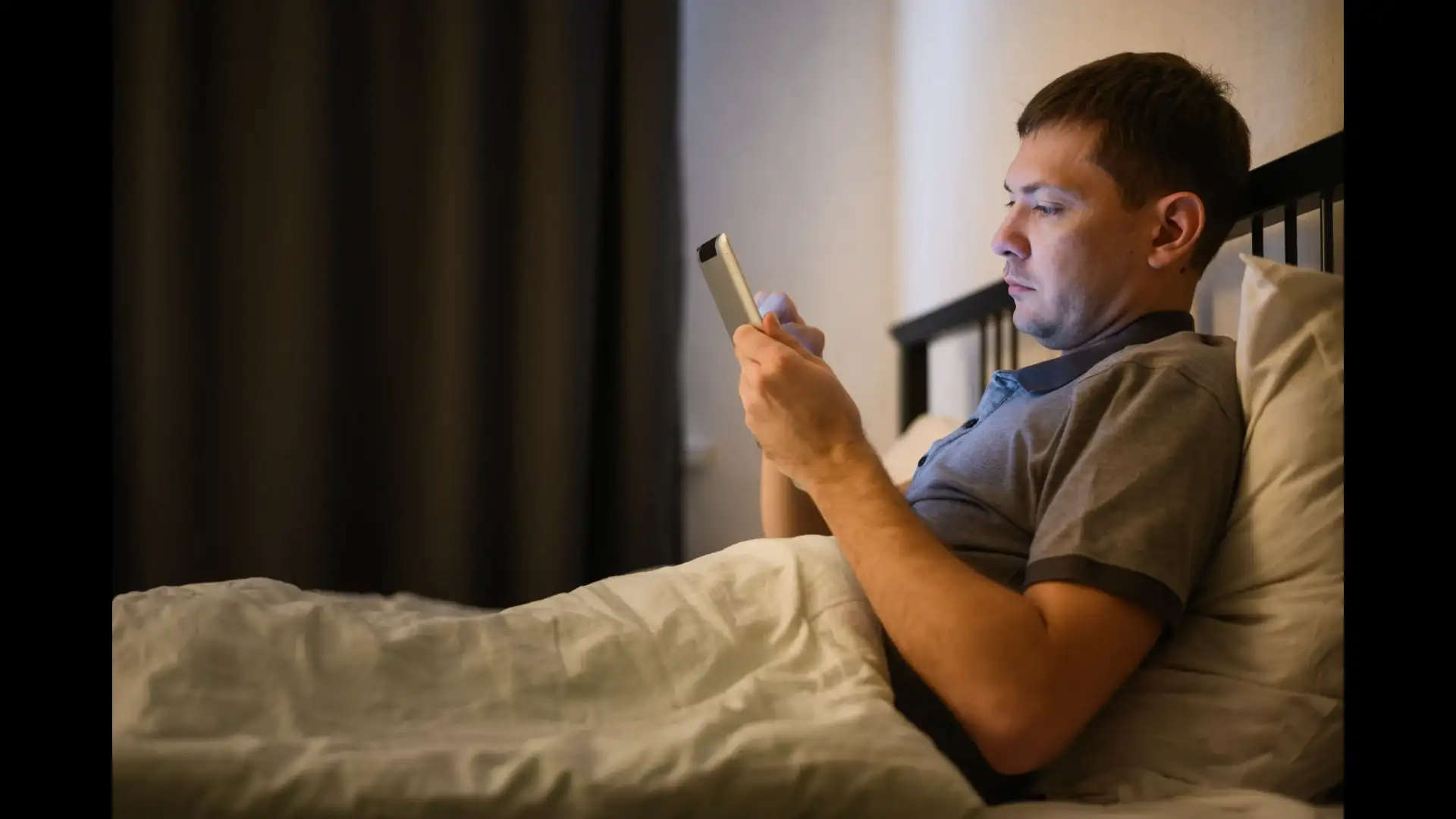
Sleep is not a switch you flip. It is a process the brain runs when the conditions are right. The phone in bed does not just delay sleep, it actively works against the conditions that allow it to start. Move the phone out of the room, reduce the stimulation in the hour before bed, and the process tends to run on its own.
What the Screen Does to Your Brain's Sleep Signal
Your brain releases melatonin, the chemical that makes you feel genuinely drowsy, in response to dimming light. Bright screens held close to your face at night suppress this release. Blue-wavelength light, which LED and OLED screens emit in quantity, is particularly effective at telling the brain's internal clock that it is still afternoon. The suppression is not dramatic in a single night, but it is consistent: push melatonin release back by even thirty to forty minutes regularly, and your sleep window shifts, your total sleep shortens, and the quality of the deep sleep you do get degrades.The Alertness Problem That Blue Light Cannot Explain
Melatonin suppression does not account for why scrolling feels so different from reading a paperback under a lamp of comparable brightness. The difference is content. Social media feeds, news apps, and short video platforms are engineered to produce small, rapid loops of novelty and mild reward. Each new post triggers a minor orienting response, the same reflex that makes you look up when something moves in your peripheral vision. Your nervous system is not winding down. It is running a low-grade alert scan, over and over, at the exact moment it needs to be doing the opposite. A dim e-reader set to a warm colour profile causes a fraction of this arousal, because the text is static and the pacing is yours. The feed controls the pace. That distinction matters more than the light.Why Keeping the Phone Nearby Makes Things Worse Even When You Are Not Using It
The phone on the nightstand does something even when the screen is off. Awareness of its presence keeps a portion of your attention on standby, a documented effect sometimes called cognitive arousal. You know a notification could arrive. You know the option to check exists. That low hum of availability is incompatible with the mental loosening sleep requires. Studies on this specific question have found that people sleep measurably better when the phone is in another room, compared to when it is face-down on the nightstand, even when both groups reported not checking it during the night. The body responds to proximity, not just use.Practical Steps That Actually Reduce the Habit
Willpower at 11 pm is a depleted resource. The people who scroll least in bed are not more disciplined at night, they have made the phone harder to reach earlier in the day. A few changes that work with the brain's defaults rather than against them: charge the phone outside the bedroom, using a basic alarm clock for the morning; set the phone to greyscale mode from early evening, which strips the visual reward that makes feeds compelling without blocking any function; use the screen-time tools built into the phone's operating system to set a hard cutoff on specific apps, because a friction barrier at the app level is harder to override than a personal resolution. If reading before sleep genuinely helps you wind down, a physical book or a warm-backlit e-reader set to the dimmest comfortable level is a workable replacement. The goal is not to eliminate the wind-down period, it is to replace a stimulating one with a settling one.The Habit Loop Behind the Scroll
Bedtime scrolling persists partly because it works in the short term. After a long day, the passive absorption of a feed requires nothing from you. It feels like rest. The problem is that it mimics rest while preventing the physiological preparation for sleep. Recognising that gap, between what the habit feels like and what it actually does, is more useful than guilt. The scroll is not a character flaw. It is a low-effort response to the genuine need to decompress. Finding a replacement that meets the same need with less neurological cost is the practical path forward. That replacement does not have to be meditation or journaling. It can be anything that is slow, self-paced, and not connected to a notification system.Sleep is not a switch you flip. It is a process the brain runs when the conditions are right. The phone in bed does not just delay sleep, it actively works against the conditions that allow it to start. Move the phone out of the room, reduce the stimulation in the hour before bed, and the process tends to run on its own.
Next Story