
Yoga Is For The Universal Harmony


The word yoga means ‘to join’. It is akin to the English word ‘Yoke,’ meaning unification. In essence, it is contemplation or absorption with Divine. Christianity has a corresponding term, ‘the mystic union,’ which expresses a similar idea. Islam too has an analogous term ‘tawhid,’ meaning unification. Hence, it means a spiritual union by which an individual may become united with the reality which underlies this apparent ephemeral universe.
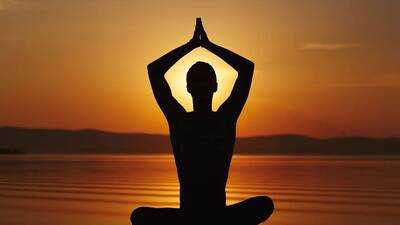 The question bewildering today, do we practice yoga primarily to display ostentatiously bending and curving of body parts or for the spiritual wellbeing of all and ultimately unification with Him? The answer is the ancient sage Patanjali’s yoga, which underlies and defines a systematic approach towards the idea of self realisation. It builds self awareness together with regulation of body, mind and emotions.
Actions of yoga become more meaningful when we realise its true purpose. Yogis strive from bondage to universal freedom through Yoga that cultivates equanimity, unravels negativity and eradicates human suffering with compassion. Yoga empowers to live freely with greater sense of joy for others as well as to oneself.
Freedom from bondage confers empowerment and joy, bestows clear sense of the relationship between past experience and future expectations. Freedom is rooted deeply in understanding our relationships with others, the world, nature and beyond. As we unravel the causes of negative experiences, we get liberated because we understand more deeply how our experience has evolved in pursuit in knowing the truth. Our actions become more meaningful as we realise its true purpose.
Pitanjali teaches knowing this experience of freedom from bondage through the components of mind - manas (recording faculty), buddhi (discriminative faculty) and ahamkara (the ego faculty). It illuminates us to integrate these essentials of mind and heart so to transcend more deeply into intellectual, logical and rational boundaries.
Transcending beyond boundaries needs developing transformative practices based on clear, effective and sound thinking. These transformative practices must not be personal but for the good of all. In fact, being able to inspire and guide all with coherent account of one’s deepest experience has always been a vital part of yogi’s development.
Yoga educates us that mind is not intelligent and conscious. It is only an instrument of knowledge, an object of perception. Knowledge acquired by mind is a thought wave, all objective. Mind merely reflects consciousness and so it appears to be conscious.
Every perception of mind therefore, arouses the ego sense of ‘I.’ If a thought wave is raised in the mind, the ego sense identifies itself with this wave. If the wave is pleasant, the ego sense feels ‘I am happy’; if the wave is unpleasant; the ego sense will feel ‘unhappiness.’ This false identification is the cause of all miseries. Even the temporary ego sensation of happiness brings anxiety which is a desire to cling to pleasure. The Atman is outside all these pleasantries and un-pleasantries and this realisation can be experienced through yoga. So, yoga is a tool to convey and eradicate limitations in perception of mind.
Yoga is recognized as the science of healthy living . It is not merely a physical activity, but a mental and emotional force to control subtle forces within. It builds positive mental attitudes, gives freedom from negativity, brings service to others, builds inner happiness and peace with the body, mind and emotions.
The truth of yoga is that we all are one with Divine consciousness. God, the underlying reality, is by definition omnipresent. If the reality exists, it must be everywhere; it must be present within every sentient being, every inanimate object that reflects oneness of being with the rest.
Actions of yoga become more meaningful when we realise its true purpose. Yogis strive from bondage to universal freedom through Yoga that cultivates equanimity, unravels negativity and eradicates human suffering with compassion. Yoga empowers to live freely with greater sense of joy for others as well as to oneself.
Freedom from bondage confers empowerment and joy, bestows clear sense of the relationship between past experience and future expectations. Freedom is rooted deeply in understanding our relationships with others, the world, nature and beyond. As we unravel the causes of negative experiences, we get liberated because we understand more deeply how our experience has evolved in pursuit in knowing the truth. Our actions become more meaningful as we realise its true purpose.
Transcending beyond boundaries needs developing transformative practices based on clear, effective and sound thinking. These transformative practices must not be personal but for the good of all. In fact, being able to inspire and guide all with coherent account of one’s deepest experience has always been a vital part of yogi’s development.
Every perception of mind therefore, arouses the ego sense of ‘I.’ If a thought wave is raised in the mind, the ego sense identifies itself with this wave. If the wave is pleasant, the ego sense feels ‘I am happy’; if the wave is unpleasant; the ego sense will feel ‘unhappiness.’ This false identification is the cause of all miseries. Even the temporary ego sensation of happiness brings anxiety which is a desire to cling to pleasure. The Atman is outside all these pleasantries and un-pleasantries and this realisation can be experienced through yoga. So, yoga is a tool to convey and eradicate limitations in perception of mind.
The truth of yoga is that we all are one with Divine consciousness. God, the underlying reality, is by definition omnipresent. If the reality exists, it must be everywhere; it must be present within every sentient being, every inanimate object that reflects oneness of being with the rest.
Next Story