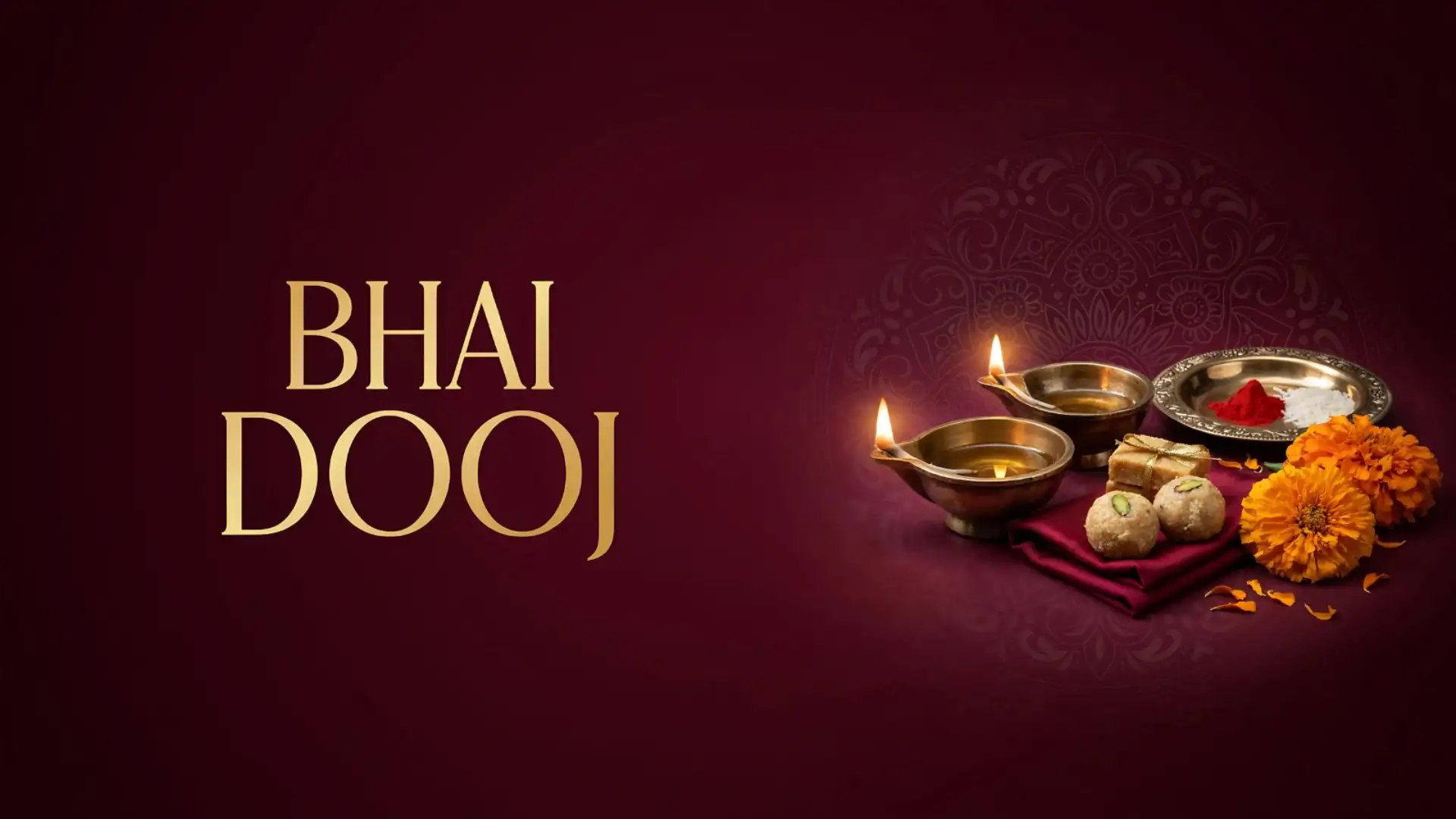
Bhai Dooj is a festival that celebrates the special bond between brothers and sisters through prayers, sweets and the traditional tilak ceremony. But behind this heartwarming ritual lies an ancient Hindu legend about Yama, the god of death, and his sister Yamuna, the river goddess. Their story explains the significance of Bhai Dooj and why sisters pray for their brothers' long life, happiness and protection on this auspicious day.
Who Yama and Yamuna Are
In Hindu tradition, Yama is the lord of death, the one who weighs a life's deeds and determines what follows. Yamuna is his twin sister, a goddess whose earthly form is the river that runs through the heart of the subcontinent. They share the same father, Surya the sun god, and the same mother, Sanjna. Born together, they grew up together, and then, as the tradition tells it, their duties pulled them apart. Yama toward the realm of the dead, Yamuna toward the living world. The distance between them became the distance between two worlds.
The Reunion That Became a Festival
According to popular tradition, Yamuna longed to see her brother and sent him word repeatedly, asking him to visit. Yama, bound by his duties and his nature, kept putting the meeting off. When he finally came to her, on the second day of the bright fortnight of the month of Kartik, Yamuna received him with everything she had. She bathed him, applied a tilak to his forehead, fed him his favourite foods, and prayed for his wellbeing. Yama, moved by the warmth of that welcome, asked what gift she would accept in return. Yamuna asked only that he visit her again, and that any brother who received a tilak from his sister on this day would be blessed with long life. Yama granted both. In some regional versions of the story, he also freed certain souls from his realm as a gesture of his love for her. The details shift across traditions, but the core stays the same: a sister's love was enough to soften even the one figure in the cosmos whose job is to be unmoved.
What the Tilak Actually Means
The tilak is not decoration. In the context of this story, it is a mark of protection, a sister's claim on her brother's life, made visible on his skin. The act of applying it re-enacts Yamuna's gesture toward Yama. The sweets that follow echo the meal she prepared. The prayer for long life is the same prayer she offered. When a sister performs these steps, she is not simply following a custom; she is, in the logic of the tradition, placing her brother under the same blessing Yamuna secured from death itself. The ritual turns a family moment into a cosmological one.
Where It Sits in the Festival Calendar
Bhai Dooj falls two days after Diwali, on the second day of Shukla Paksha in Kartik. It shares the season with Raksha Bandhan, which also centres on the bond between a brother and a sister, but the two festivals carry different emotional registers. Raksha Bandhan is the brother's promise of protection. Bhai Dooj is the sister's prayer for the brother's life. One moves outward, one moves inward. The festival is observed across much of India under different names, Bhai Phota in Bengal, Bhau Beej in Maharashtra, Yama Dwitiya in some parts of the south, and the ritual details shift, but the tilak and the prayer remain at the centre everywhere.
A Story That Holds Because of What It Asks
Most festival stories are about gods doing extraordinary things. This one is about a sister doing an ordinary thing, cooking a meal, waiting at the door, putting a mark on a forehead, and that ordinary thing turning out to matter enormously. The story does not ask the listener to be divine. It asks them to show up for the people they love, and suggests that showing up, done with full attention, carries a weight the cosmos notices. That is why the tilak still gets pressed onto foreheads long after the story's origins have faded from everyday memory. The gesture remembers what the words have half-forgotten.