
Sawan Somwar: The regional customs, food, and family questions readers search for


By the time the first Monday of Sawan arrives, many homes already smell different. There is the cool scent of soaked bel patra, or bilva leaves sacred to Shiva , the sharp sweetness of incense, and in diaspora kitchens, the familiar improvisation of faith, Greek yogurt standing in for fresh dahi, maple leaves checked twice and set aside because they are not bilva, and a quick family message asking, "Are we fasting from sunrise there or here?"
That question, more than anything else, captures what Sawan Somwar has become for many families in India and abroad. Everyone knows these Mondays of Shravana, the lunar month beloved to Lord Shiva, matter. What everyone searches for in the week of observance is simpler and more immediate. Which date applies to my city? What if my family follows a different calendar from my in-laws? Can I drink tea? What do we actually offer if we don't have a temple nearby?
Quick details for readers
In North Indian usage, Sawan Somwar refers to the Mondays that fall in Shravan or Sawan. For 2026, several published panchang-style sources place North Indian Shravan from July 30 to August 28, with New Delhi's Sawan Somwar dates commonly listed as August 3, 10, 17 and 24. But this is where the practical caution begins. The observance depends on the regional calendar tradition and local sunrise. If you're in London, New Jersey, Dubai or Sydney, don't lift a New Delhi list and assume it fits your household. Use a city-specific panchang, because the vrata, or sacred fast, is kept according to local time.
Why these Mondays feel different
The month itself carries the emotional weight. Shravan is the season of rain, fertility, inwardness, and Shiva bhakti, devotion to Shiva. Puranic retellings often connect this period to the Samudra Manthana, the churning of the cosmic ocean, when Shiva drank the halahala poison to protect creation. Devotees offer water, milk, bilva leaves, and repeated chants of "Om Namah Shivaya" as acts of cooling, gratitude, and surrender.
That is also why the observance never sits neatly in the category of "just a fast." For some, it is a prayer for steadiness in marriage. For unmarried women in many families, it is tied to the hope of a good life partner, often with Parvati worship alongside Shiva, recalling the goddess's tapas, or austere penance, to win Shiva as her husband. For others, especially older devotees, it is simply a month of discipline, less noise, less indulgence, more japa, or repeated mantra recitation.
One month, many calendars, many households
This is the part that confuses even regular observers. North India often follows the purnimanta reckoning, where the lunar month runs from the day after the full moon to the next full moon. Much of South and West India follows the amanta system, where the month runs from the day after amavasya, or new moon, to the next new moon. That means a family from Uttar Pradesh may begin Shravan earlier than a family from महाराष्ट्र or Andhra Pradesh in the same city.
Neither side is "wrong." They are following different accepted calendar traditions.
In diaspora homes, this becomes a weekly negotiation. A mother in Leicester may keep Sawan Somwar by the North Indian count. Her daughter-in-law from Bengaluru may observe Shravana Somavara later , by the South Indian count. Many families now do the sensible thing. They honour both, or each person follows their inherited parampara, family tradition, without turning the kitchen into a debate hall.
If your family has an established custom, stick with it unless your guru, family priest, or community temple advises otherwise. If you're starting fresh, choose a reliable local panchang and stay consistent through the month.
What the fast actually looks like at home
There is no single menu because there is no single Sawan household. Some devotees keep a nirjala fast, without water, though this is less common and not for everyone. Many observe a phalahar vrat, a fruit-based fast, with milk, curd, nuts, sabudana, or tapioca pearls, vrat ke aloo, potatoes cooked without regular grains, and sendha namak, rock salt used in fasting foods. Others eat one satvik meal, simple vegetarian food without onion and garlic, after evening puja.
In North Indian homes, you'll often see kuttu ka atta, buckwheat flour, singhare ka atta, water chestnut flour, sabudana khichdi, roasted makhana, fox nuts, and fruit. In Maharashtra, fasting dishes may lean toward peanut, potato, and sabudana preparations. In Tamil and Telugu homes observing Shravana Mondays, the food pattern can differ, but the mood of restraint remains the same. In the UK and US, practical substitutions are common. If fresh coconut is hard to find, dried coconut may be used in naivedya, the food offering. If bilva leaves are unavailable, many priests advise offering clean water and sincere prayer rather than panicking over missing ingredients.
Tea and coffee become family flashpoints every year. Strict vrat observers avoid them. Many working devotees, especially abroad, take tea and still keep the spirit of the fast with one simple meal and Shiva puja. If you're following a family rule, follow that. If not, avoid turning a devotional observance into a test of who suffered more.
At the altar, simplicity is enough
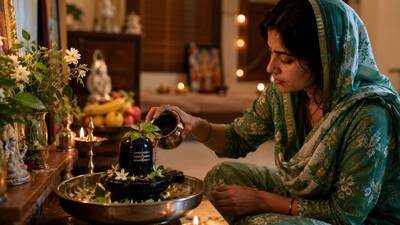
A home puja for Sawan Somwar need not be elaborate. Bathe early if possible, clean the puja space, place a Shiva linga, or emblem of Shiva, or even a picture of Shiva-Parvati, and offer jal, water, milk if your custom permits, bilva leaves, white flowers, sandal paste, and a lamp. Chant "Om Namah Shivaya," the Maha Mrityunjaya mantra if known, or read a short Shiva stotra, hymn. Some families also hear or recite the Sawan Somwar vrat katha, the devotional story associated with the fast.
One point often missed, offer bilva leaves correctly. They should be clean, not torn, and usually offered face up according to custom. Do not place turmeric on the Shiva linga in traditions that avoid it for Shiva worship. And if you're pouring milk, do so with restraint. Many temples and teachers now encourage symbolic abhisheka, ritual bathing, followed by food donation, so worship does not become waste.
The mistakes families make, and the ones that don't matter
The most common mistake is date confusion. People search one viral calendar image, then discover their local temple is observing on a different Monday. The fix is simple, check a city-based panchang.
The second is mixing up custom and absolute rule. Some families break the fast after sunset. Some do so after evening puja. Some eat only after seeing the Monday observance through the full day. These are differences of practice, not failures of faith.
The third is anxiety over ingredients. No bilva leaves, no copper lota, no temple nearby, no priest on call, none of this cancels your vrata. Hindu ritual texts value bhava, inner devotion, alongside dravya, ritual material. Cleanliness, sincerity, and consistency matter more than assembling a perfect social media thali.
Another frequent question comes from working readers abroad, especially in the US and UK, where Monday is not designed for slow ritual. Can you do the puja before work? Yes. Can you keep a partial fast if you have health issues, pregnancy, medication, or a physically demanding job? Yes. A vrata is an offering, not self-harm. Elderly family members have always adapted observances to health.
When family WhatsApp becomes the real panchang
The sweetest part of Sawan Somwar may be this, the way it keeps family memory alive across time zones. An aunt in Jaipur sends the katha audio. Someone in Toronto asks whether basil can replace bilva and gets five contradictory answers in two minutes. A student in Manchester lights a small diya, or sacred lamp, before leaving for class. A father in Delhi reminds his son in Chicago to check the local sunrise, not Indian time.
That is how this observance survives, not as a rigid package, but as living practice. If you're outside India, begin with your local panchang, ask what your family has always done, and keep the Monday with as much steadiness as your life allows. Then, when the lamp burns low and the last mantra fades, place the bilva leaves down gently, and let the room hold that rain-month quiet for one more minute.
That question, more than anything else, captures what Sawan Somwar has become for many families in India and abroad. Everyone knows these Mondays of Shravana, the lunar month beloved to Lord Shiva, matter. What everyone searches for in the week of observance is simpler and more immediate. Which date applies to my city? What if my family follows a different calendar from my in-laws? Can I drink tea? What do we actually offer if we don't have a temple nearby?
Quick details for readers
In North Indian usage, Sawan Somwar refers to the Mondays that fall in Shravan or Sawan. For 2026, several published panchang-style sources place North Indian Shravan from July 30 to August 28, with New Delhi's Sawan Somwar dates commonly listed as August 3, 10, 17 and 24. But this is where the practical caution begins. The observance depends on the regional calendar tradition and local sunrise. If you're in London, New Jersey, Dubai or Sydney, don't lift a New Delhi list and assume it fits your household. Use a city-specific panchang, because the vrata, or sacred fast, is kept according to local time.
Why these Mondays feel different
The month itself carries the emotional weight. Shravan is the season of rain, fertility, inwardness, and Shiva bhakti, devotion to Shiva. Puranic retellings often connect this period to the Samudra Manthana, the churning of the cosmic ocean, when Shiva drank the halahala poison to protect creation. Devotees offer water, milk, bilva leaves, and repeated chants of "Om Namah Shivaya" as acts of cooling, gratitude, and surrender.
That is also why the observance never sits neatly in the category of "just a fast." For some, it is a prayer for steadiness in marriage. For unmarried women in many families, it is tied to the hope of a good life partner, often with Parvati worship alongside Shiva, recalling the goddess's tapas, or austere penance, to win Shiva as her husband. For others, especially older devotees, it is simply a month of discipline, less noise, less indulgence, more japa, or repeated mantra recitation.
One month, many calendars, many households
This is the part that confuses even regular observers. North India often follows the purnimanta reckoning, where the lunar month runs from the day after the full moon to the next full moon. Much of South and West India follows the amanta system, where the month runs from the day after amavasya, or new moon, to the next new moon. That means a family from Uttar Pradesh may begin Shravan earlier than a family from महाराष्ट्र or Andhra Pradesh in the same city.
Neither side is "wrong." They are following different accepted calendar traditions.
In diaspora homes, this becomes a weekly negotiation. A mother in Leicester may keep Sawan Somwar by the North Indian count. Her daughter-in-law from Bengaluru may observe Shravana Somavara later , by the South Indian count. Many families now do the sensible thing. They honour both, or each person follows their inherited parampara, family tradition, without turning the kitchen into a debate hall.
If your family has an established custom, stick with it unless your guru, family priest, or community temple advises otherwise. If you're starting fresh, choose a reliable local panchang and stay consistent through the month.
What the fast actually looks like at home
There is no single menu because there is no single Sawan household. Some devotees keep a nirjala fast, without water, though this is less common and not for everyone. Many observe a phalahar vrat, a fruit-based fast, with milk, curd, nuts, sabudana, or tapioca pearls, vrat ke aloo, potatoes cooked without regular grains, and sendha namak, rock salt used in fasting foods. Others eat one satvik meal, simple vegetarian food without onion and garlic, after evening puja.
In North Indian homes, you'll often see kuttu ka atta, buckwheat flour, singhare ka atta, water chestnut flour, sabudana khichdi, roasted makhana, fox nuts, and fruit. In Maharashtra, fasting dishes may lean toward peanut, potato, and sabudana preparations. In Tamil and Telugu homes observing Shravana Mondays, the food pattern can differ, but the mood of restraint remains the same. In the UK and US, practical substitutions are common. If fresh coconut is hard to find, dried coconut may be used in naivedya, the food offering. If bilva leaves are unavailable, many priests advise offering clean water and sincere prayer rather than panicking over missing ingredients.
Tea and coffee become family flashpoints every year. Strict vrat observers avoid them. Many working devotees, especially abroad, take tea and still keep the spirit of the fast with one simple meal and Shiva puja. If you're following a family rule, follow that. If not, avoid turning a devotional observance into a test of who suffered more.
At the altar, simplicity is enough
A home puja for Sawan Somwar need not be elaborate. Bathe early if possible, clean the puja space, place a Shiva linga, or emblem of Shiva, or even a picture of Shiva-Parvati, and offer jal, water, milk if your custom permits, bilva leaves, white flowers, sandal paste, and a lamp. Chant "Om Namah Shivaya," the Maha Mrityunjaya mantra if known, or read a short Shiva stotra, hymn. Some families also hear or recite the Sawan Somwar vrat katha, the devotional story associated with the fast.
One point often missed, offer bilva leaves correctly. They should be clean, not torn, and usually offered face up according to custom. Do not place turmeric on the Shiva linga in traditions that avoid it for Shiva worship. And if you're pouring milk, do so with restraint. Many temples and teachers now encourage symbolic abhisheka, ritual bathing, followed by food donation, so worship does not become waste.
The mistakes families make, and the ones that don't matter
The most common mistake is date confusion. People search one viral calendar image, then discover their local temple is observing on a different Monday. The fix is simple, check a city-based panchang.
The second is mixing up custom and absolute rule. Some families break the fast after sunset. Some do so after evening puja. Some eat only after seeing the Monday observance through the full day. These are differences of practice, not failures of faith.
The third is anxiety over ingredients. No bilva leaves, no copper lota, no temple nearby, no priest on call, none of this cancels your vrata. Hindu ritual texts value bhava, inner devotion, alongside dravya, ritual material. Cleanliness, sincerity, and consistency matter more than assembling a perfect social media thali.
Another frequent question comes from working readers abroad, especially in the US and UK, where Monday is not designed for slow ritual. Can you do the puja before work? Yes. Can you keep a partial fast if you have health issues, pregnancy, medication, or a physically demanding job? Yes. A vrata is an offering, not self-harm. Elderly family members have always adapted observances to health.
When family WhatsApp becomes the real panchang
The sweetest part of Sawan Somwar may be this, the way it keeps family memory alive across time zones. An aunt in Jaipur sends the katha audio. Someone in Toronto asks whether basil can replace bilva and gets five contradictory answers in two minutes. A student in Manchester lights a small diya, or sacred lamp, before leaving for class. A father in Delhi reminds his son in Chicago to check the local sunrise, not Indian time.
That is how this observance survives, not as a rigid package, but as living practice. If you're outside India, begin with your local panchang, ask what your family has always done, and keep the Monday with as much steadiness as your life allows. Then, when the lamp burns low and the last mantra fades, place the bilva leaves down gently, and let the room hold that rain-month quiet for one more minute.
Next Story