
Why Hindus Circle and Worship the Peepal Tree

Walk past any old temple courtyard or a crossroads in a Hindi-belt town before sunrise, and you will almost certainly see someone circling a peepal tree. A woman in a cotton saree, bare feet on warm stone, moving clockwise, lips moving in quiet prayer. The ritual looks simple. The reasons behind it stretch back through some of the oldest layers of Hindu thought.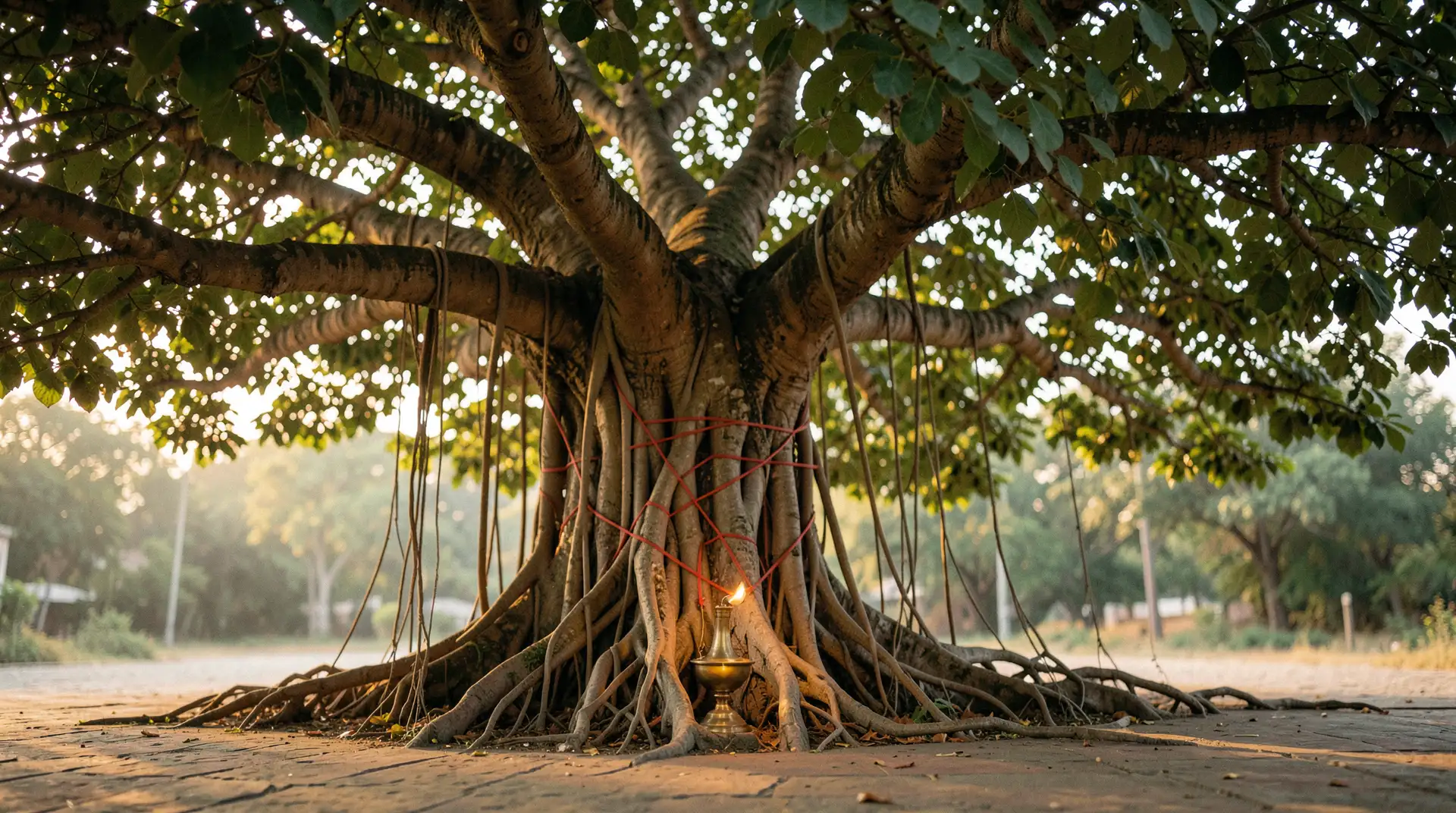
The Skanda Purana and the Padma Purana both carry passages describing the peepal as a home of Vishnu, with some regional traditions holding that Brahma resides in its roots, Vishnu in its trunk, and Shiva in its crown. Whether a reader takes these as cosmology or as metaphor, they explain why the tree is treated not as vegetation but as a living shrine.
In some regional folk traditions, the peepal is believed to shelter ancestral spirits after death, which is why circumambulation is also performed as an act of remembrance for the departed. This belief varies considerably by region: in parts of Rajasthan and Uttar Pradesh it is strong; in coastal traditions it takes a different form entirely. Where a story has more than one version, the honest thing is to say so rather than present one as universal.
The act of moving clockwise keeps the sacred object on the devotee's right, the side of honour in Indian custom. Water is poured at the roots, a red thread is sometimes tied around the trunk, and a diya is lit in the hollow where roots meet earth. Each gesture has its own explanation within the tradition, but together they constitute a complete act of reverence.
A tree that cannot be destroyed, that breathes through the night, that shelters everything beneath it: the sacred associations are not arbitrary. They grew from observation. The tradition wove meaning around what people could already see.
A diya of mustard oil, a black sesame offering, and seven clockwise circles are the most common form this takes. This is belief, and the tradition presents it as such: a way of approaching a planetary force through a sacred intermediary. The peepal on a Saturday morning, ringed by devotees, is one of the most ordinary and most layered sights in a Hindu town.
The peepal holds together things that usually stay separate: botany and scripture, village memory and Vedic verse, the daily and the cosmic. A tree that breathes at night, shelters the weary, and cannot easily be felled became, over centuries, the place where people brought what they could not resolve anywhere else. The ritual survived because the tree kept earning it.
What the Scriptures Say
In the Bhagavad Gita, Krishna tells Arjuna: 'Among trees, I am the Ashvattha.' Ashvattha is the Sanskrit name for the peepal, Ficus religiosa, and this single verse placed it above every other tree in the Hindu imagination.The Skanda Purana and the Padma Purana both carry passages describing the peepal as a home of Vishnu, with some regional traditions holding that Brahma resides in its roots, Vishnu in its trunk, and Shiva in its crown. Whether a reader takes these as cosmology or as metaphor, they explain why the tree is treated not as vegetation but as a living shrine.
The Stories Attached to It
Popular tradition holds that the peepal is one of the few trees under which Vishnu rested during his earthly wanderings, and that the Buddha attained enlightenment under a close botanical relative, the Bodhi tree, also a Ficus.In some regional folk traditions, the peepal is believed to shelter ancestral spirits after death, which is why circumambulation is also performed as an act of remembrance for the departed. This belief varies considerably by region: in parts of Rajasthan and Uttar Pradesh it is strong; in coastal traditions it takes a different form entirely. Where a story has more than one version, the honest thing is to say so rather than present one as universal.
The Ritual of Circumambulation
Pradakshina, circling a sacred object clockwise, is among the oldest acts of Hindu worship, applied to temples, sacred fires, and certain trees. The number of circles varies by tradition and by the day: Saturdays are widely considered the most auspicious day for peepal worship, associated in Vedic astrology with Shani, and women observing the Vat Savitri vrat circle the tree as a central part of the fast.The act of moving clockwise keeps the sacred object on the devotee's right, the side of honour in Indian custom. Water is poured at the roots, a red thread is sometimes tied around the trunk, and a diya is lit in the hollow where roots meet earth. Each gesture has its own explanation within the tradition, but together they constitute a complete act of reverence.
Why This Particular Tree
The peepal is unusual in ways that any farmer or traveller in the subcontinent would have noticed long before the word botany existed. It is one of very few trees that releases oxygen through the night as well as the day, through a metabolic process called Crassulacean Acid Metabolism. Its canopy is wide enough to shade a well or a resting place for miles of walking. It is nearly impossible to kill, roots push through stone walls, trunks survive fire, the tree outlives the structures built around it.A tree that cannot be destroyed, that breathes through the night, that shelters everything beneath it: the sacred associations are not arbitrary. They grew from observation. The tradition wove meaning around what people could already see.
Saturday and the Peepal
In Vedic astrology, Shani, Saturn, is associated with the peepal tree, and Saturday worship at the tree is practiced widely as a way of seeking Shani's favour or softening what the tradition describes as his difficult influence.A diya of mustard oil, a black sesame offering, and seven clockwise circles are the most common form this takes. This is belief, and the tradition presents it as such: a way of approaching a planetary force through a sacred intermediary. The peepal on a Saturday morning, ringed by devotees, is one of the most ordinary and most layered sights in a Hindu town.
The peepal holds together things that usually stay separate: botany and scripture, village memory and Vedic verse, the daily and the cosmic. A tree that breathes at night, shelters the weary, and cannot easily be felled became, over centuries, the place where people brought what they could not resolve anywhere else. The ritual survived because the tree kept earning it.