
Why a Coconut Is Broken at Temples and Before Every Auspicious Start

Why is a coconut broken at temples and before every auspicious start in Hindu tradition? From opening a new shop and buying a vehicle to weddings and religious ceremonies, breaking a coconut is a common ritual believed to bring good fortune and blessings. Also known as a symbol of purity, prosperity and devotion, the coconut holds a special place in Hindu customs. But what does this age-old tradition actually mean, and why is a coconut offered before beginning something new?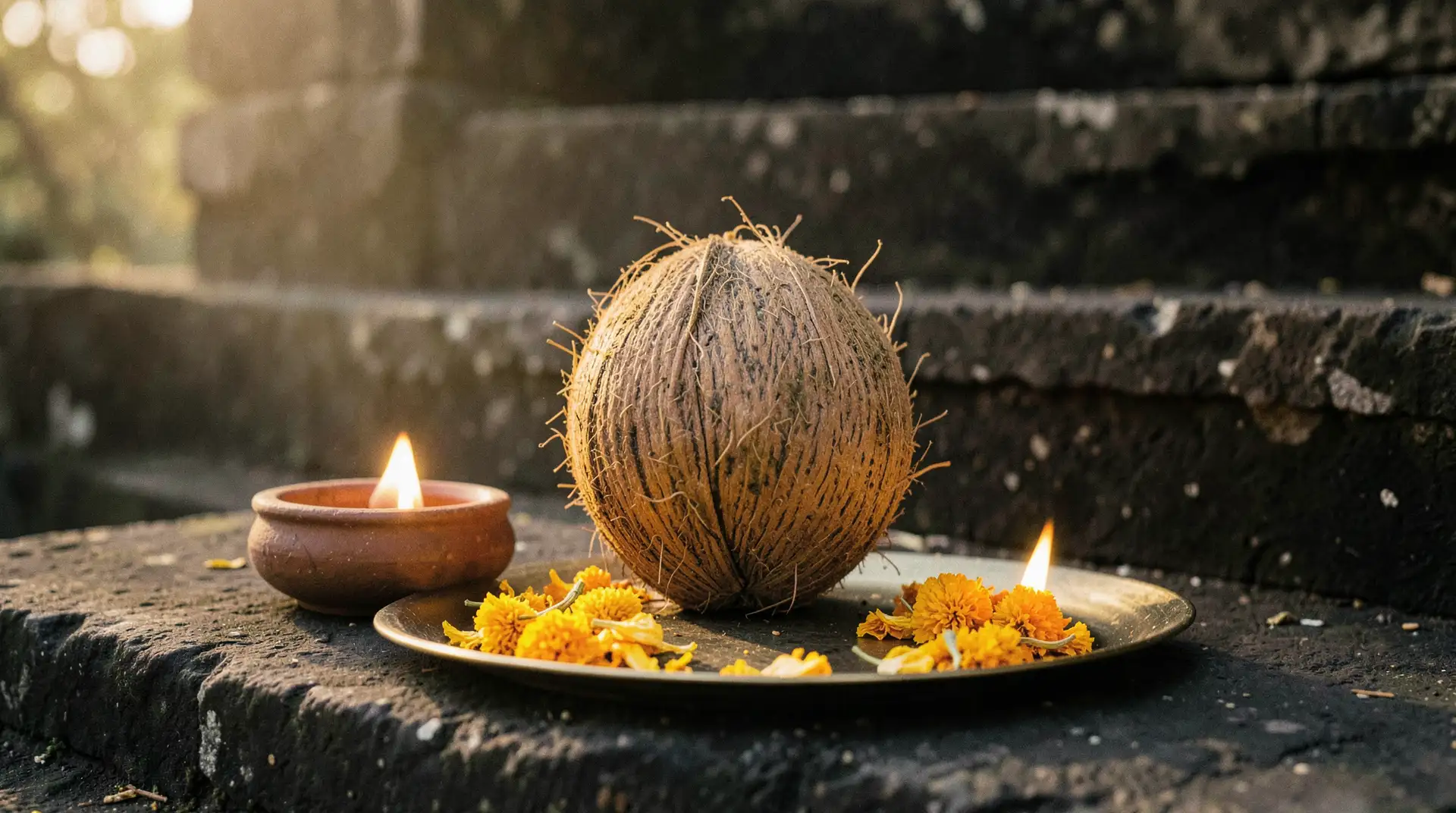
This reading is not a modern interpretation. It appears across commentaries on puja ritual and in the explanations given by temple priests across different regions of India. The act of breaking the coconut is, in this framework, a symbolic act of ego-surrender: the devotee offers not just a fruit but the idea of the self, cracked open before the divine.
The fruit's practical properties reinforced its ritual status. Coconut water is naturally sterile and was used in purification. The husk burns slowly and cleanly, useful in the sacred fire. The flesh feeds. A single fruit carried all the elements a ritual required.
Before a new beginning, a journey, a business, a construction, the coconut serves a second purpose. Popular tradition holds that breaking it clears the path of obstacles, and the practice is associated with Ganesha, the deity invoked at every commencement. The logic follows from the symbolism: the devotee begins by surrendering ego, which is understood as the primary obstacle to any undertaking. What begins in humility, the tradition suggests, has already cleared its first hurdle.
These variations do not contradict each other. They reflect the same underlying meaning expressed through the customs of different communities, each of which inherited the practice through its own line of transmission.
That is why the tradition has survived the journey from village temple to urban high-rise. The coconut does not need a priest or a fire or a Sanskrit verse to carry its meaning. It needs only the moment of breaking, and someone willing to understand what they are putting down.
The Fruit That Stands In for the Self
In Hindu tradition, the coconut is held to mirror the human being in a way no other fruit does. The rough outer husk represents the ego, the hard, fibrous shell of pride, desire, and attachment that each person carries. Beneath it lies a harder inner shell, which the tradition associates with the subtler layers of selfhood: the mind and its habits. Crack that open, and there is the white flesh, soft and nourishing, which represents the inner self. At the centre is the water, pure, clear, and often offered to the deity, which stands for the atman, the soul, untouched by everything surrounding it.This reading is not a modern interpretation. It appears across commentaries on puja ritual and in the explanations given by temple priests across different regions of India. The act of breaking the coconut is, in this framework, a symbolic act of ego-surrender: the devotee offers not just a fruit but the idea of the self, cracked open before the divine.
Why the Coconut Specifically
Several fruits are offered in worship, but the coconut carries a particular status in Vedic tradition as a sriphala, literally, the fruit of Sri, another name for Lakshmi. It is considered the most complete offering a householder can make without taking a life. Early ritual texts describe animal sacrifice as a form of offering; the coconut, with its three eyes, its water, its flesh, and its husk, came to be accepted as a full substitute. The three dark spots on the shell are widely understood in popular tradition as representing the three eyes of Shiva, which is one reason the coconut appears so centrally in Shaiva worship.The fruit's practical properties reinforced its ritual status. Coconut water is naturally sterile and was used in purification. The husk burns slowly and cleanly, useful in the sacred fire. The flesh feeds. A single fruit carried all the elements a ritual required.
The Moment of Breaking and What It Marks
The breaking itself is not incidental. It is the ritual's hinge. Offering a whole, unbroken coconut would be incomplete, the point is the rupture, the release of what is inside. In temple practice, the coconut is typically broken on a stone set aside for the purpose, and the two halves are placed before the deity. The water, which has already been offered, is understood to have reached the divine through that act of splitting.Before a new beginning, a journey, a business, a construction, the coconut serves a second purpose. Popular tradition holds that breaking it clears the path of obstacles, and the practice is associated with Ganesha, the deity invoked at every commencement. The logic follows from the symbolism: the devotee begins by surrendering ego, which is understood as the primary obstacle to any undertaking. What begins in humility, the tradition suggests, has already cleared its first hurdle.
Regional Variations in the Practice
The core gesture is consistent across India, but its details shift by region. In Tamil Nadu and Kerala, the coconut is often broken with a single downward strike on a stone at the temple entrance, and the two halves are left as an offering. In Maharashtra, the coconut is sometimes broken at the feet of the deity's image rather than on a separate stone. In some Bengali traditions, the whole coconut is offered without breaking and later distributed as prasad. In coastal Karnataka, the coconut's role in ritual is so central that certain festivals are structured around its offering entirely.These variations do not contradict each other. They reflect the same underlying meaning expressed through the customs of different communities, each of which inherited the practice through its own line of transmission.
What the Gesture Asks of the Person Performing It
A ritual done without understanding is still a ritual, and most traditions hold that the outer act carries weight regardless of the inner state of the person performing it. But the coconut's symbolism is designed to do something to the person who holds it. To stand before a deity or a new beginning with a coconut in hand is to hold, physically, the object that represents your own ego. The breaking is supposed to be felt as more than percussion.That is why the tradition has survived the journey from village temple to urban high-rise. The coconut does not need a priest or a fire or a Sanskrit verse to carry its meaning. It needs only the moment of breaking, and someone willing to understand what they are putting down.
Next Story