
Why a Red Kalava Thread Is Tied on the Wrist During Puja

Before the first mantra is chanted or the first grain of rice offered, a priest reaches for a length of red thread. He winds it around the right wrist of the person sitting before him and ties it with a knot. The gesture takes ten seconds. The meaning it carries has been part of Hindu worship for centuries.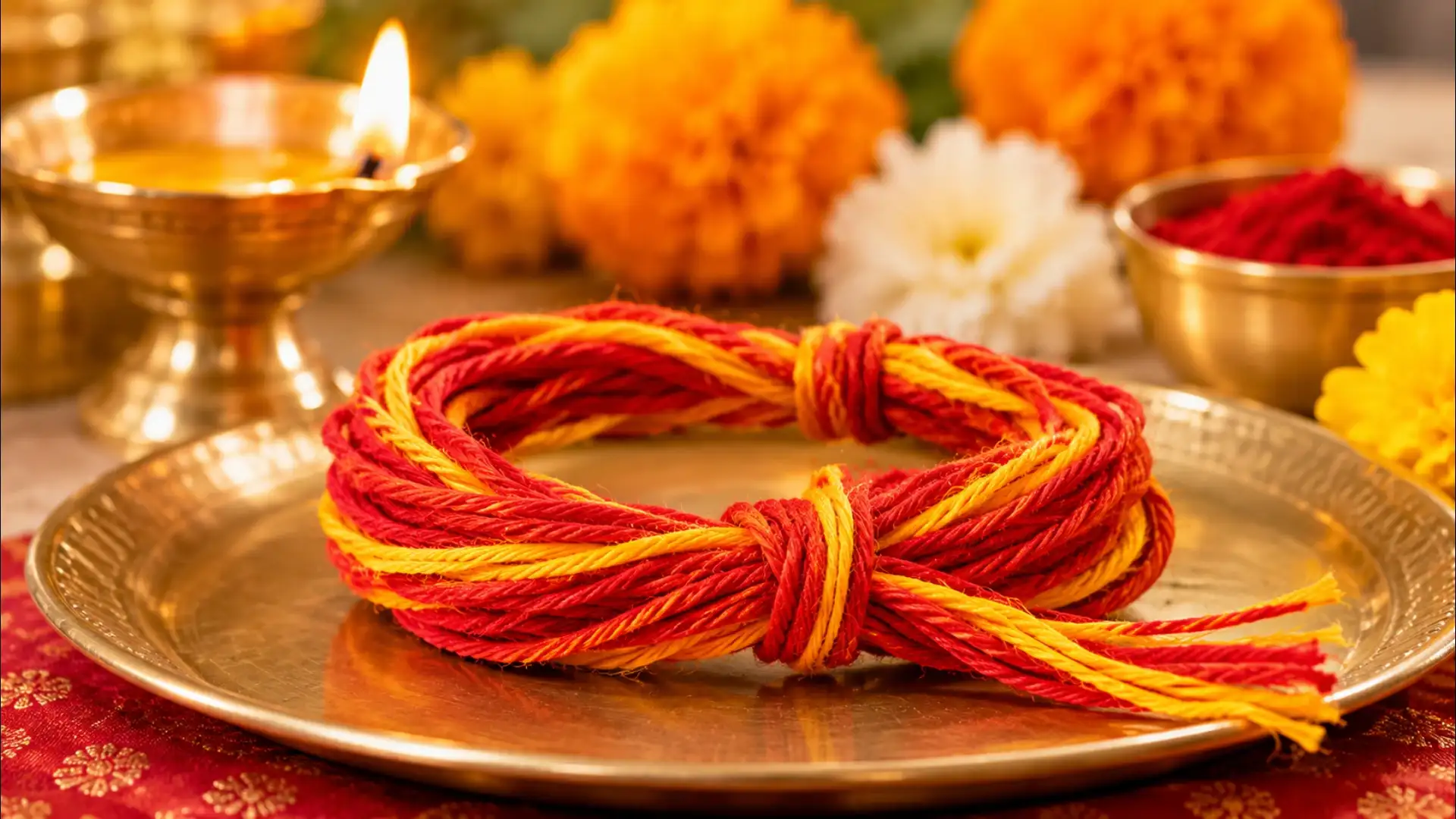
Raksha sutra translates plainly as protection thread. Both names describe the same object: a length of raw cotton thread, most commonly red, sometimes red and yellow twisted together, occasionally red, yellow, and white.
The thread is not silk, not synthetic. Cotton is chosen because it is a natural, unprocessed material, considered ritually clean in the Vedic tradition. The raw quality of the fibre is part of its meaning.
Yellow, when twisted in, stands for knowledge and the blessings of Vishnu. Together, the colours are not decorative choices, they are a visual shorthand for the protective and auspicious qualities the thread is meant to carry.
Vastu shastra also associates red with the south direction and with protective energy. Some practitioners of Vedic ritual theory hold that the colour itself acts as a kind of energetic seal when the thread is tied with the correct intention and the correct mantra.
The right wrist is considered the active, outward-facing side of the body in Vedic ritual logic, the side through which energy is given and action is taken. Tying the thread there is understood as placing a seal on that action.
The knot matters too. It is tied while a mantra is recited, most commonly a verse from the Rigveda that calls on the binding power used to protect the god Bali, or a verse invoking the protection of the goddess.
The mantra turns a physical knot into a ritual act. Without the mantra, in this tradition's understanding, it is string. With it, it becomes a raksha.
The second is from the Mahabharata: when Krishna's finger was cut during the Govardhan episode, Draupadi tore a strip from her sari and bound his wound. Krishna is said to have promised her protection in return, a bond sealed by cloth around a wrist.
Whether these stories are the origin of the kalava or later explanations attached to an older practice, they give the thread a narrative weight that purely ritual description cannot.
The thread is not meant to be worn forever. When it frays and falls off on its own, the tradition holds that it has done its work. Many people remove it at a river or a body of flowing water, returning it to nature rather than throwing it away, because a thread that has been part of a sacred act is treated with the same care as any other ritual object.
The kalava is one of those objects that sits at the intersection of the visible and the intended, a physical mark of something the tradition considers real but invisible: the protective attention of the divine, acknowledged at the wrist, carried into ordinary life.
Disclaimer: The information presented is based on Hindu religious traditions, cultural beliefs and ritual practices. Customs and interpretations surrounding the kalava may vary across regions and communities. This article is intended for general knowledge and cultural understanding only.
What the Kalava Is and What It Is Called
The kalava goes by several names: mauli, raksha sutra, or simply the sacred thread of the puja. Mauli comes from the Sanskrit word for crown or top, a reference to its status as the first thing offered in a ritual, placed above everything else that follows.Raksha sutra translates plainly as protection thread. Both names describe the same object: a length of raw cotton thread, most commonly red, sometimes red and yellow twisted together, occasionally red, yellow, and white.
The thread is not silk, not synthetic. Cotton is chosen because it is a natural, unprocessed material, considered ritually clean in the Vedic tradition. The raw quality of the fibre is part of its meaning.
The Colour and What It Represents
Red in Hindu ritual thought carries a dense cluster of associations. It is the colour of the goddess Shakti in her active, protective form. It is the colour of sindoor and of auspicious beginnings. In the context of a puja, red signals life force, energy, and the presence of the divine.Yellow, when twisted in, stands for knowledge and the blessings of Vishnu. Together, the colours are not decorative choices, they are a visual shorthand for the protective and auspicious qualities the thread is meant to carry.
Vastu shastra also associates red with the south direction and with protective energy. Some practitioners of Vedic ritual theory hold that the colour itself acts as a kind of energetic seal when the thread is tied with the correct intention and the correct mantra.
The Wrist, the Knot, and the Direction
In most Hindu traditions, the kalava is tied on the right wrist for men and unmarried women, and on the left wrist for married women.The right wrist is considered the active, outward-facing side of the body in Vedic ritual logic, the side through which energy is given and action is taken. Tying the thread there is understood as placing a seal on that action.
The knot matters too. It is tied while a mantra is recited, most commonly a verse from the Rigveda that calls on the binding power used to protect the god Bali, or a verse invoking the protection of the goddess.
The mantra turns a physical knot into a ritual act. Without the mantra, in this tradition's understanding, it is string. With it, it becomes a raksha.
The Story Behind the Thread
Popular tradition connects the kalava to two stories in particular. The first comes from the Bhagavata Purana: when the demon king Bali gave everything he had to Vamana, an avatar of Vishnu, Vishnu himself is said to have tied a protective thread on Bali's wrist as a mark of honour and protection.The second is from the Mahabharata: when Krishna's finger was cut during the Govardhan episode, Draupadi tore a strip from her sari and bound his wound. Krishna is said to have promised her protection in return, a bond sealed by cloth around a wrist.
Whether these stories are the origin of the kalava or later explanations attached to an older practice, they give the thread a narrative weight that purely ritual description cannot.
When It Is Tied and When It Is Removed
The kalava is tied at the start of any significant puja, at the beginning of a festival, or before an important undertaking. It is also tied at temples when a devotee receives prasad from a priest.The thread is not meant to be worn forever. When it frays and falls off on its own, the tradition holds that it has done its work. Many people remove it at a river or a body of flowing water, returning it to nature rather than throwing it away, because a thread that has been part of a sacred act is treated with the same care as any other ritual object.
The kalava is one of those objects that sits at the intersection of the visible and the intended, a physical mark of something the tradition considers real but invisible: the protective attention of the divine, acknowledged at the wrist, carried into ordinary life.
Disclaimer: The information presented is based on Hindu religious traditions, cultural beliefs and ritual practices. Customs and interpretations surrounding the kalava may vary across regions and communities. This article is intended for general knowledge and cultural understanding only.
Next Story