
Why Camphor Is Lit During Aarti and Leaves Nothing Behind

A piece of camphor placed on a brass plate, a flame touched to it, and within moments it is gone. No char, no ash, no trace. Of all the materials used in Hindu worship, camphor is the only one that disappears entirely in fire. The tradition says this is exactly the point.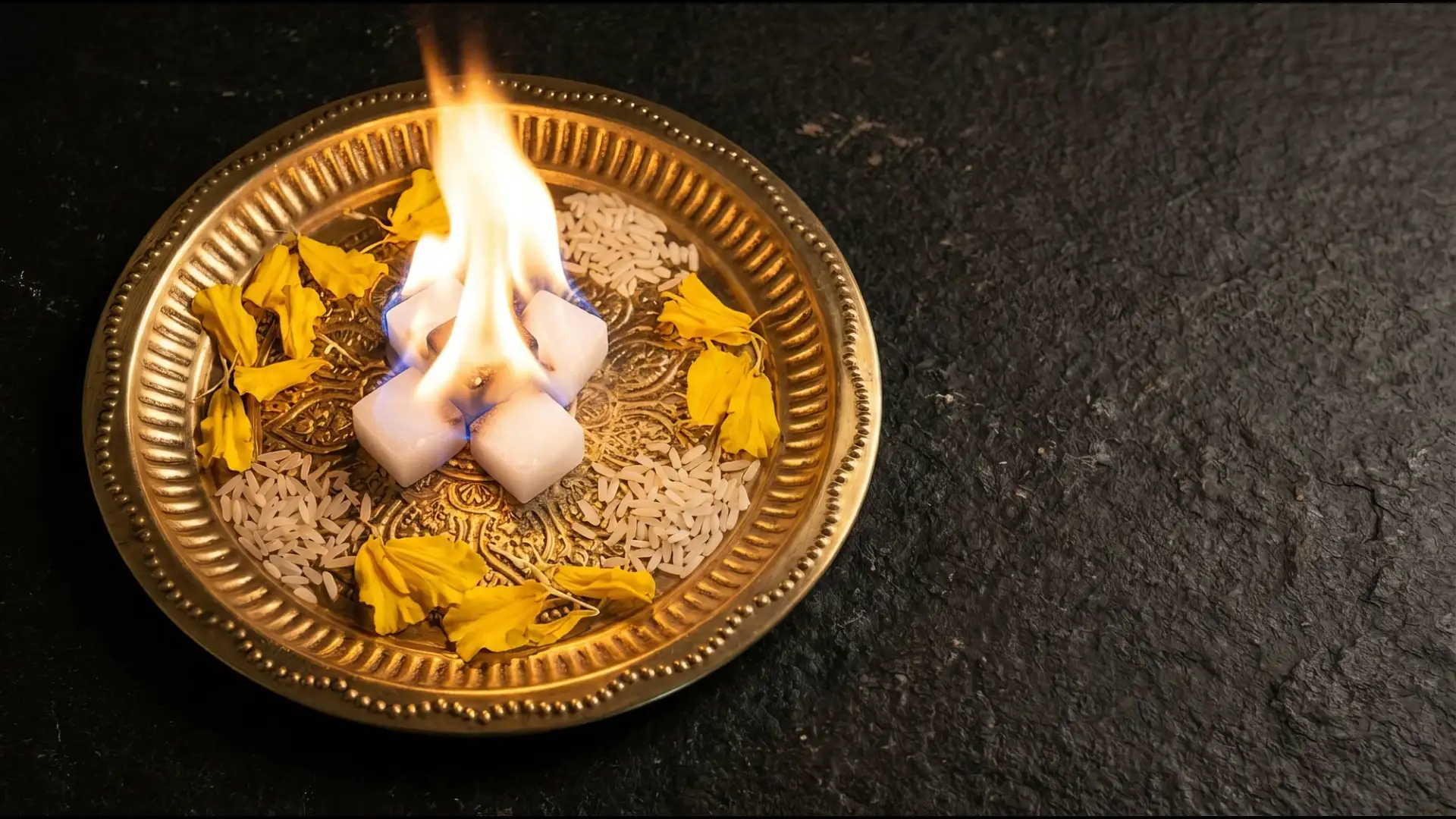
The flame of the aarti lamp represents divine consciousness, or in simpler terms, the light of awareness that the tradition says underlies everything. When camphor meets that flame, it does not merely burn. It merges, completely and without remainder.
The tradition reads this as a teaching: the self, surrendered fully to the divine, leaves nothing behind. No residue of pride, no fragment of separateness. This is the idea at the heart of the aarti ritual, offered visually to every person present, whether or not they can read a Sanskrit text.
Ghee leaves a darkened wick. Camphor leaves nothing. In popular tradition, this is described as the ideal of selfless devotion: to give oneself completely, holding back nothing, and to vanish into what one loves without leaving a mark of having been there at all.
The Sanskrit term most associated with this idea is nishkama, action without attachment to outcome or residue. The camphor flame makes that abstract idea visible and repeatable, every evening, in every home where aarti is performed.
The fragrance does not stay in one corner. It moves. Popular tradition holds that where the smoke of burning camphor reaches, the space is purified and the presence of the deity is felt.
This is why the aarti plate is moved in a clockwise circle before the deity and then carried to each person present, who cups their hands over the flame and draws the warmth toward their face. The gesture is both a receiving of light and a receiving of the fragrance that has already spread through the room.
The deity looks outward through the flame; the worshipper looks inward through it. What the worshipper is meant to see, in that moment of circling light, is the same light that burns in the camphor, the awareness that the tradition says is identical in the individual and in the divine, different only in scale, the way a candle flame and a bonfire are different in size but not in nature.
The aarti is not, in this reading, a performance staged for the deity. It is a recognition, offered by the worshipper to themselves, using fire as the medium.
The specific act of burning camphor is most strongly associated with Hindu aarti, and within that, it has remained consistent across centuries because its meaning is carried in the material itself, not in a text that can be lost or a language that can be forgotten.
A person who has never heard the Sanskrit word karpura, who cannot read a Purana, who enters a temple for the first time, sees the camphor disappear and understands, without being told, that something complete just happened. The ritual does its teaching through the eye.
The camphor's disappearance is the ritual's argument. Everything else, the bell, the incense, the flowers, the chant, surrounds and supports it. But the moment the flame goes out and the plate is clean, the tradition has already said what it came to say: give fully, leave nothing, and the fragrance of having been here will remain long after the self is gone.
What Camphor Means in the Tradition
In Vedic and Puranic tradition, camphor, known as karpura in Sanskrit, is held to represent the individual self, the ego, the sense of separate existence that each person carries through life.The flame of the aarti lamp represents divine consciousness, or in simpler terms, the light of awareness that the tradition says underlies everything. When camphor meets that flame, it does not merely burn. It merges, completely and without remainder.
The tradition reads this as a teaching: the self, surrendered fully to the divine, leaves nothing behind. No residue of pride, no fragment of separateness. This is the idea at the heart of the aarti ritual, offered visually to every person present, whether or not they can read a Sanskrit text.
Why the Residue Matters
The absence of ash is not incidental, it is the whole point of choosing camphor over any other aromatic substance. Wood leaves charcoal. Incense leaves grey powder.Ghee leaves a darkened wick. Camphor leaves nothing. In popular tradition, this is described as the ideal of selfless devotion: to give oneself completely, holding back nothing, and to vanish into what one loves without leaving a mark of having been there at all.
The Sanskrit term most associated with this idea is nishkama, action without attachment to outcome or residue. The camphor flame makes that abstract idea visible and repeatable, every evening, in every home where aarti is performed.
The Fragrance as Blessing
As camphor burns, it releases a sharp, clean fragrance that fills the room. In the tradition, this is understood as prasad in its most direct form, something given outward to all present, equally and without preference.The fragrance does not stay in one corner. It moves. Popular tradition holds that where the smoke of burning camphor reaches, the space is purified and the presence of the deity is felt.
You may also like
- Cosmic connection of Dev Deepawali: Understanding the divine relationship between energy, spirituality, and universe
- Short on Time on Tuesday: 5 Powerful Hanuman Chalisa Chaupais to Chant
- Kartik Purnima 2026: How Many Lamps to Light Near Tulsi Tonight
- Vaikuntha Chaturdashi 2026: How Worship Rules Change Across India
- Kartik Purnima 2026: Simple Daan Remedies on This Auspicious Full Moon
This is why the aarti plate is moved in a clockwise circle before the deity and then carried to each person present, who cups their hands over the flame and draws the warmth toward their face. The gesture is both a receiving of light and a receiving of the fragrance that has already spread through the room.
The Camphor Flame as a Mirror
There is a second layer of meaning that appears in several Vaishnava and Shaiva commentarial traditions. The camphor flame is described as a mirror held up to the worshipper.The deity looks outward through the flame; the worshipper looks inward through it. What the worshipper is meant to see, in that moment of circling light, is the same light that burns in the camphor, the awareness that the tradition says is identical in the individual and in the divine, different only in scale, the way a candle flame and a bonfire are different in size but not in nature.
The aarti is not, in this reading, a performance staged for the deity. It is a recognition, offered by the worshipper to themselves, using fire as the medium.
Why This Ritual Has Stayed Unchanged
Aarti is performed across denominations, regions, and languages, in temples dedicated to Vishnu and Shiva and Devi alike, in Jain temples where the ritual takes a slightly different form, and in Sikh practice where the Gurbani aarti replaces the lamp with verse.The specific act of burning camphor is most strongly associated with Hindu aarti, and within that, it has remained consistent across centuries because its meaning is carried in the material itself, not in a text that can be lost or a language that can be forgotten.
A person who has never heard the Sanskrit word karpura, who cannot read a Purana, who enters a temple for the first time, sees the camphor disappear and understands, without being told, that something complete just happened. The ritual does its teaching through the eye.
The camphor's disappearance is the ritual's argument. Everything else, the bell, the incense, the flowers, the chant, surrounds and supports it. But the moment the flame goes out and the plate is clean, the tradition has already said what it came to say: give fully, leave nothing, and the fragrance of having been here will remain long after the self is gone.






Loving Newspoint? Download the app now
