
Why Ravana Is Shown with Ten Heads in Hindu Tradition

Ravana rules Lanka, abducts Sita, and falls to Rama's arrow, but the image that stays is the one with ten heads, each face turned in a slightly different direction. The Ramayana gives us this form, and the tradition has never settled on a single explanation for it. What survives are several readings, each revealing something different about how the epic works.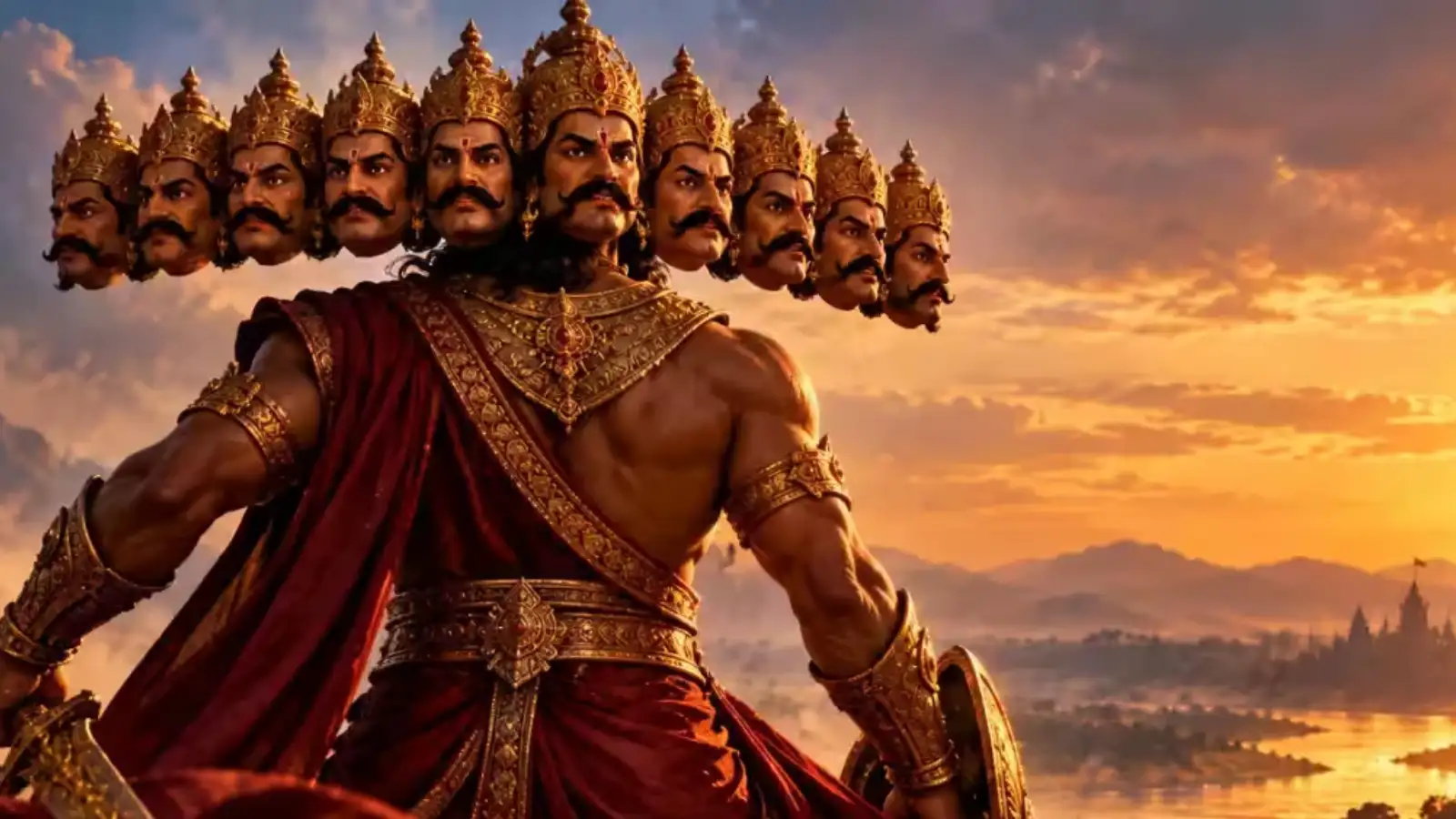
A second reading, found across regional tellings of the Ramayana, maps each head onto a human emotion or vice: kama (desire), krodha (anger), lobha (greed), moha (attachment), mada (pride), matsarya (envy), and others, depending on the version. The list shifts between traditions, but the structure stays the same, Ravana contains within himself every destructive force a person carries. He is not a demon from outside. He is the interior life, magnified.
In this grammar, ten is not a random number. The tradition associates it with completeness, the ten directions of space, the ten senses in some schools of thought, the ten fingers that build and destroy. Giving Ravana ten heads was a way of saying: this is a complete being, one who contains every capacity, every vice, every gift. That completeness is what makes him genuinely dangerous and genuinely tragic. A simple villain needs only one face.
Later traditions filled in the symbolism. The Adhyatma Ramayana, a Sanskrit text that reads the epic as an allegory of the self, treats the ten heads as the ten modifications of the mind that keep a person bound to illusion. In some South Indian tellings, particularly in Sri Lanka where Ravana is remembered with more ambivalence, the ten heads represent his ten lifetimes of devotion to Shiva before he was granted power. The same image, read differently, produces a tyrant in one telling and a saint in another.
The ten heads hold this contradiction in one image. They show a being of extraordinary capacity who turned every gift toward the wrong end. The same knowledge that could have made him a sage made him certain he could take what he wanted. In this sense, the ten heads are not about how many faces he has. They are about how many ways a gifted person can go wrong when pride sits at the centre of all of them.
The image has lasted because it does what good storytelling does, it makes the internal visible. Every head is a different face of the same mistake.
The Ten Heads as Ten Emotions
One of the most widely held readings in popular tradition holds that the ten heads represent the six shastras and four Vedas, the complete body of sacred knowledge that Ravana had mastered. He was, before everything else, a scholar. The Shiva Purana describes him as a devoted worshipper who composed hymns and played the veena. The ten heads in this reading are not a mark of monstrosity but of learning so vast it could not fit in one mind.A second reading, found across regional tellings of the Ramayana, maps each head onto a human emotion or vice: kama (desire), krodha (anger), lobha (greed), moha (attachment), mada (pride), matsarya (envy), and others, depending on the version. The list shifts between traditions, but the structure stays the same, Ravana contains within himself every destructive force a person carries. He is not a demon from outside. He is the interior life, magnified.
What the Storytellers Were Building
Ancient Indian storytellers worked in a tradition where a figure's visible form was a map of their inner nature. Ganesha's elephant head is not a biological fact, it is a statement about wisdom and the removal of obstacles. Vishnu's four arms hold specific objects that name his attributes. Ravana's ten heads follow the same grammar.In this grammar, ten is not a random number. The tradition associates it with completeness, the ten directions of space, the ten senses in some schools of thought, the ten fingers that build and destroy. Giving Ravana ten heads was a way of saying: this is a complete being, one who contains every capacity, every vice, every gift. That completeness is what makes him genuinely dangerous and genuinely tragic. A simple villain needs only one face.
Ravana Across Regional Traditions
The Valmiki Ramayana, the oldest surviving version, describes Ravana's ten heads but does not explain them as symbols. It presents them as the form he was born with, the result of his lineage, his father was the sage Vishrava, his grandfather the great Pulastya. The demonic form came from his mother's side, the divine from his father's.Later traditions filled in the symbolism. The Adhyatma Ramayana, a Sanskrit text that reads the epic as an allegory of the self, treats the ten heads as the ten modifications of the mind that keep a person bound to illusion. In some South Indian tellings, particularly in Sri Lanka where Ravana is remembered with more ambivalence, the ten heads represent his ten lifetimes of devotion to Shiva before he was granted power. The same image, read differently, produces a tyrant in one telling and a saint in another.
Why He Cannot Simply Be the Villain
The tradition has always been uneasy about reducing Ravana to evil. He was a Brahmin by birth, a Shiva bhakta of the highest order, a musician, a king who kept his kingdom prosperous, and a man who, in the Valmiki Ramayana, never touches Sita against her will, waiting for her to come to him of her own accord. His flaw is not cruelty but pride: the belief that his learning and devotion placed him above consequence.The ten heads hold this contradiction in one image. They show a being of extraordinary capacity who turned every gift toward the wrong end. The same knowledge that could have made him a sage made him certain he could take what he wanted. In this sense, the ten heads are not about how many faces he has. They are about how many ways a gifted person can go wrong when pride sits at the centre of all of them.
The image has lasted because it does what good storytelling does, it makes the internal visible. Every head is a different face of the same mistake.
Next Story