
Why Govardhan Puja Involves a Mountain of Food Called Annakut

Govardhan Puja is celebrated with a unique tradition that turns temple courtyards across North India into spectacular displays of food. Known as Annakut, meaning 'mountain of food', this elaborate offering features hundreds of dishes, sweets, breads and grains arranged in the shape of a hill. But this fascinating ritual is more than a grand festive feast. It is rooted in an ancient Hindu legend involving Lord Krishna, Govardhan Hill and his decision to challenge the rain god Indra.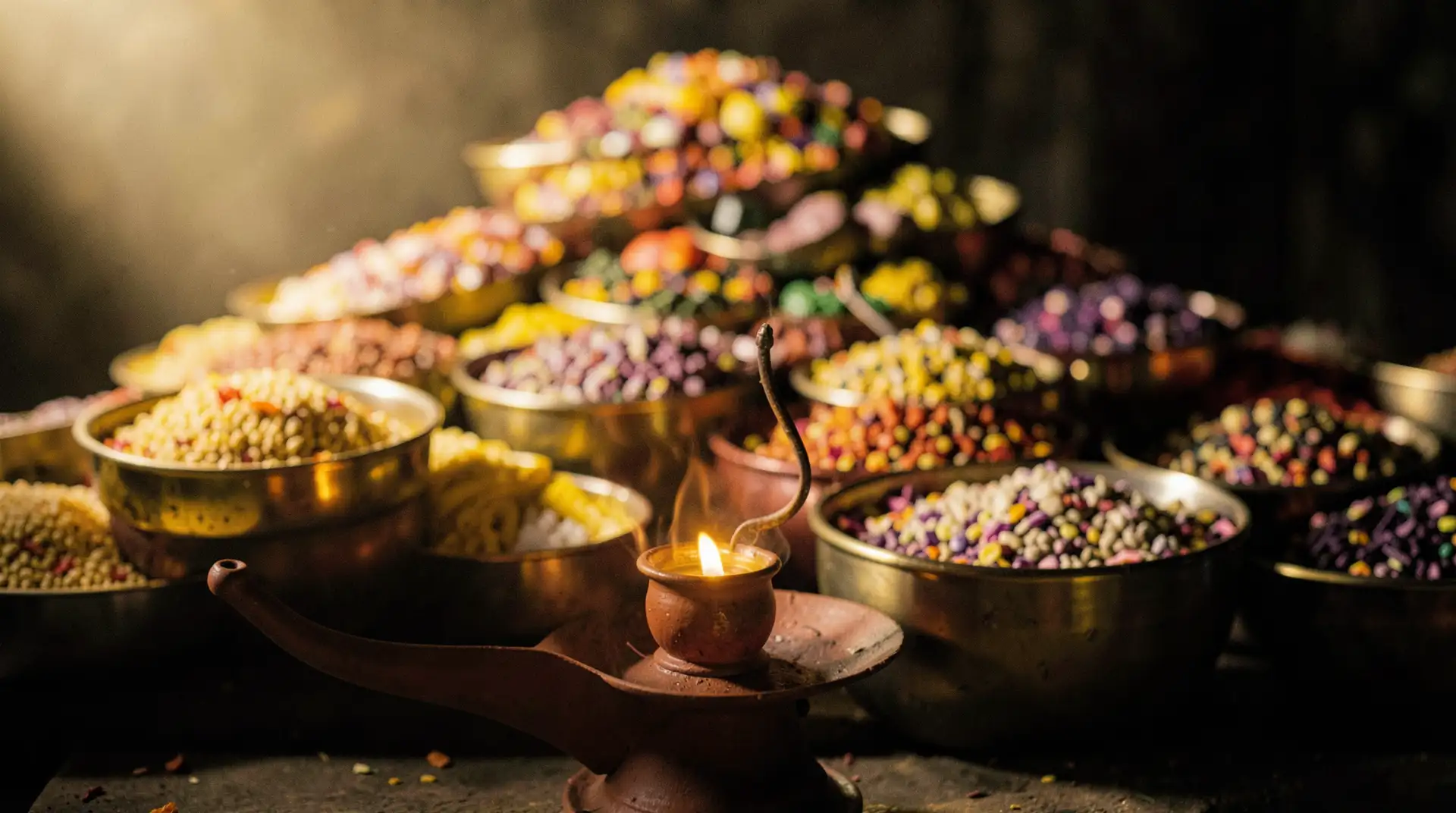
Indra was furious. He sent seven days of storm and flood to punish the village. Krishna responded by lifting Govardhan Hill on the tip of his little finger and holding it overhead like an umbrella, sheltering every person and animal beneath it. When Indra finally understood what he was dealing with, he withdrew the storm and came down to acknowledge that the cowherd was no ordinary child.
The variety matters as much as the quantity. Temples and households try to include every grain, vegetable, and sweet available to them, because the mound is meant to represent the totality of what the earth gives. A single dish would be a personal preference. Hundreds of dishes together say: all of this came from somewhere beyond us, and we return it in acknowledgment.
In homes, the scale is smaller but the logic is the same. Families cook as many dishes as they can manage, arrange them together, perform a short puja, and share the meal. In some communities, particularly in Gujarat and Rajasthan, a clay or cow-dung representation of Govardhan Hill is made in the courtyard and decorated with flowers before the food is arranged around it. The hill is worshipped directly, not just symbolised by the food.
This connection between the ritual and the harvest cycle is what gives Govardhan Puja its staying power across regions and communities that otherwise observe Diwali in quite different ways. The story of Krishna and Indra is specific to Vaishnava tradition, but the impulse to mark the harvest with a communal meal is older and wider than any single story.
The Story That Started It All
In the Bhagavata Purana, the people of Vrindavan had always offered their harvest to Indra, the god of rain, believing he alone controlled whether their crops lived or died. Krishna, still a boy tending cattle on the banks of the Yamuna, told the villagers to stop. Indra did not deserve the credit, he said. It was Govardhan Hill, the land itself, the grass, the soil, the rain that soaked into it, that fed their cattle and, through their cattle, fed them. Worship the hill.Indra was furious. He sent seven days of storm and flood to punish the village. Krishna responded by lifting Govardhan Hill on the tip of his little finger and holding it overhead like an umbrella, sheltering every person and animal beneath it. When Indra finally understood what he was dealing with, he withdrew the storm and came down to acknowledge that the cowherd was no ordinary child.
What Annakut Represents
The mountain of food is a re-enactment of gratitude, not to a distant sky-god who demands tribute, but to the earth that produces everything on the plate. In Vaishnava tradition, Govardhan Hill is itself considered a form of Krishna, the deity made manifest as land. Offering Annakut is therefore both a thanksgiving to the hill and a direct offering to Krishna as the source of all nourishment.The variety matters as much as the quantity. Temples and households try to include every grain, vegetable, and sweet available to them, because the mound is meant to represent the totality of what the earth gives. A single dish would be a personal preference. Hundreds of dishes together say: all of this came from somewhere beyond us, and we return it in acknowledgment.
You may also like
- Vidur Niti: 4 Fatal Money Mistakes That Can Reduce a King to a Pauper
- Dakshina Kali vs Shmashana Kali: Differences and Must Avoid Cremation Sadhana
- Kali Chaudas 2026: Why Maa Kali Is Worshipped Before Diwali
- Beyond Lakshmi Puja: Why Chopad Pujan Powers Gujarat's New Financial Year
- Key Differences Between Regular Kali Puja and Cremation Ground Kali Sadhana Explained
How It Is Observed
In temples with a strong Vaishnava tradition, particularly in Mathura, Vrindavan, and Nathdwara, the Annakut display can run to several thousand preparations. Priests begin cooking before dawn. By the time the temple opens, the offering fills the entire sanctum floor and spills into the courtyard. The deity is symbolically shown the mountain, the food is consecrated as prasad, and then it is distributed to everyone present.In homes, the scale is smaller but the logic is the same. Families cook as many dishes as they can manage, arrange them together, perform a short puja, and share the meal. In some communities, particularly in Gujarat and Rajasthan, a clay or cow-dung representation of Govardhan Hill is made in the courtyard and decorated with flowers before the food is arranged around it. The hill is worshipped directly, not just symbolised by the food.
Why the Timing Matters
Govardhan Puja falls on the first day of the bright fortnight in the month of Kartik, the day immediately after Diwali. In the agricultural calendar this was historically the period just after the kharif harvest came in. The granaries were full, the hard work of the growing season was done, and the community had something real to be grateful for. Annakut was the ritual form that gratitude took, a physical, edible, shareable expression of relief and abundance rather than an abstract prayer.This connection between the ritual and the harvest cycle is what gives Govardhan Puja its staying power across regions and communities that otherwise observe Diwali in quite different ways. The story of Krishna and Indra is specific to Vaishnava tradition, but the impulse to mark the harvest with a communal meal is older and wider than any single story.
The Idea the Festival Carries Forward
What the Annakut ritual encodes, in a form anyone can see and taste, is a particular understanding of where abundance comes from. It does not come from the powerful demanding tribute. It comes from the land, from the labour of ordinary people, and from something in the relationship between a community and the ground it lives on. Krishna lifting the hill was not a display of superior force, it was a demonstration that protection flows from the right relationship with the earth, not from fear of the sky. The mountain of food, rebuilt every year in temple after temple, is the community's way of saying it still remembers which hill held them up.





Loving Newspoint? Download the app now
