
Chaturanga: How Chess Began in India as a Game of Four Army Divisions

Every time a player moves a bishop, they are moving what was once a war elephant. Every rook began as a chariot. The modern game of chess carries inside it the shape of an ancient Indian army, and the word that named that army, chaturanga, is where the whole story starts.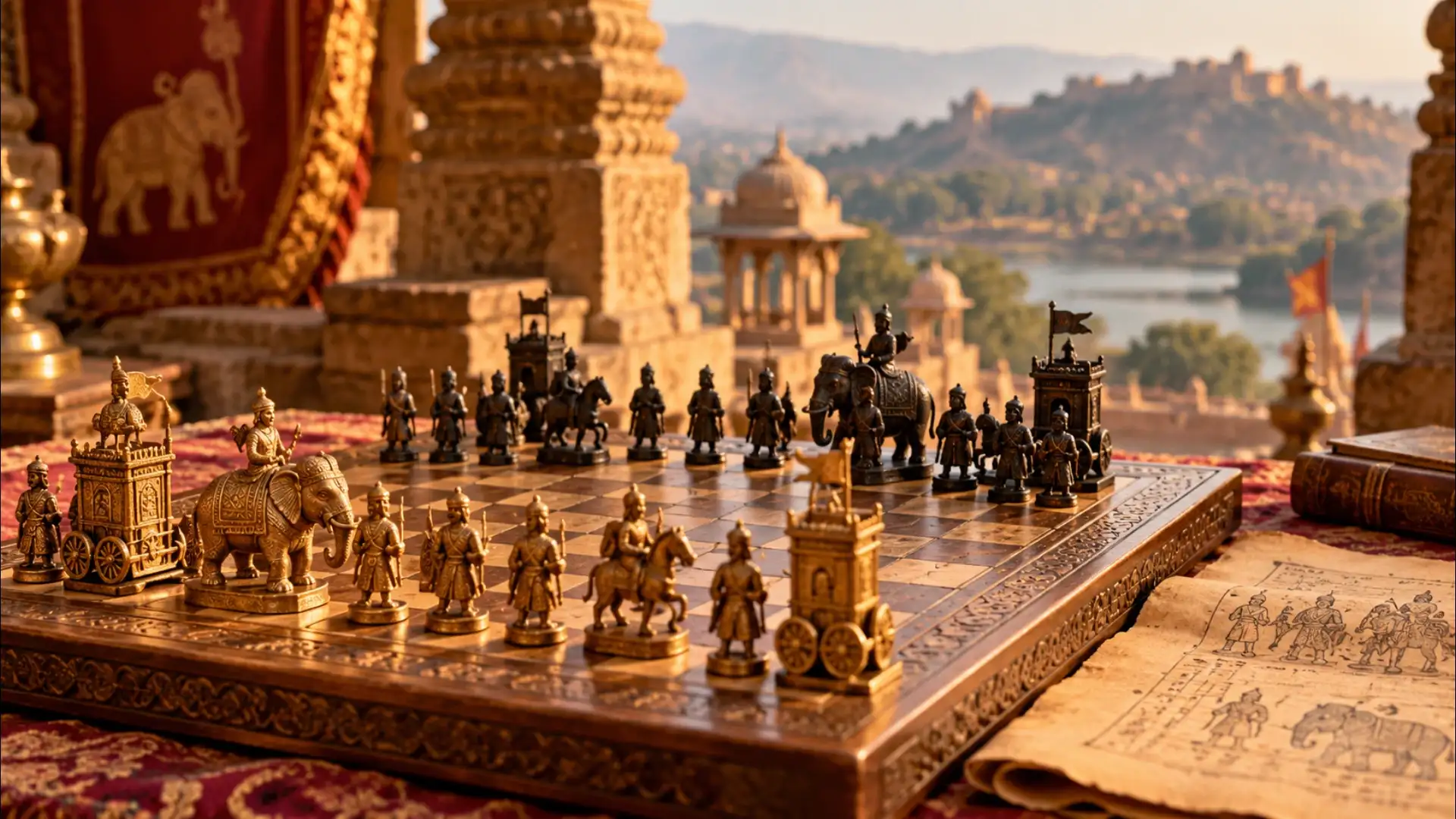
The pieces mapped directly. The elephant, or hasti, became the piece we now call the bishop. The chariot, or ratha, became the rook. The horse, or ashva, became the knight. The foot soldier, or padati, became the pawn. At the centre of each side stood the raja, the king, and beside him the counsellor, the mantri, the piece that would eventually become the queen, though in chaturanga it moved only one square diagonally and had none of the queen's sweeping modern power.
From Persia, shatranj moved into the Arab world following the Islamic conquests of the seventh century. Arab players kept the piece names but translated them: the raja became the shah, the mantri became the firzan. When a shah was in danger, players called out "shah", the word that became "check". When the shah could not escape, they said "shah mat", meaning the king is helpless or the king is dead. That phrase became "checkmate".
The game entered Europe through several routes: through the Moorish presence in Spain, through the Crusades, through Byzantine trade. By the time it settled into European courts in the tenth and eleventh centuries, the pieces had been dressed in feudal clothing. The firzan became a queen. The elephant, a piece with no European equivalent, was reinterpreted variously as a bishop, a jester, or a standard-bearer depending on the region. The chariot became a castle, then a rook, a word whose origin is disputed, but one strong candidate is the Persian rukh, meaning chariot.
The biggest rule change came in Europe around the late fifteenth century. The mantri-turned-queen was given its current range of movement, able to travel any number of squares in any direction, which made the game dramatically faster and more tactical. Pawns were given the option of moving two squares on their first move. The bishop's diagonal range was extended. These changes produced the game played today.
But the structure that chaturanga gave the game never changed. Two sides, a king who must not be captured, pieces with different movement rules representing different military functions, and a board that is the same size it was when Gupta-era players first sat across from each other. The game's logic is still the logic of combined arms: different pieces doing different things, none of them sufficient alone.
The word chaturanga disappeared from common use, replaced by shatranj, then chess, then the dozens of names the game carries in different languages. But the four divisions are still there. The next time a player trades a bishop to open a file for a rook, they are running a version of a tactical exchange that Indian military thinking made thinkable more than fifteen centuries ago.
What Chaturanga Means
Chaturanga is Sanskrit for "four limbs" or "four divisions". In the military texts of ancient India, the term described the four arms of a complete fighting force: the elephant corps, the chariot corps, the cavalry, and the infantry. A general commanding all four held the full range of battlefield capability. When the game appeared, probably during the Gupta period, somewhere between the fourth and seventh centuries CE, it placed exactly those four divisions on a board and asked two players to fight a miniature war.The pieces mapped directly. The elephant, or hasti, became the piece we now call the bishop. The chariot, or ratha, became the rook. The horse, or ashva, became the knight. The foot soldier, or padati, became the pawn. At the centre of each side stood the raja, the king, and beside him the counsellor, the mantri, the piece that would eventually become the queen, though in chaturanga it moved only one square diagonally and had none of the queen's sweeping modern power.
How the Game Travelled West
The path from Indian courts to the rest of the world ran through Persia. Sometime in the sixth century CE, during the reign of the Sasanian king Khosrow I, a version of the game arrived in Persia, where it was adopted and renamed chatrang, then shatranj. Persian poets wrote about it. The Shahnameh, the great Persian epic, contains a passage describing the game's Indian origin and the riddle of its rules being decoded at court.From Persia, shatranj moved into the Arab world following the Islamic conquests of the seventh century. Arab players kept the piece names but translated them: the raja became the shah, the mantri became the firzan. When a shah was in danger, players called out "shah", the word that became "check". When the shah could not escape, they said "shah mat", meaning the king is helpless or the king is dead. That phrase became "checkmate".
You may also like
- Glenn Phillips scripts history, unleashes mayhem as New Zealand smash highest-ever T20I total vs India
- Phillips smashed a century in 46 balls; Bracewell also roared, setting India a target of 260 in the fourth T20.
- Jemimah Rodrigues: Cleared after three‑month rehab, but will she reclaim her spot?
- 'We need to win both': Gautam Gambhir asks team India to win 'every match' of series
- Aaryavir Sehwag, Anvay Dravid headline Raichandani-led India squad for U19 Asia Cup
The game entered Europe through several routes: through the Moorish presence in Spain, through the Crusades, through Byzantine trade. By the time it settled into European courts in the tenth and eleventh centuries, the pieces had been dressed in feudal clothing. The firzan became a queen. The elephant, a piece with no European equivalent, was reinterpreted variously as a bishop, a jester, or a standard-bearer depending on the region. The chariot became a castle, then a rook, a word whose origin is disputed, but one strong candidate is the Persian rukh, meaning chariot.
What Changed and What Stayed
The rules of chaturanga were not identical to modern chess. Some versions were played by four players, one for each army division, using dice to determine which piece could move. The two-player version without dice is the ancestor that survived. The board, eight squares by eight squares, stayed constant across every transformation the game underwent.The biggest rule change came in Europe around the late fifteenth century. The mantri-turned-queen was given its current range of movement, able to travel any number of squares in any direction, which made the game dramatically faster and more tactical. Pawns were given the option of moving two squares on their first move. The bishop's diagonal range was extended. These changes produced the game played today.
But the structure that chaturanga gave the game never changed. Two sides, a king who must not be captured, pieces with different movement rules representing different military functions, and a board that is the same size it was when Gupta-era players first sat across from each other. The game's logic is still the logic of combined arms: different pieces doing different things, none of them sufficient alone.
Why It Matters That It Started Here
Chess is often described as the game that teaches strategy, patience, and the ability to hold several possibilities in mind at once. Those qualities were baked in from the beginning, because the game was designed to model something real. A general commanding elephants, chariots, cavalry, and infantry had to think about how each arm supported the others, where each was vulnerable, and when to sacrifice one to preserve the rest. The game asked its players to think like that general.The word chaturanga disappeared from common use, replaced by shatranj, then chess, then the dozens of names the game carries in different languages. But the four divisions are still there. The next time a player trades a bishop to open a file for a rook, they are running a version of a tactical exchange that Indian military thinking made thinkable more than fifteen centuries ago.






Loving Newspoint? Download the app now
