
BMW deploys Figure 03 humanoid robot at US factory to transform automotive manufacturing


The future of car manufacturing is taking another step towards science fiction. BMW Group has begun deploying Figure AI's latest humanoid robot, Figure 03, at its Spartanburg plant in South Carolina, marking one of the world's most advanced real-world applications of artificial intelligence in automotive production. Rather than replacing assembly-line workers, the new robot has been assigned to a demanding logistics task that requires precision, adaptability and continuous movement across the factory floor. The deployment builds on the successful trial in Figure 02, which supported the production of more than 30,000 BMW X3 vehicles. By introducing a more capable generation of humanoid robots, BMW is testing how Physical AI could reshape manufacturing while improving efficiency, workplace ergonomics and production flexibility.
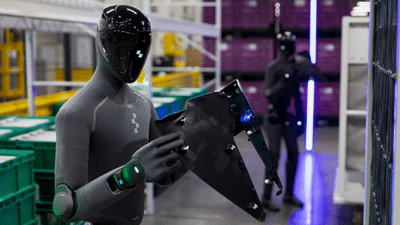
Why BMW is introducing the Figure 03 humanoid robot at its US smart factory
BMW has selected its Spartanburg plant, the company's largest manufacturing facility worldwide, as the first site in the United States to deploy Figure 03 for logistics operations.
Unlike traditional industrial robots that remain fixed behind safety barriers, Figure 03 is designed to operate in environments originally built for people. Its primary responsibility is sequencing components before they reach the production line.
Vehicle parts arrive at the factory in large containers without a predetermined order. Figure 03 identifies, picks and places each component into specialised sequencing trolleys so they arrive at assembly stations in exactly the right order. The trolleys are then transported using automated tugger trains or Smart Transport Robots, ensuring uninterrupted vehicle production.
The deployment follows an 11-month production trial involving Figure 02, during which the humanoid robot inserted sheet metal components for welding while supporting the manufacture of more than 30,000 BMW X3 vehicles.
Ulrich Wieland, Vice President of Production Control and Logistics, BMW Manufacturing, said:
"Plant Spartanburg is the birthplace of humanoid robotics in BMW Manufacturing’s operational day-to-day activities. Having already successfully completed a pilot with Figure 02 in our body shop, we are now looking forward to deploying Figure 03 for a sequencing use case in logistics."
What makes Figure 03 different from earlier factory robots
Figure 03 represents a significant upgrade over its predecessor, combining new hardware with more capable artificial intelligence.
According to Figure AI, the robot features redesigned hands equipped with tactile sensors and integrated palm cameras, allowing it to detect, grasp and manipulate components with much greater precision. It also introduces wireless charging for improved operational availability, speech-to-speech communication for interaction with workers and softer external materials designed to enhance safety in shared workspaces.
Unlike conventional robotic arms programmed for repetitive, fixed movements, Figure 03 is powered by Physical AI, enabling it to perceive its surroundings, adapt to changing conditions and perform a wider variety of tasks using human-like movements.
Brett Adcock, Founder and Chief Executive Officer of Figure AI, said:
"Our 11-month deployment of Figure 02 proved that humanoids are no longer lab experiments, they can be a valuable asset in establishing a flexible, reliable manufacturing workforce."
How humanoid robots could transform the future of automotive manufacturing
BMW describes the deployment as another milestone in its iFACTORY strategy, which combines automation, artificial intelligence, digital simulation and sustainable production to create smarter manufacturing facilities.
The company believes humanoid robots could eventually undertake physically demanding, repetitive and ergonomically challenging tasks, allowing employees to focus on work requiring decision-making, quality control and specialised technical skills.
Why BMW is introducing the Figure 03 humanoid robot at its US smart factory
BMW has selected its Spartanburg plant, the company's largest manufacturing facility worldwide, as the first site in the United States to deploy Figure 03 for logistics operations.
Unlike traditional industrial robots that remain fixed behind safety barriers, Figure 03 is designed to operate in environments originally built for people. Its primary responsibility is sequencing components before they reach the production line.
Vehicle parts arrive at the factory in large containers without a predetermined order. Figure 03 identifies, picks and places each component into specialised sequencing trolleys so they arrive at assembly stations in exactly the right order. The trolleys are then transported using automated tugger trains or Smart Transport Robots, ensuring uninterrupted vehicle production.
The deployment follows an 11-month production trial involving Figure 02, during which the humanoid robot inserted sheet metal components for welding while supporting the manufacture of more than 30,000 BMW X3 vehicles.
Ulrich Wieland, Vice President of Production Control and Logistics, BMW Manufacturing, said:
"Plant Spartanburg is the birthplace of humanoid robotics in BMW Manufacturing’s operational day-to-day activities. Having already successfully completed a pilot with Figure 02 in our body shop, we are now looking forward to deploying Figure 03 for a sequencing use case in logistics."
What makes Figure 03 different from earlier factory robots
Figure 03 represents a significant upgrade over its predecessor, combining new hardware with more capable artificial intelligence.
According to Figure AI, the robot features redesigned hands equipped with tactile sensors and integrated palm cameras, allowing it to detect, grasp and manipulate components with much greater precision. It also introduces wireless charging for improved operational availability, speech-to-speech communication for interaction with workers and softer external materials designed to enhance safety in shared workspaces.
Unlike conventional robotic arms programmed for repetitive, fixed movements, Figure 03 is powered by Physical AI, enabling it to perceive its surroundings, adapt to changing conditions and perform a wider variety of tasks using human-like movements.
Brett Adcock, Founder and Chief Executive Officer of Figure AI, said:
"Our 11-month deployment of Figure 02 proved that humanoids are no longer lab experiments, they can be a valuable asset in establishing a flexible, reliable manufacturing workforce."
How humanoid robots could transform the future of automotive manufacturing
BMW describes the deployment as another milestone in its iFACTORY strategy, which combines automation, artificial intelligence, digital simulation and sustainable production to create smarter manufacturing facilities.
The company believes humanoid robots could eventually undertake physically demanding, repetitive and ergonomically challenging tasks, allowing employees to focus on work requiring decision-making, quality control and specialised technical skills.
Next Story