
CERN and Mistral Develop Flare: What the New AI Model Could Do

Artificial intelligence is increasingly being explored beyond chatbots, image generation and office productivity. Researchers are investigating whether specialised models can help analyse scientific data that is too large or complex for conventional workflows to handle efficiently.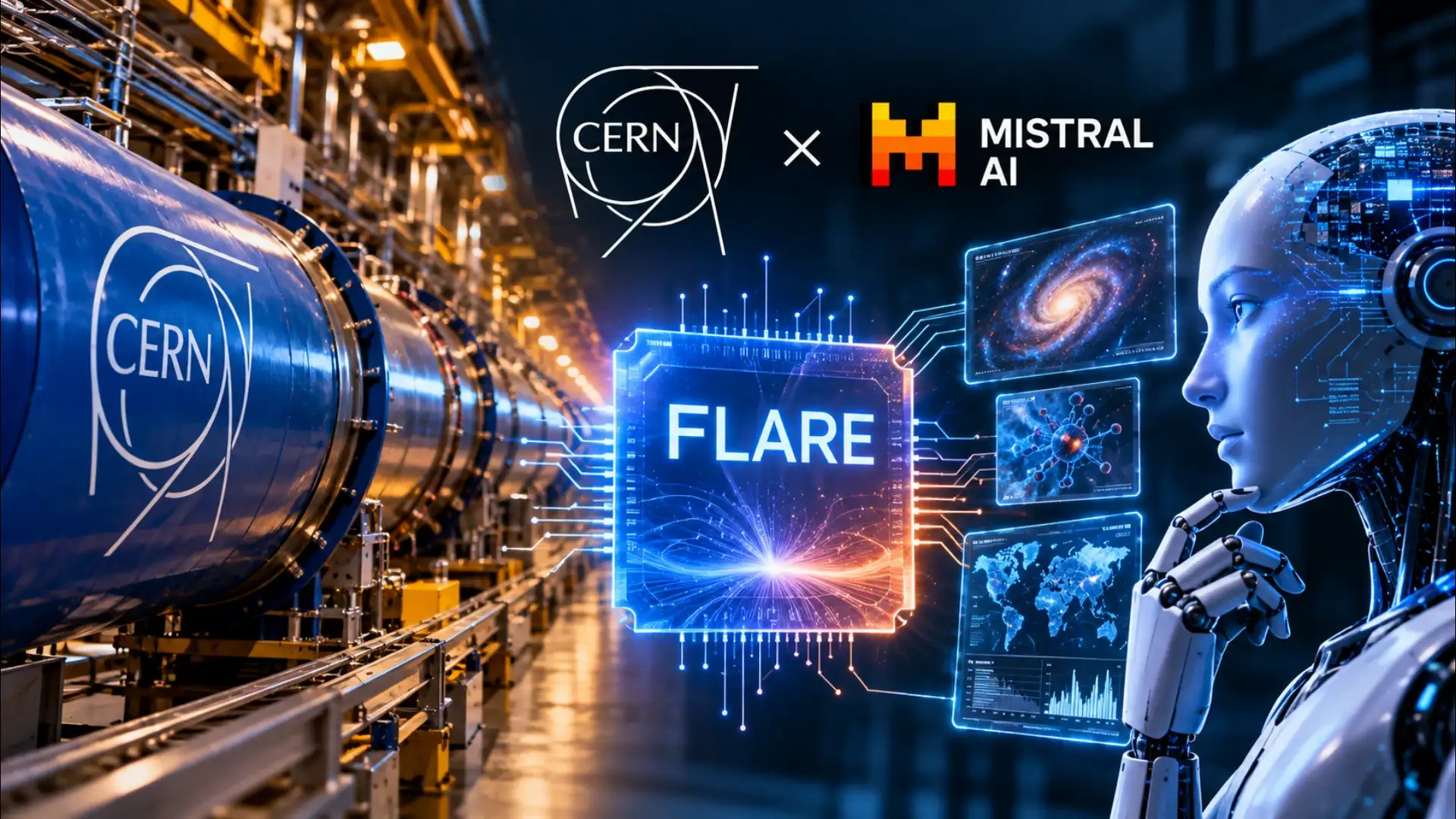
A new partnership between CERN, the European particle physics research centre, and French AI company Mistral AI brings that possibility into focus. Announced on 15 October 2026, the collaboration aims to develop a model called Flare for collider physics. Rather than learning primarily from ordinary text, the proposed system will be trained on simulated particle collisions.
CERN and Mistral plan to train it using billions of simulated particle collisions. These simulations provide examples of the complex events that researchers investigate using particle accelerators.
Large language models learn patterns from text. Flare's proposed approach applies a related idea to scientific data, potentially helping researchers recognise relationships in particle collision events.
The partners aim to create a system that could replace some specialised algorithms currently used to reconstruct and identify particles. However, the model is still under development, and its performance in practical research remains to be demonstrated.
CERN holds approximately one exabyte of experimental data from the Large Hadron Collider. That is equivalent to roughly one million terabytes. The volume of collision data is expected to increase substantially following an upgrade anticipated around 2030.
Processing such information requires sophisticated computing systems and specialised analysis tools.
AI could potentially help researchers identify useful patterns, accelerate parts of data analysis and reduce the need to maintain separate models for individual steps. Scientists would still need to validate the findings against established physics and experimental evidence.
Scientific fields such as astronomy, materials science and biology also generate large, complex datasets. A specialised model that learns meaningful relationships within scientific data could eventually inspire similar approaches elsewhere.
However, transferring a model between disciplines is not straightforward. Each field has different data structures, standards and requirements for accuracy.
The project is promising because it explores a more specialised approach to scientific AI. Its real value will depend on whether researchers can demonstrate accurate, reproducible results and share useful capabilities with the wider scientific community.
A new partnership between CERN, the European particle physics research centre, and French AI company Mistral AI brings that possibility into focus. Announced on 15 October 2026, the collaboration aims to develop a model called Flare for collider physics. Rather than learning primarily from ordinary text, the proposed system will be trained on simulated particle collisions.
What Is the Flare AI Model ?
Flare is intended to be a foundation model for scientific discovery, with an initial focus on high-energy particle physics.CERN and Mistral plan to train it using billions of simulated particle collisions. These simulations provide examples of the complex events that researchers investigate using particle accelerators.
Large language models learn patterns from text. Flare's proposed approach applies a related idea to scientific data, potentially helping researchers recognise relationships in particle collision events.
The partners aim to create a system that could replace some specialised algorithms currently used to reconstruct and identify particles. However, the model is still under development, and its performance in practical research remains to be demonstrated.
Why Does CERN Need AI?
The scale of scientific data is a major challenge.CERN holds approximately one exabyte of experimental data from the Large Hadron Collider. That is equivalent to roughly one million terabytes. The volume of collision data is expected to increase substantially following an upgrade anticipated around 2030.
Processing such information requires sophisticated computing systems and specialised analysis tools.
You may also like
- Jack Dorsey's $32 million mansion renovation has been dragging on for 14 years; and his neighbors are fed up
- Google co-founder Sergey Brin says company's AI is helping build its own successors, hinting 'no slowing down' of AI development
- Some Accenture employees spent $1,000 a month on Anthropic's Claude AI, the company will now pay only $29; memo warns: All costs are...
- Explained: What is CNAP, government's new Caller Name Display Service, becoming mandatory from November 1; how it works and all you need to know
- Krafton launches Battlin app to make BGMI tournaments easier to find, join and host: All details
AI could potentially help researchers identify useful patterns, accelerate parts of data analysis and reduce the need to maintain separate models for individual steps. Scientists would still need to validate the findings against established physics and experimental evidence.
Could Flare Benefit Other Scientific Fields?
The partnership could have implications beyond particle physics if its methods prove effective.Scientific fields such as astronomy, materials science and biology also generate large, complex datasets. A specialised model that learns meaningful relationships within scientific data could eventually inspire similar approaches elsewhere.
However, transferring a model between disciplines is not straightforward. Each field has different data structures, standards and requirements for accuracy.
What Happens Next?
CERN and Mistral have not announced a detailed development timeline or budget for Flare.The project is promising because it explores a more specialised approach to scientific AI. Its real value will depend on whether researchers can demonstrate accurate, reproducible results and share useful capabilities with the wider scientific community.






Loving Newspoint? Download the app now
