
In 1962, Shackleton's last ship sank in the icy North Atlantic; now the first images show Quest is badly damaged but thriving as a marine habitat


Sixty years after its disappearance into the icy depths of the Labrador Sea, Quest , the last vessel linked to Sir Ernest Shackleton , the legendary Antarctic explorer, has been spotted with unprecedented clarity. Using underwater cameras, an international team of scientists has taken high-resolution pictures and three-dimensional images of the wreckage of this iconic ship, a ship that has been ravaged by time but now serves as an undersea haven for marine life . This mission also sheds light on how shipwrecks can support marine ecosystems.
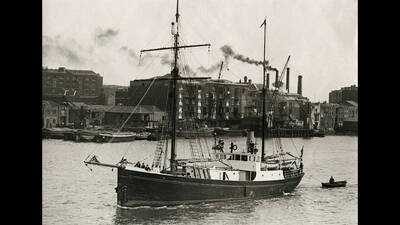
Sir Ernest Shackleton is best known for his remarkable leadership during the ill-fated Endurance expedition, where he successfully led his entire crew to safety despite the ship being crushed by Antarctic ice. Less well known, however, is Quest, the vessel used during Shackleton's final expedition. After serving in several polar voyages, Quest returned to commercial service as a sealing ship in the North Atlantic. The vessel remained in operation for decades before becoming trapped in heavy ice off the coast of Labrador and sinking in 1962, marking the end of its long and eventful career.
A historic ship beneath the sea
Quest was built in Norway in 1917 and bought by Ernest Shackleton for the 1921-22 Shackleton-Rowett Expedition, his last voyage to Antarctica. Although the expedition was unsuccessful scientifically because Shackleton died at South Georgia in January 1922, Quest remained closely linked to his name.
According to a report published in Polar Record by Cambridge University Press, Quest returned to service as a sealing vessel after Shackleton's expedition and was lost on 5 May 1962 after being crushed by heavy ice off Labrador. The wreck was later confirmed to lie at a depth of about 390 metres.
However, recent advances in underwater robotics have added to the information. Remote-operated vehicles with ultra-high-definition cameras, laser scanners, and an advanced navigation system were used by scientists to document the wreck in remarkable detail. The images showed that, although much of the wooden structure has collapsed and parts of the hull are badly deteriorated, features such as portholes, deck fittings and sections of the steel structure remain visible. Marine archaeological research increasingly supports non-invasive digital documentation for studying historically significant shipwrecks.
When shipwrecks become underwater ecosystems
One of the most unexpected discoveries by the team was not necessarily the ship itself, but rather how much life had managed to make its home within the hull of the ship. Despite the considerable damage the Quest suffered during its fall to the seabed, the ship has become a sort of artificial reef for various kinds of marine organisms, including corals, sponges, sea anemones, crustaceans, and many different fish species.
This phenomenon is seen in many oceans. When a ship reaches the seabed, it can become a habitat for micro-organisms, invertebrates, and other organisms that need shelter. Many organisms can live on a wreck, and in some cases, their numbers may exceed those on the adjacent seabed. Some of the scientists found marine life settled in abandoned nets near parts of the ship. Despite the disturbance, marine life is still present around the Quest wreck.
Some studies suggest that historic shipwrecks can function as biodiversity hotspots. Perkol-Finkel and Benayahu (2007) found that artificial marine structures, including shipwrecks, often develop ecological communities comparable to those found on natural reefs, providing habitat for numerous species while enhancing local marine biodiversity.

Preserving history beneath the waves
The latest photos of Quest arrive amid ongoing interest in underwater cultural heritage. Modern technology now makes it possible to study ancient wrecks with amazing accuracy, allowing researchers to create digital records that can be analysed while leaving the delicate archaeological site intact. This is especially useful in the case of wooden shipwrecks, which can be dependent upon delicate environmental conditions that may become altered due to increased ocean temperatures and human interaction.
Sir Ernest Shackleton is best known for his remarkable leadership during the ill-fated Endurance expedition, where he successfully led his entire crew to safety despite the ship being crushed by Antarctic ice. Less well known, however, is Quest, the vessel used during Shackleton's final expedition. After serving in several polar voyages, Quest returned to commercial service as a sealing ship in the North Atlantic. The vessel remained in operation for decades before becoming trapped in heavy ice off the coast of Labrador and sinking in 1962, marking the end of its long and eventful career.
A historic ship beneath the sea
Quest was built in Norway in 1917 and bought by Ernest Shackleton for the 1921-22 Shackleton-Rowett Expedition, his last voyage to Antarctica. Although the expedition was unsuccessful scientifically because Shackleton died at South Georgia in January 1922, Quest remained closely linked to his name.
According to a report published in Polar Record by Cambridge University Press
However, recent advances in underwater robotics have added to the information. Remote-operated vehicles with ultra-high-definition cameras, laser scanners, and an advanced navigation system were used by scientists to document the wreck in remarkable detail. The images showed that, although much of the wooden structure has collapsed and parts of the hull are badly deteriorated, features such as portholes, deck fittings and sections of the steel structure remain visible. Marine archaeological research increasingly supports non-invasive digital documentation for studying historically significant shipwrecks.
When shipwrecks become underwater ecosystems
One of the most unexpected discoveries by the team was not necessarily the ship itself, but rather how much life had managed to make its home within the hull of the ship. Despite the considerable damage the Quest suffered during its fall to the seabed, the ship has become a sort of artificial reef for various kinds of marine organisms, including corals, sponges, sea anemones, crustaceans, and many different fish species.
This phenomenon is seen in many oceans. When a ship reaches the seabed, it can become a habitat for micro-organisms, invertebrates, and other organisms that need shelter. Many organisms can live on a wreck, and in some cases, their numbers may exceed those on the adjacent seabed. Some of the scientists found marine life settled in abandoned nets near parts of the ship. Despite the disturbance, marine life is still present around the Quest wreck.
Some studies suggest that historic shipwrecks can function as biodiversity hotspots. Perkol-Finkel and Benayahu (2007) found that artificial marine structures, including shipwrecks, often develop ecological communities comparable to those found on natural reefs, providing habitat for numerous species while enhancing local marine biodiversity.
Preserving history beneath the waves
The latest photos of Quest arrive amid ongoing interest in underwater cultural heritage. Modern technology now makes it possible to study ancient wrecks with amazing accuracy, allowing researchers to create digital records that can be analysed while leaving the delicate archaeological site intact. This is especially useful in the case of wooden shipwrecks, which can be dependent upon delicate environmental conditions that may become altered due to increased ocean temperatures and human interaction.
Next Story