
Indian scientists predict Sun's corona for Europe eclipse


BENGALURU: Indian solar physicists have predicted the structure of the Sun's million-degree corona ahead of the total solar eclipse that will sweep across parts of Europe on August 12.
The team, led by the Raman Research Institute (RRI), has forecast multiple large-scale, petal-like structures and elongated streamers in the Sun's outer atmosphere. The prediction is based on two distinct computational models of the Sun's magnetic field, using solar observations available up to August 10.
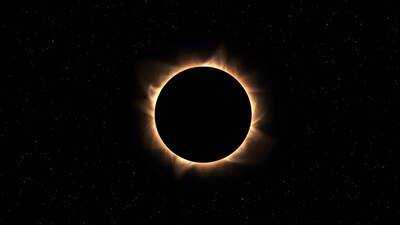
The eclipse will begin at 9:04 pm IST on August 12 and will not be visible from India as it will occur during the night here. The Moon's shadow will cover the Sun for two minutes and 18 seconds. Much of Spain will experience totality, while western Europe, parts of northwestern Africa and some parts of the US will see a partial eclipse.
Scientists study the corona during eclipses because it is normally difficult to observe. The corona is much fainter than the Sun's visible surface, but when the Moon blocks the solar disk during an eclipse, its structures become visible. Outside eclipses, scientists rely on coronagraphs, artificial disks that block out the Sun's glare, such as those aboard India's Aditya-L1 satellite and the European Space Agency's SOHO and Proba-3 missions, the latter of which was launched by ISRO.
Understanding the corona is important because changes in its magnetic field can trigger solar flares, solar storms and coronal mass ejections (CMEs). These eruptions send energy and charged particles towards Earth and can disrupt satellites, communications, GPS networks and power systems. They can also expose astronauts to increased radiation.
RRI senior professor Dibyendu Nandi's group is one of about five research teams in India, the US and Europe with the modelling capabilities to make such predictions. The group has made similar predictions for previous eclipses.
For the 2026 eclipse, the team used a data-driven model with a memory extending over several years to predict the Sun's surface magnetic field on August 12. The model was then used to forecast the magnetic structure of the corona.
"Calibrating the model with past solar observations is essential to obtain accurate estimations," Nandi said. "We strive to continuously improve our models by comparing our simulated predictions with observations, the best test for any theoretical model."
The scientists will compare the prediction with observations during the eclipse. Such comparisons can help improve models of solar magnetism and, ultimately, the ability to forecast space weather events that can affect Earth and space-based technologies. The team, led by Nandi, includes Sagnik Saha from RRI, Priyansh Jaswal from the Center of Excellence in Space Sciences India at IISER Kolkata, Shaonwita Pal from the Indian Institute of Astrophysics and the Department of Technical Education and Skill Development, Government of West Bengal, Soumyaranjan Dash from the US National Solar Observatory, and Chitradeep Saha from the University of Reading, UK.
The team, led by the Raman Research Institute (RRI), has forecast multiple large-scale, petal-like structures and elongated streamers in the Sun's outer atmosphere. The prediction is based on two distinct computational models of the Sun's magnetic field, using solar observations available up to August 10.
The eclipse will begin at 9:04 pm IST on August 12 and will not be visible from India as it will occur during the night here. The Moon's shadow will cover the Sun for two minutes and 18 seconds. Much of Spain will experience totality, while western Europe, parts of northwestern Africa and some parts of the US will see a partial eclipse.
Scientists study the corona during eclipses because it is normally difficult to observe. The corona is much fainter than the Sun's visible surface, but when the Moon blocks the solar disk during an eclipse, its structures become visible. Outside eclipses, scientists rely on coronagraphs, artificial disks that block out the Sun's glare, such as those aboard India's Aditya-L1 satellite and the European Space Agency's SOHO and Proba-3 missions, the latter of which was launched by ISRO.
Understanding the corona is important because changes in its magnetic field can trigger solar flares, solar storms and coronal mass ejections (CMEs). These eruptions send energy and charged particles towards Earth and can disrupt satellites, communications, GPS networks and power systems. They can also expose astronauts to increased radiation.
RRI senior professor Dibyendu Nandi's group is one of about five research teams in India, the US and Europe with the modelling capabilities to make such predictions. The group has made similar predictions for previous eclipses.
For the 2026 eclipse, the team used a data-driven model with a memory extending over several years to predict the Sun's surface magnetic field on August 12. The model was then used to forecast the magnetic structure of the corona.
"Calibrating the model with past solar observations is essential to obtain accurate estimations," Nandi said. "We strive to continuously improve our models by comparing our simulated predictions with observations, the best test for any theoretical model."
The scientists will compare the prediction with observations during the eclipse. Such comparisons can help improve models of solar magnetism and, ultimately, the ability to forecast space weather events that can affect Earth and space-based technologies. The team, led by Nandi, includes Sagnik Saha from RRI, Priyansh Jaswal from the Center of Excellence in Space Sciences India at IISER Kolkata, Shaonwita Pal from the Indian Institute of Astrophysics and the Department of Technical Education and Skill Development, Government of West Bengal, Soumyaranjan Dash from the US National Solar Observatory, and Chitradeep Saha from the University of Reading, UK.
Next Story