
iPhone designer Jony Ive's first full car is the electric Ferrari Luce


The Luce, unveiled at Rome's Vela di Calatrava, is the most visible work yet to come out of LoveFrom—the design collective Jony Ive—the main who designed the iPhone—set up after leaving Apple in 2019, with longtime collaborator Marc Newson. Chairman John Elkann said he first approached the pair after watching what they'd done with the Apple Watch, which he called "probably the most successful example" of an analog product going digital without losing the plot. He wanted that same trick pulled on a car.
Starting price in Italy is €550,000, roughly $640,000. US pricing is still TBD. First deliveries begin this autumn. American cars land in spring 2027.
A Ferrari that doesn't look like one
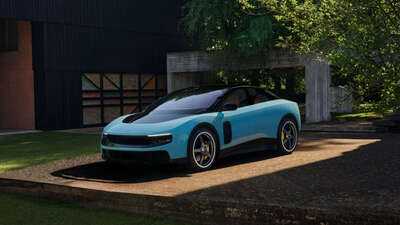
The exterior is where the fight will start. The Luce is a five-seater—a Ferrari first—with four doors, the rear pair hinged backwards. The upper half is mostly glass, supplied by Corning. Retractable handles hide the second set of doors entirely. The four round taillights, a Ferrari signature since the 1960s, sit invisible behind a black panel until you switch the car on.
"It doesn't look like what you would imagine a sports car to be," Elkann said at the launch. Chief design officer Flavio Manzoni has admitted the response is polarising, but reckons people will warm to it.
A Jony Ive interior that still has switches
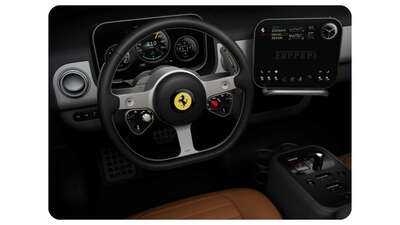
Inside is where the LoveFrom thinking really lands. Two Samsung OLED screens. A centre touchscreen that swivels towards the driver. Instrument gauges that look analog but aren't. Standard Ive vocabulary.
What's interesting is what he chose not to do. He didn't bury the controls in a touchscreen. The gear selector is a physical piece of glass. The window switches stayed. So did the drive mode toggles and a row of dials that would feel familiar in any older Ferrari. Elkann framed this as a deliberate correction. "As a car becomes electric, it doesn't mean it needs to be a consumer electronics object," he told reporters, calling that one of the auto industry's biggest mistakes over the past decade.
The hardware does the badge justice. Four motors, one per wheel, putting out a combined 1,035 horsepower. Ferrari claims 0 to 60 mph in under 2.5 seconds and a 193 mph top speed. The 122-kWh battery runs on an 800-volt architecture and charges at up to 350 kW. WLTP range is around 330 miles—probably closer to 280 on the EPA cycle.
Even the soundtrack got the LoveFrom treatment. Rather than piping in a fake engine note, Ferrari fitted an acoustic pickup to the rear axle. It samples actual vibrations from the motors and amplifies them into the cabin. The company likens it to an electric guitar amp. Analog signal in, performance out.
Starting price in Italy is €550,000, roughly $640,000. US pricing is still TBD. First deliveries begin this autumn. American cars land in spring 2027.
A Ferrari that doesn't look like one
The exterior is where the fight will start. The Luce is a five-seater—a Ferrari first—with four doors, the rear pair hinged backwards. The upper half is mostly glass, supplied by Corning. Retractable handles hide the second set of doors entirely. The four round taillights, a Ferrari signature since the 1960s, sit invisible behind a black panel until you switch the car on.
"It doesn't look like what you would imagine a sports car to be," Elkann said at the launch. Chief design officer Flavio Manzoni has admitted the response is polarising, but reckons people will warm to it.
A Jony Ive interior that still has switches
Inside is where the LoveFrom thinking really lands. Two Samsung OLED screens. A centre touchscreen that swivels towards the driver. Instrument gauges that look analog but aren't. Standard Ive vocabulary.
What's interesting is what he chose not to do. He didn't bury the controls in a touchscreen. The gear selector is a physical piece of glass. The window switches stayed. So did the drive mode toggles and a row of dials that would feel familiar in any older Ferrari. Elkann framed this as a deliberate correction. "As a car becomes electric, it doesn't mean it needs to be a consumer electronics object," he told reporters, calling that one of the auto industry's biggest mistakes over the past decade.
The hardware does the badge justice. Four motors, one per wheel, putting out a combined 1,035 horsepower. Ferrari claims 0 to 60 mph in under 2.5 seconds and a 193 mph top speed. The 122-kWh battery runs on an 800-volt architecture and charges at up to 350 kW. WLTP range is around 330 miles—probably closer to 280 on the EPA cycle.
Even the soundtrack got the LoveFrom treatment. Rather than piping in a fake engine note, Ferrari fitted an acoustic pickup to the rear axle. It samples actual vibrations from the motors and amplifies them into the cabin. The company likens it to an electric guitar amp. Analog signal in, performance out.
Next Story