
Rise of Sarvam AI as India's voice in global AI policy talks


The highlight story of this year’s India AI Summit was probably neither the world’s top tech CEOs flying into New Delhi, nor the scale of business deals announced at its sidelines, and not even the star-studded interviews with Silicon Valley's biggest names. For India, the most distinctive story was Sarvam AI – and the praise it drew from the very leaders who run the world’s most powerful AI companies. Google CEO Sundar Pichai, speaking at the India AI Impact Summit 2026 in February, said he was ‘impressed’ by Sarvam’s progress in building foundational models designed specifically for Indian languages and real-world use cases. For a three-year-old startup out of Bengaluru, that endorsement meant something.
What is Sarvam AI and its story
Sarvam AI was founded in August 2023 – months after ChatGPT was released – by Vivek Raghavan and Pratyush Kumar, who were previously associated with AI4Bharat at the Indian Institute of Technology Madras. Raghavan had an IIT Delhi degree, a PhD from Carnegie Mellon, and a vice president role at a chip design firm. He walked into the Unique Identification Authority of India and offered to help build Aadhaar's biometric systems for free, staying for twelve years. Kumar, meanwhile, spent years building open-source AI datasets for Indian languages. They shared a vision that AI, to work for India, had to be built in India.
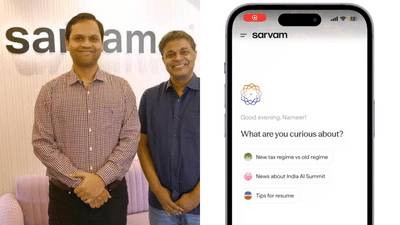
In December 2023, the company announced a seed and Series A funding round of approximately $41 million, led by Lightspeed Venture Partners, with participation from Peak XV Partners and Khosla Ventures. Then, in April 2025, the Ministry of Electronics and Information Technology (MEITY) selected Sarvam AI as one of the companies to develop an indigenous foundational model under the IndiaAI Mission. The government also provided access to computing infrastructure, including GPUs allocated for model training.
And just last week, the company made reached a milestone by becoming India’s newest unicorn, raising $234 million in the first close of a $300 million Series B at a $1.5 billion valuation, led by HCLTech with $150 million, alongside Bessemer Venture Partners.
What exactly has Sarvam built that merits all this attention
The answer to this lies in a problem most global AI companies have not taken up. The founders noticed that global AI models were highly inefficient at processing Indian scripts, making AI expensive and slow for Indian users. Sarvam’s entire architecture is an attempt to solve that at the foundational level, not patch over it.
At the India AI Impact Summit 2026, Sarvam launched a new generation of large language models, including 30-billion and 105-billion parameter models using a mixture-of-experts architecture, as well as text-to-speech, speech-to-text, and vision models. The 105-billion parameter model, named Indus, was released as a beta on February 20 and is now available on the App Store, Google Play and the web.
Built specifically for Indian users, it can understand regional accents, slang, and cultural nuances that global models routinely miss, and allows seamless switching between English and Indic languages like Hindi, Tamil or Bengali.
Add to this the Sarvam Vision, the company’s optical character recognition model. As per the official Sarvam blog, it scored 84.3% accuracy on olmOCR-Bench, surpassing Gemini 3 Pro and DeepSeek OCR v2, and an even higher 93.28% on OmniDocBench v1.5. olmOCR-Bench is a comprehensive benchmark that evaluates OCR systems on diverse, real-world document layouts with challenging structures
Sarvam also announced partnerships with Qualcomm for generative AI solutions and with German company Bosch to bring AI onto car panels. The company also introduced the Kaze smartglasses, its first hardware product, which Prime Minister Modi tested at the summit’s expo. The device supports more than ten Indian languages.
Why SarvamAI makes more sense for India now
What is Sarvam AI and its story
Sarvam AI was founded in August 2023 – months after ChatGPT was released – by Vivek Raghavan and Pratyush Kumar, who were previously associated with AI4Bharat at the Indian Institute of Technology Madras. Raghavan had an IIT Delhi degree, a PhD from Carnegie Mellon, and a vice president role at a chip design firm. He walked into the Unique Identification Authority of India and offered to help build Aadhaar's biometric systems for free, staying for twelve years. Kumar, meanwhile, spent years building open-source AI datasets for Indian languages. They shared a vision that AI, to work for India, had to be built in India.
In December 2023, the company announced a seed and Series A funding round of approximately $41 million, led by Lightspeed Venture Partners, with participation from Peak XV Partners and Khosla Ventures. Then, in April 2025, the Ministry of Electronics and Information Technology (MEITY) selected Sarvam AI as one of the companies to develop an indigenous foundational model under the IndiaAI Mission. The government also provided access to computing infrastructure, including GPUs allocated for model training.
And just last week, the company made reached a milestone by becoming India’s newest unicorn, raising $234 million in the first close of a $300 million Series B at a $1.5 billion valuation, led by HCLTech with $150 million, alongside Bessemer Venture Partners.
What exactly has Sarvam built that merits all this attention
The answer to this lies in a problem most global AI companies have not taken up. The founders noticed that global AI models were highly inefficient at processing Indian scripts, making AI expensive and slow for Indian users. Sarvam’s entire architecture is an attempt to solve that at the foundational level, not patch over it.
At the India AI Impact Summit 2026, Sarvam launched a new generation of large language models, including 30-billion and 105-billion parameter models using a mixture-of-experts architecture, as well as text-to-speech, speech-to-text, and vision models. The 105-billion parameter model, named Indus, was released as a beta on February 20 and is now available on the App Store, Google Play and the web.
Built specifically for Indian users, it can understand regional accents, slang, and cultural nuances that global models routinely miss, and allows seamless switching between English and Indic languages like Hindi, Tamil or Bengali.
Add to this the Sarvam Vision, the company’s optical character recognition model. As per the official Sarvam blog, it scored 84.3% accuracy on olmOCR-Bench, surpassing Gemini 3 Pro and DeepSeek OCR v2, and an even higher 93.28% on OmniDocBench v1.5. olmOCR-Bench is a comprehensive benchmark that evaluates OCR systems on diverse, real-world document layouts with challenging structures
Sarvam also announced partnerships with Qualcomm for generative AI solutions and with German company Bosch to bring AI onto car panels. The company also introduced the Kaze smartglasses, its first hardware product, which Prime Minister Modi tested at the summit’s expo. The device supports more than ten Indian languages.
Why SarvamAI makes more sense for India now
Next Story