
Scientists build a jacket that harvests nearly 1 litre of clean drinking water straight from the air


Access to clean drinking water is one of the most pressing challenges of our time, and scientists have now found an unusually wearable solution to it. Engineers at the University of Texas at Austin have developed a prototype jacket that harvests drinking water directly from the air around it, using a specially engineered textile that absorbs atmospheric moisture and converts it into clean, drinkable water through a simple heating process. In real world field tests conducted across multiple climates, the jacket produced between 400 and 900 millilitres of drinkable water per day depending on local humidity conditions, performing at a level that is three to ten times better than many existing atmospheric water harvesting materials at comparable scale. The research was published in Science Advances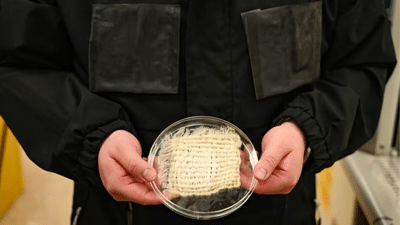 by a team led by Professor Guihua Yu of the Walker Department of Mechanical Engineering and the Texas Materials Institute.
How the water harvesting jacket actually works
At the heart of the jacket is a biomass derived hydrogel fibre that has been engineered to do something most water harvesting materials struggle with at scale, not just absorb moisture from the air but actively transport it through the fabric in a controlled and efficient pathway. Professor Keith Johnston, co-author of the study, explained that the key advance was that the team did not simply build another material that absorbs water. Instead they designed a complete pathway for water to move through the system, progressing from vapour in the surrounding air, to liquid on the fibre surface, and then into the textile's internal structure, which is precisely what allows the material to function effectively as a wearable garment rather than remaining confined to a small laboratory sample or a rigid stationary device. Once the detachable harvesting units embedded in the jacket fill up with captured moisture, they are removed and placed inside a compact foldable collector, where a simple heating step releases the trapped water in drinkable form.
Field testing across climates proved the technology works outside the lab
The research team took the jacket beyond controlled laboratory conditions, running outdoor trials in Austin, Texas, and at two additional sites in China, including a dry and remote location well away from any conventional water infrastructure. Across all three locations and their varying levels of humidity, the jacket consistently produced between 14 and 30 ounces of drinkable water per day, equivalent to roughly one to two standard water bottles pulled entirely from the surrounding air. Crucially, the water that came out of the process was found to be very clean, carrying only trace levels of residual lithium from the harvesting material while meeting World Health Organization standards for potable drinking water, meaning it could be consumed safely on the spot without any additional purification steps.
A companion device set a new world record for atmospheric water harvesting
Running alongside the jacket research, the same University of Texas team published a second simultaneous study in Nature Water describing a separate portable solar-powered atmospheric water harvesting device built around a related gel fabric architecture. That device was tested in the hot, arid conditions of the Chihuahuan Desert of New Mexico as well as in the comparatively humid environment of Austin, and it captured 1.3 litres of clean water per day across both locations, translating to 4.3 litres of water per kilogram of moisture capturing material per day, a figure that the researchers say exceeds anything previously reported by any other research group in the field. Lead study author Weixin Guan described the result as a major stride toward practical atmospheric water harvesting at a scale that could make a genuine difference in real communities.
How the water harvesting jacket actually works
At the heart of the jacket is a biomass derived hydrogel fibre that has been engineered to do something most water harvesting materials struggle with at scale, not just absorb moisture from the air but actively transport it through the fabric in a controlled and efficient pathway. Professor Keith Johnston, co-author of the study, explained that the key advance was that the team did not simply build another material that absorbs water. Instead they designed a complete pathway for water to move through the system, progressing from vapour in the surrounding air, to liquid on the fibre surface, and then into the textile's internal structure, which is precisely what allows the material to function effectively as a wearable garment rather than remaining confined to a small laboratory sample or a rigid stationary device. Once the detachable harvesting units embedded in the jacket fill up with captured moisture, they are removed and placed inside a compact foldable collector, where a simple heating step releases the trapped water in drinkable form.
Field testing across climates proved the technology works outside the lab
The research team took the jacket beyond controlled laboratory conditions, running outdoor trials in Austin, Texas, and at two additional sites in China, including a dry and remote location well away from any conventional water infrastructure. Across all three locations and their varying levels of humidity, the jacket consistently produced between 14 and 30 ounces of drinkable water per day, equivalent to roughly one to two standard water bottles pulled entirely from the surrounding air. Crucially, the water that came out of the process was found to be very clean, carrying only trace levels of residual lithium from the harvesting material while meeting World Health Organization standards for potable drinking water, meaning it could be consumed safely on the spot without any additional purification steps.
A companion device set a new world record for atmospheric water harvesting
Running alongside the jacket research, the same University of Texas team published a second simultaneous study in Nature Water describing a separate portable solar-powered atmospheric water harvesting device built around a related gel fabric architecture. That device was tested in the hot, arid conditions of the Chihuahuan Desert of New Mexico as well as in the comparatively humid environment of Austin, and it captured 1.3 litres of clean water per day across both locations, translating to 4.3 litres of water per kilogram of moisture capturing material per day, a figure that the researchers say exceeds anything previously reported by any other research group in the field. Lead study author Weixin Guan described the result as a major stride toward practical atmospheric water harvesting at a scale that could make a genuine difference in real communities.
Next Story