
How UPI Moves Money Between Two Different Banks in Seconds

Every UPI payment crosses at least four separate systems in the time it takes to blink. The sender's bank, the receiver's bank, the app sitting on your phone, and a central switch run by the National Payments Corporation of India all talk to each other in a single choreographed sequence. None of them holds the money for even a moment longer than necessary.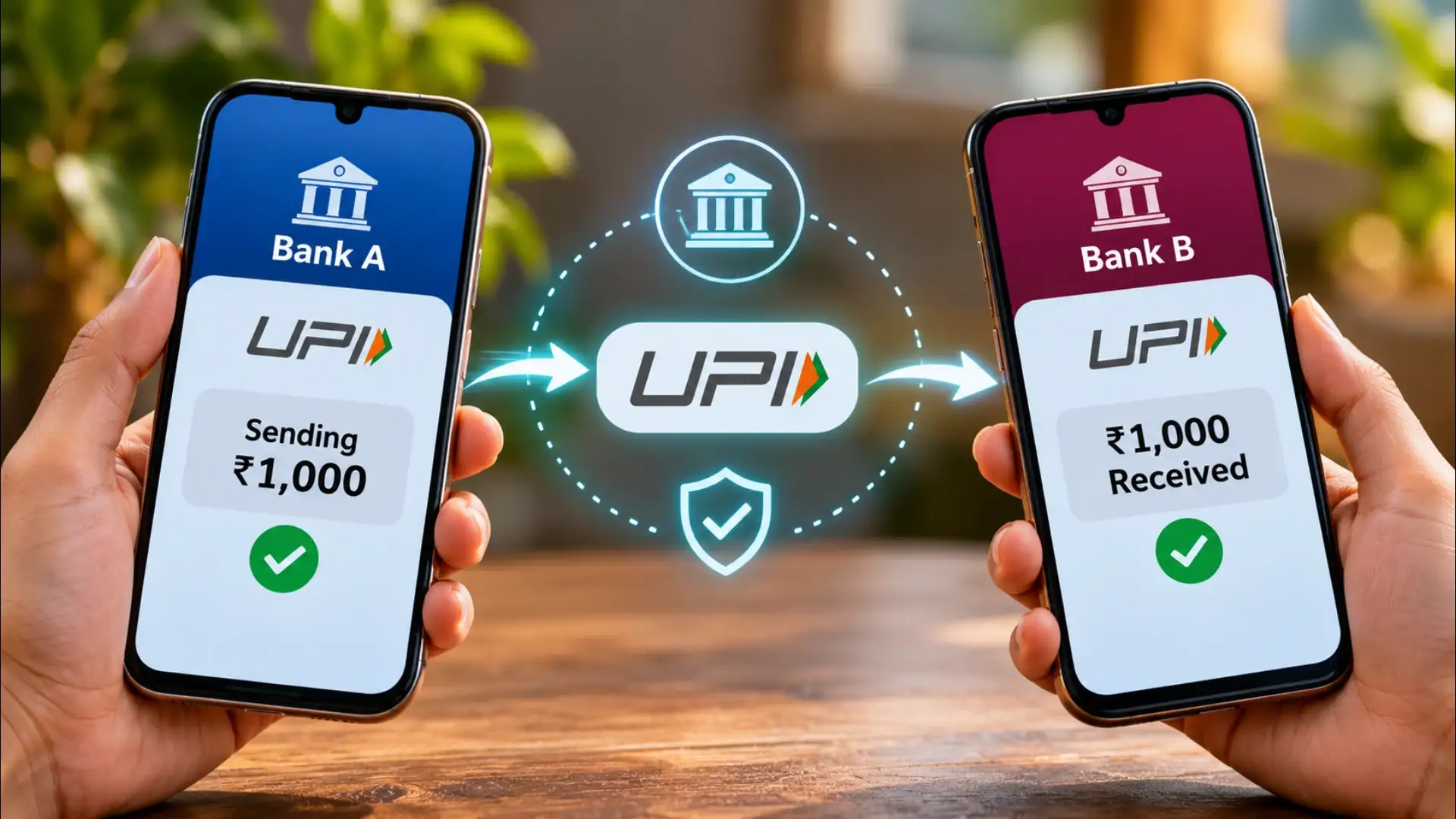
The four-way conversation between app, sender's bank, NPCI, and receiver's bank happens so fast because each party is doing exactly one job. No single institution has to understand the whole picture. The sender's bank checks your balance and authorises the debit. The receiver's bank confirms the credit. NPCI matches the two. The app shows you the result. When the chain works, it is invisible. When one link slows down, the whole chain stops and rewinds rather than leaving money stranded in the middle.
The Address That Replaces Your Account Number
When you send money to a VPA, a Virtual Payment Address like name@bankname, you are not typing an account number or an IFSC code. The VPA is a pointer. NPCI's central directory resolves it into the actual account details behind the scenes, so neither party ever needs to share their real banking credentials with the other. The VPA lookup happens before any money moves, and it happens in milliseconds.What the NPCI Switch Actually Does
NPCI acts as the central router between all participating banks. When your bank receives your payment instruction, it sends a request to the NPCI switch. The switch identifies which bank holds the destination account, forwards the debit instruction to your bank and the credit instruction to the destination bank simultaneously, and collects a confirmation from both. If either bank cannot confirm, the switch rolls the transaction back. The switch does not hold your money at any point. It only passes instructions and waits for acknowledgements.You may also like
- Elon Musk's AI company is reportedly targeting 418 homes near its Mississippi data center, with buyout offers tied to waiving noise-lawsuit claims; county records show five purchases since October 9
- Big relief for Assam farmers as govt approves Guwahati airport as export point for agarwood chips and oil: Piyush Goyal
- OnePlus 16 vs OPPO Find X10: Camera, Performance, Battery and Price Compared
- Tech Hacks: Do old WhatsApp chats disappear when you get a new phone? Try this simple method to recover all your data in an instant
- Redmi Note 15 SE 5G Launched in India: Check Price, Discounts, 5,800mAh Battery, AMOLED Display and Camera Features
Why the Settlement Happens Instantly
UPI runs on a system called IMPS, Immediate Payment Service, as its settlement backbone. Unlike older transfer systems that batched transactions and settled them at fixed times during the banking day, IMPS settles each transaction individually and in real time, around the clock. The actual movement of funds between the two banks happens through RBI's real-time gross settlement infrastructure in the background. From the user's perspective, the confirmation arrives in seconds because the debit and credit are confirmed before the app closes the transaction screen.The Role of the PSP App on Your Phone
The app you use, whether it is a bank's own app or a third-party app, is called a PSP, a Payment Service Provider. It initiates the request and collects your UPI PIN, but it never sees your full account details and never touches the money. Your PIN is encrypted on your device using a key issued by your bank. The PSP forwards the encrypted instruction to your bank, which is the only entity that decrypts and verifies it. This is why a UPI PIN works even on a third-party app without that app having any access to your account.What Happens When a Transaction Fails
A UPI failure almost always happens at one of three points: the VPA lookup returns no result, one of the two banks does not respond within the timeout window, or the debit confirmation and credit confirmation do not both arrive before the switch closes the request. In each case, the switch marks the transaction as failed and triggers an automatic reversal. A debit that goes through without a corresponding credit gets reversed, typically within a few minutes, because the switch holds a record of every unmatched debit and reconciles them on a short cycle. The money does not disappear; it waits in a suspense state until the reversal completes.The four-way conversation between app, sender's bank, NPCI, and receiver's bank happens so fast because each party is doing exactly one job. No single institution has to understand the whole picture. The sender's bank checks your balance and authorises the debit. The receiver's bank confirms the credit. NPCI matches the two. The app shows you the result. When the chain works, it is invisible. When one link slows down, the whole chain stops and rewinds rather than leaving money stranded in the middle.






Loving Newspoint? Download the app now
