
How Your Phone Recognises Your Face and Tells It Apart from Others

The first time you set up face unlock, your phone does not take a photograph. It builds a map. A dot projector throws thousands of invisible infrared points onto your face, and a separate infrared camera reads how those dots land, closer together where your nose rises, spread wider across your forehead. The result is a depth map, a three-dimensional record of the distances and contours that make your face the shape it is.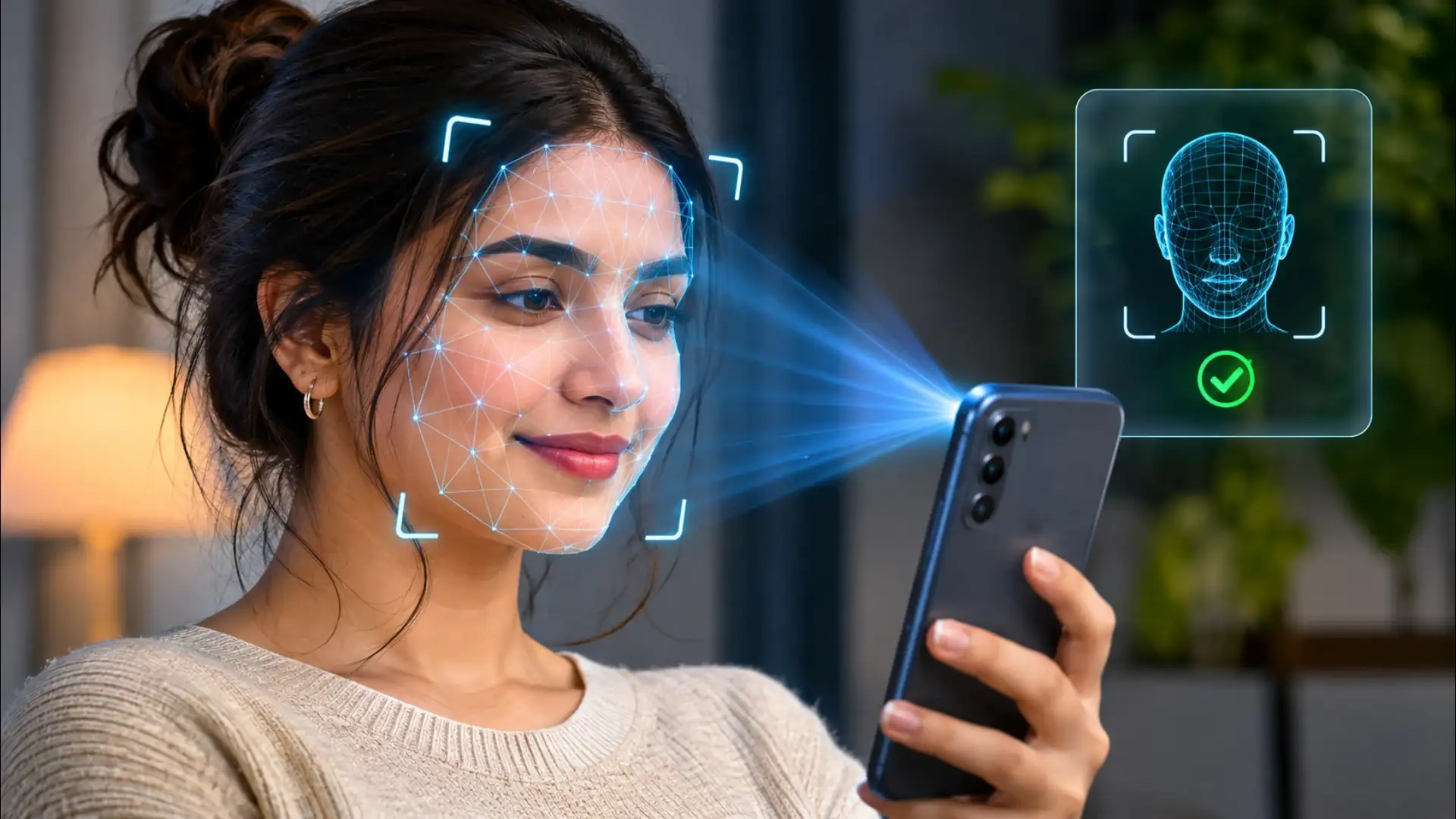
From Light Dots to a Number
A depth map is still just raw geometry. To make it useful, the phone's chip runs it through a neural network, a set of mathematical layers trained on millions of faces. The network does not look for features the way a human would. It does not find your eyes and then your nose. Instead it transforms the whole map into a long string of numbers, called an embedding, where every face produces a different string. Your face's embedding is stored in a secure enclave on the chip, a locked partition that the operating system itself cannot read directly.The Match Happens in Milliseconds
Each time you raise the phone, the dot projector fires again, the camera reads the new depth map, the neural network converts it to a fresh embedding, and the chip compares that embedding to the stored one. It is not looking for an exact copy, no two scans of the same face are identical because light changes, your expression shifts, a few days of beard growth alters the surface. Instead it measures the mathematical distance between the two embeddings. If that distance falls below a threshold the manufacturer sets during calibration, the phone unlocks. If it does not, it stays locked.Why a Photo Cannot Fool It
A printed photograph or a screen showing your face fails because it has no depth. The dot projector reads a flat surface and the depth map comes back wrong, the contours are missing. Higher-end systems add a flood illuminator that checks whether the infrared light bouncing back has the scatter pattern of real skin rather than paper or a screen. Some also use a standard RGB camera alongside the infrared one, running a liveness check that looks for the micro-movements of a breathing, blinking person. A still image has none of those signals.How It Tells You Apart from Everyone Else
The neural network was trained to push different faces far apart in the embedding space and to pull the same face close together across different scans and lighting conditions. Identical twins are the hardest case because their geometry is genuinely similar, and most manufacturers acknowledge that a twin has a higher-than-normal chance of unlocking a sibling's phone. For everyone else, the distance between any two people's embeddings is large enough that the threshold is never crossed. The system is not memorising your face, it is measuring a mathematical gap, and that gap is what keeps strangers out.Where the Data Lives
The embedding never leaves the chip. It does not go to the manufacturer's servers. It is not part of your backup. When you delete face data in settings, the enclave wipes it. The dot-projection hardware and the secure enclave together mean the system is doing something a camera app and a cloud server could not replicate: the measurement, the comparison, and the decision all happen in one locked piece of silicon, in the time it takes you to glance down.Next Story