
When AI writes code, engineers must learn context


AI’s now writing 70-80% of code in many organisations. And if it isn’t there yet in some, it will get there. All humans have to do is give the system a prompt in our language. This phenomenal ability of AI is transforming what’s expected of engineers. And the performance of India’s IT services companies in the coming years will depend a great deal on how they – and the country – are able to help our talent make that transformation.
 That was the broad message from a discussion we had at Nasscom’s People Summit in Bengaluru last week. The message to talent in particular was stark: AI is reducing traditional entry-level roles, because all they did was write code; it’s making domain context more valuable; and students, freshers and middle managers have to rethink how they build careers. What AI is entailing is very different from the tech disruptions of the past – be it internet, mobile phones, or cloud.
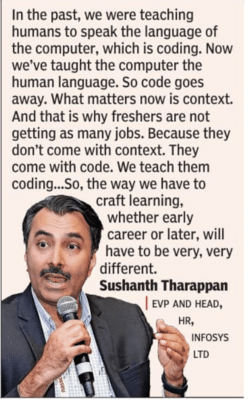
“In the past, we were teaching humans to speak the language of the computer, which is coding,” Sushanth Tharappan, EVP and head of HR at Infosys, said. “Now, we’ve taught the computer the human language. So code goes away. What matters now is context. And that is why freshers are not getting as many jobs. Because they don’t come with context. They come with code…So, the way we have to craft learning, whether early career or later, will have to be very, very different.”
Richard Lobo, chief people officer at Tech Mahindra, noted that AI can reduce coding work that took a week to a few hours. But, he noted, the harder part is to fit that AI-generated work into complex enterprise systems, ensure it works over the long term, and make sure it does not create vulnerabilities. That, he said, involves a lot of work, and many people do not recognise this yet. The IT industry, he said, must learn to orchestrate this new model, and ensure they retain and develop human understanding of system complexity.
For decades, large IT companies hired graduates from multiple engineering streams and trained them in programming. But AI changes the economics of that model. If AI can do routine coding, migration and process-standardisation work, companies need employees who understand business domains, client context and judgment.
Sachin Khurana, chief people officer at Happiest Minds, said the value of theory-only education has fallen. Students, he said, must use AI as a thought partner, mentor or faculty, and build their own learning paths beyond the formal curriculum. Students should build projects, explore domains such as supply chain, aerospace, or retail, and discover where their passion lies. The differentiator, he said, would be such hands-on work.
Tharappan gives the example of business process management. Earlier, IT providers simplified and standardised processes to deliver 3040% efficiency. With AI, clients are beginning to ask for 70-80% gains. That cannot be delivered by simply bolting on technology. It requires higher-order contextual work.
If a company is doing an SAP S/4Hana or Oracle migration for a retail supply chain, AI can handle much of the migration work. The human value shifts to understanding supply-chain bottlenecks, reducing friction, and knowing what outcome the client actually needs.
Value In The Middle
This is why the middle layer in IT companies is becoming more important, even as traditional pyramids are being challenged. Middle managers have client knowledge, organisational memory and domain context. They are also the group most anxious about AI. Lobo said companies risk making a mistake if they put all responsibility on middle managers by saying, “skill or lose your job.” He argues that the responsibility must be shared. Companiesmust invest in this layer just as they invest in entry-level training.
“In the past, we were teaching humans to speak the language of the computer, which is coding,” Sushanth Tharappan, EVP and head of HR at Infosys, said. “Now, we’ve taught the computer the human language. So code goes away. What matters now is context. And that is why freshers are not getting as many jobs. Because they don’t come with context. They come with code…So, the way we have to craft learning, whether early career or later, will have to be very, very different.”
Richard Lobo, chief people officer at Tech Mahindra, noted that AI can reduce coding work that took a week to a few hours. But, he noted, the harder part is to fit that AI-generated work into complex enterprise systems, ensure it works over the long term, and make sure it does not create vulnerabilities. That, he said, involves a lot of work, and many people do not recognise this yet. The IT industry, he said, must learn to orchestrate this new model, and ensure they retain and develop human understanding of system complexity.
Sachin Khurana, chief people officer at Happiest Minds, said the value of theory-only education has fallen. Students, he said, must use AI as a thought partner, mentor or faculty, and build their own learning paths beyond the formal curriculum. Students should build projects, explore domains such as supply chain, aerospace, or retail, and discover where their passion lies. The differentiator, he said, would be such hands-on work.
If a company is doing an SAP S/4Hana or Oracle migration for a retail supply chain, AI can handle much of the migration work. The human value shifts to understanding supply-chain bottlenecks, reducing friction, and knowing what outcome the client actually needs.
This is why the middle layer in IT companies is becoming more important, even as traditional pyramids are being challenged. Middle managers have client knowledge, organisational memory and domain context. They are also the group most anxious about AI. Lobo said companies risk making a mistake if they put all responsibility on middle managers by saying, “skill or lose your job.” He argues that the responsibility must be shared. Companiesmust invest in this layer just as they invest in entry-level training.
Next Story