
World's largest Particle Accelerator that has been the center of many conspiracies is getting ready for CERN's Long Shutdown as...


The Large Hadron Collider , the 27-kilometre ring buried beneath the French-Swiss border that a stubborn corner of the internet still insists will swallow the planet into a black hole, has been switched off. No black hole. No portal. No end of days. Just a very long, very expensive maintenance window. After nearly two decades of smashing protons together and rewriting physics textbooks, the world's most powerful particle accelerator has gone quiet so CERN can take it apart and build something bigger.
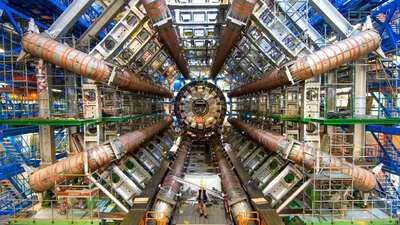
That something is the High-Luminosity LHC , and the teardown that gets us there is called Long Shutdown 3, or LS3, a sprawling upgrade programme running until the end of the decade. The goal is to crank up the collision rate by a factor of up to ten. The current machine, which has run since 2008 and famously bagged the Higgs boson in 2012, is being retired as we know it. Its replacement is scheduled to be fully operational in 2030, with a gradual restart from 2028.
Long Shutdown 3: what actually happens during the LHC's four-year "pause"Quite a lot, as it turns out. Around 1.2 kilometres of magnets and components will be pulled out and swapped for new equipment. CERN's Jean-Philippe Tock, who heads the LS3 coordination team, calls it the most extensive intervention on the complex since the LHC was built, involving thousands of engineers, physicists and technicians across the whole site. Dozens of separate projects are running in parallel.
It isn't just the main ring. The Super Proton Synchrotron 's North Area gets consolidated. The old CERN Neutrinos to Gran Sasso target area gets dismantled. Experimental Cavern North 3 becomes a high-intensity fixed-target facility, the ISOLDE facility gets renovated, and the electrical network, safety systems and technical galleries all get overhauled too.
The detectors get the biggest facelift. ATLAS and CMS are being rebuilt so thoroughly they'll effectively be new machines. They have to be. The upgraded collider will pile 140 to 200 proton-proton collisions into every bunch crossing, up from around 60 on the last run. That means picking the interesting events out of more than five billion interactions every second, so both experiments are ripping out their trigger systems and fitting all-silicon trackers with billions of readout channels and timing detectors accurate to tens of picoseconds.
That something is the High-Luminosity LHC , and the teardown that gets us there is called Long Shutdown 3, or LS3, a sprawling upgrade programme running until the end of the decade. The goal is to crank up the collision rate by a factor of up to ten. The current machine, which has run since 2008 and famously bagged the Higgs boson in 2012, is being retired as we know it. Its replacement is scheduled to be fully operational in 2030, with a gradual restart from 2028.
Long Shutdown 3: what actually happens during the LHC's four-year "pause"Quite a lot, as it turns out. Around 1.2 kilometres of magnets and components will be pulled out and swapped for new equipment. CERN's Jean-Philippe Tock, who heads the LS3 coordination team, calls it the most extensive intervention on the complex since the LHC was built, involving thousands of engineers, physicists and technicians across the whole site. Dozens of separate projects are running in parallel.
It isn't just the main ring. The Super Proton Synchrotron 's North Area gets consolidated. The old CERN Neutrinos to Gran Sasso target area gets dismantled. Experimental Cavern North 3 becomes a high-intensity fixed-target facility, the ISOLDE facility gets renovated, and the electrical network, safety systems and technical galleries all get overhauled too.
The detectors get the biggest facelift. ATLAS and CMS are being rebuilt so thoroughly they'll effectively be new machines. They have to be. The upgraded collider will pile 140 to 200 proton-proton collisions into every bunch crossing, up from around 60 on the last run. That means picking the interesting events out of more than five billion interactions every second, so both experiments are ripping out their trigger systems and fitting all-silicon trackers with billions of readout channels and timing detectors accurate to tens of picoseconds.
Next Story