
Restaurants bring more to table for regaining diners


Kolkata: India’s leading restaurant operators are cooking up fresh strategies to bring back customers to the table, nearly six years after the onset of the Covid-19 pandemic sparked a surge in the food delivery segment. Companies such as Jubilant FoodWorks, Devyani International, Restaurant Brands Asia and Speciality Restaurants are devising exclusive dishes for restaurants as well as offering targeted redemption coupons and app-led dining discounts to revive footfall while reducing discounts on deliveries.
Executives say the focus has shifted to accelerating dine-in growth, even as deliveries remain dominant. Chains such as KFC, Burger King, Tata Starbucks, Biryani by Kilo and Costa Coffee have reported improvement in same-store sales, signalling a gradual recovery of in-store demand.
“The question that we have to solve is how to build a strong dine-in and takeaway proposition, which is very differentiated and compels the customer to go to the nearby store… and do a dine-in or a takeaway. So that piece, we are fully on,” Sameer Khetarpal, chief executive officer at Jubilant FoodWorks- —which operates brands such as Domino’s, Popeyes and Dunkin’—told analysts earlier this month. Speciality Restaurants, which runs Mainland China and Oh! Calcutta, has introduced direct-to-customer offers, including redemption coupons and weekday promotions such as ‘Monday Bonanza’ to boost traffic during typically weak periods.
About 40% of its menu items, such as lamb chops and vegetable tempura fries, are now dine-in exclusive.
“The social fabric has changed. Online orders have grown due to traffic congestion and habits formed during the pandemic,” said managing director Anjan Chatterjee.
Online sales at the company have increased to 24% from 5-6% before the pandemic, further aided by growing consumption of internet-based streaming services.
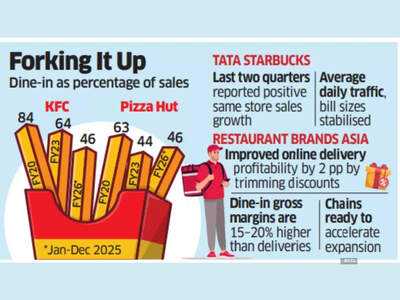
Over the past five-six years, customer acquisition in the industry shifted decisively to delivery from dine-in, via proprietary apps and aggregators such as Swiggy and Zomato. In the case of KFC, the proportion of dinein sales fell to 54% between April-December 2025 in this financial year from 64% in 2022-23 and 84% in 2019-20.
Executives estimate dine-in gross margins are 15-20% higher than for deliveries, given savings on aggregator commissions and deep discounting, along with greater scope for up-selling premium items while fixed costs remain the same.
Chains are tweaking menus across price points to draw instore traffic. Jubilant FoodWorks has launched premium sourdough pizzas while introducing entry-level pizzas priced to compete with local staples such as idli, dosa and samosa. Devyani International has launched new fried chicken and pizza offerings.
Restaurant Brands Asia is pushing app-led dine-in deals while “significantly” trimming delivery discounts, chief executive Rajeev Varman told analysts this month. The strategy lifted delivery profitability by two percentage points in the last quarter.
Devyani International has also split promotions between online and offline channels, helping it return to positive same-store growth in January across brands, except Pizza Hut. Promoter-chairman Ravi Jaipuria recently told analysts that early signs of consumption recovery were visible, supported by the government’s fiscal measures.
The chains also told analysts that they would speed up store expansion if positive indicators emerged. They said there had been some improvement in not just sales but also order values and gross margins, which are mostly driven by business on the tables.
Executives say the focus has shifted to accelerating dine-in growth, even as deliveries remain dominant. Chains such as KFC, Burger King, Tata Starbucks, Biryani by Kilo and Costa Coffee have reported improvement in same-store sales, signalling a gradual recovery of in-store demand.
“The question that we have to solve is how to build a strong dine-in and takeaway proposition, which is very differentiated and compels the customer to go to the nearby store… and do a dine-in or a takeaway. So that piece, we are fully on,” Sameer Khetarpal, chief executive officer at Jubilant FoodWorks- —which operates brands such as Domino’s, Popeyes and Dunkin’—told analysts earlier this month. Speciality Restaurants, which runs Mainland China and Oh! Calcutta, has introduced direct-to-customer offers, including redemption coupons and weekday promotions such as ‘Monday Bonanza’ to boost traffic during typically weak periods.
About 40% of its menu items, such as lamb chops and vegetable tempura fries, are now dine-in exclusive.
“The social fabric has changed. Online orders have grown due to traffic congestion and habits formed during the pandemic,” said managing director Anjan Chatterjee.
Online sales at the company have increased to 24% from 5-6% before the pandemic, further aided by growing consumption of internet-based streaming services.
Over the past five-six years, customer acquisition in the industry shifted decisively to delivery from dine-in, via proprietary apps and aggregators such as Swiggy and Zomato. In the case of KFC, the proportion of dinein sales fell to 54% between April-December 2025 in this financial year from 64% in 2022-23 and 84% in 2019-20.
Executives estimate dine-in gross margins are 15-20% higher than for deliveries, given savings on aggregator commissions and deep discounting, along with greater scope for up-selling premium items while fixed costs remain the same.
Chains are tweaking menus across price points to draw instore traffic. Jubilant FoodWorks has launched premium sourdough pizzas while introducing entry-level pizzas priced to compete with local staples such as idli, dosa and samosa. Devyani International has launched new fried chicken and pizza offerings.
Restaurant Brands Asia is pushing app-led dine-in deals while “significantly” trimming delivery discounts, chief executive Rajeev Varman told analysts this month. The strategy lifted delivery profitability by two percentage points in the last quarter.
Devyani International has also split promotions between online and offline channels, helping it return to positive same-store growth in January across brands, except Pizza Hut. Promoter-chairman Ravi Jaipuria recently told analysts that early signs of consumption recovery were visible, supported by the government’s fiscal measures.
The chains also told analysts that they would speed up store expansion if positive indicators emerged. They said there had been some improvement in not just sales but also order values and gross margins, which are mostly driven by business on the tables.
Next Story