
Staring down the barrel: India Inc stockpiles ahead of festive season


Kolkata: Renewed escalation of the West Asia crisis, and a fresh weakening of the rupee has pushed consumer goods and electronics makers into war-room mode to safeguard supply chains ahead of the festive season.
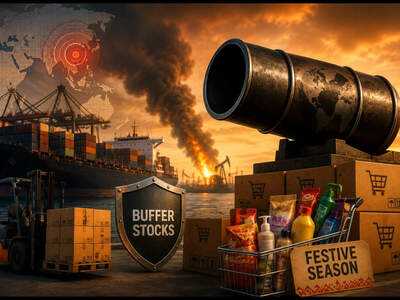
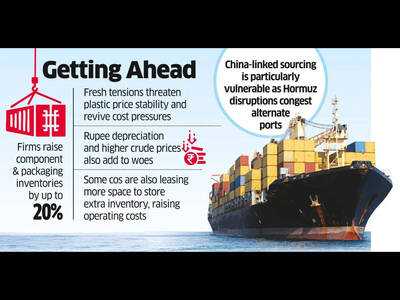
Companies are advancing shipments from China and increasing buffer stocks of imported parts and raw materials, including petrochemical-based packaging materials, by up to 20% to minimise production disruptions.
Also Read: War returns to West Asia, oil seesaws as Hormuz bleeds
Executives said the latest escalation comes just as factories started to ramp up festive season production. The festive season starts with Onam in Kerala and Ganesh Chaturthi in Maharashtra, with the core season from Navratri in October till Diwali in November. The season is considered as India's biggest consumption period, contributing as much as 30% of annual sales in several categories.
 "While we are monitoring the situation, we have ordered a 10-15% higher buffer of plastic packaging material and are creating an 8-10% additional buffer of finished goods to ensure there is no stock-out if production is disrupted due to any fresh shortage of LPG or other factors," said Mayank Shah, vice president at biscuit maker Parle Products.
The West Asia crisis that erupted in February due to the US-Iran war disrupted supply chains, triggered industrial LPG shortages, raised prices of petrochemical-based raw materials and freight, and delayed shipments due to closure of the Strait of Hormuz. A ceasefire in mid-June briefly eased pressure, with crude oil, plastic packaging, and freight rates softening before the latest escalation.
Tarun Arora, chief executive at Zydus Wellness, which markets Complan and Glucon-D, said the company will build an additional 1-2 month inventory of plastics. "The fresh round of tension was completely unexpected," he said. "Plastic prices had started stabilising, but the sudden escalation has once again pushed up prices."
Following the renewed tensions between the US and Iran, and closure of the strait, shipping lines have warned of longer transit times, while crude oil prices spiralled to their highest level in four weeks, and the rupee weakened past 96 against the US dollar.
Industry executives said Indian companies sourcing materials from China are particularly vulnerable because disruptions around the strait often cause congestion at alternative ports, delaying vessel schedules and extending delivery lead times. Many ships serving India continue onward to ports in the Middle East or Europe after unloading cargo.
Super Plastronics, which manufactures and sells televisions under the Blaupunkt, Kodak and Thomson brands, Monday received a consignment of components from China's Shenzhen Port shipped on May 11. Instead of taking its usual route, the vessel was diverted to Karachi before returning to Gujarat's Mundra Port due to congestion, stretching the journey well beyond the normal 22-30 days.
Also Read: US reports 'wave of strikes' on Iran as war returns
The company fears the latest crisis escalation will further delay shipping times. "As a precautionary measure, we have asked our component suppliers to immediately dispatch 15-20% additional stock," said Avneet Singh Marwah, chief executive of Super Plastronics. "Things have become extremely chaotic, making advance planning essential to avoid shortages during the festive season."
Companies are advancing shipments from China and increasing buffer stocks of imported parts and raw materials, including petrochemical-based packaging materials, by up to 20% to minimise production disruptions.
Also Read: War returns to West Asia, oil seesaws as Hormuz bleeds
Executives said the latest escalation comes just as factories started to ramp up festive season production. The festive season starts with Onam in Kerala and Ganesh Chaturthi in Maharashtra, with the core season from Navratri in October till Diwali in November. The season is considered as India's biggest consumption period, contributing as much as 30% of annual sales in several categories.
The West Asia crisis that erupted in February due to the US-Iran war disrupted supply chains, triggered industrial LPG shortages, raised prices of petrochemical-based raw materials and freight, and delayed shipments due to closure of the Strait of Hormuz. A ceasefire in mid-June briefly eased pressure, with crude oil, plastic packaging, and freight rates softening before the latest escalation.
Tarun Arora, chief executive at Zydus Wellness, which markets Complan and Glucon-D, said the company will build an additional 1-2 month inventory of plastics. "The fresh round of tension was completely unexpected," he said. "Plastic prices had started stabilising, but the sudden escalation has once again pushed up prices."
Following the renewed tensions between the US and Iran, and closure of the strait, shipping lines have warned of longer transit times, while crude oil prices spiralled to their highest level in four weeks, and the rupee weakened past 96 against the US dollar.
Industry executives said Indian companies sourcing materials from China are particularly vulnerable because disruptions around the strait often cause congestion at alternative ports, delaying vessel schedules and extending delivery lead times. Many ships serving India continue onward to ports in the Middle East or Europe after unloading cargo.
Super Plastronics, which manufactures and sells televisions under the Blaupunkt, Kodak and Thomson brands, Monday received a consignment of components from China's Shenzhen Port shipped on May 11. Instead of taking its usual route, the vessel was diverted to Karachi before returning to Gujarat's Mundra Port due to congestion, stretching the journey well beyond the normal 22-30 days.
Also Read: US reports 'wave of strikes' on Iran as war returns
The company fears the latest crisis escalation will further delay shipping times. "As a precautionary measure, we have asked our component suppliers to immediately dispatch 15-20% additional stock," said Avneet Singh Marwah, chief executive of Super Plastronics. "Things have become extremely chaotic, making advance planning essential to avoid shortages during the festive season."
Next Story