
Archaeologists discover rare Roman shrine to Minerva carved into a Spanish quarry


A small rock-cut sanctuary dedicated to Minerva has been identified in an ancient Roman quarry near Carrascosa del Campo in the Spanish province of Cuenca, offering a rare glimpse into how religion intersected with working life in Roman Hispania .
Set within a landscape once famous for producing lapis specularis , a translucent gypsum prized throughout the Roman Empire, the shrine stands as an unexpected reminder that quarries were not solely places of extraction. They could also become places of worship, where labour, belief and local identity met in the same physical space.
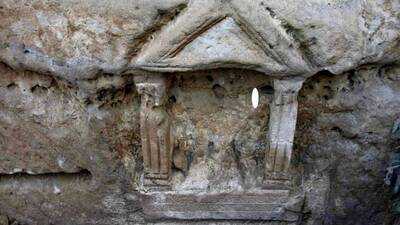
Inside the Roman Minerva shrine found in a Spanish quarry
The monument was carved directly into a sandstone quarry face and takes the form of a miniature Roman temple. Measuring roughly 70 centimetres wide and 50 centimetres high, the structure includes two fluted columns supporting a triangular pediment, creating the appearance of a small aedicula.
According to the Chester History & Heritage Museum, at its centre is a relief identified as Minerva, the Roman goddess associated with wisdom, crafts, justice and military strategy. Although centuries of weathering have softened some details, the figure can still be recognised through surviving attributes. She is shown standing upright, wearing a helmet and long tunic while carrying a spear and shield.
Archaeologists also identified the image of an owl, an animal traditionally linked with Minerva and often used as a symbol of wisdom in Roman art.
Latin inscription reveals who dedicated the Roman Minerva shrine
Perhaps the most informative element of the sanctuary is a short Latin inscription carved beneath the relief. The text records a dedication to Minerva by a man named Plotius Vigour and his companions.
Such inscriptions provide a direct connection to the individuals who commissioned religious monuments. In this case, the inscription helps place the sanctuary within the social world of Roman Hispania and offers evidence that local elites or influential families participated in the religious life of the quarrying district.
As per the Chester History & Heritage Museum, the dedication links the site to the wider presence of the Plotius family, whose members are documented in various parts of the Roman Empire. It transforms what might otherwise have been an anonymous monument into a place connected with a specific person and an act of devotion.
Roman quarry landscape behind the Minerva sanctuary
The quarry is situated within the territory of ancient Segóbriga, one of the most important Roman settlements in central Spain. The surrounding region became prosperous through the extraction of lapis specularis, a transparent gypsum mineral widely used before the spread of glass windows.
According to the Todo Alicante, material as a valuable commodity, and archaeological evidence show that extensive quarrying operations shaped both the economy and landscape of the area. Workers spent long periods underground or within quarry complexes, making such locations central to everyday life.
Set within a landscape once famous for producing lapis specularis , a translucent gypsum prized throughout the Roman Empire, the shrine stands as an unexpected reminder that quarries were not solely places of extraction. They could also become places of worship, where labour, belief and local identity met in the same physical space.
Inside the Roman Minerva shrine found in a Spanish quarry
The monument was carved directly into a sandstone quarry face and takes the form of a miniature Roman temple. Measuring roughly 70 centimetres wide and 50 centimetres high, the structure includes two fluted columns supporting a triangular pediment, creating the appearance of a small aedicula.
According to the Chester History & Heritage Museum, at its centre is a relief identified as Minerva, the Roman goddess associated with wisdom, crafts, justice and military strategy. Although centuries of weathering have softened some details, the figure can still be recognised through surviving attributes. She is shown standing upright, wearing a helmet and long tunic while carrying a spear and shield.
Archaeologists also identified the image of an owl, an animal traditionally linked with Minerva and often used as a symbol of wisdom in Roman art.
Latin inscription reveals who dedicated the Roman Minerva shrine
Perhaps the most informative element of the sanctuary is a short Latin inscription carved beneath the relief. The text records a dedication to Minerva by a man named Plotius Vigour and his companions.
As per the Chester History & Heritage Museum, the dedication links the site to the wider presence of the Plotius family, whose members are documented in various parts of the Roman Empire. It transforms what might otherwise have been an anonymous monument into a place connected with a specific person and an act of devotion.
Roman quarry landscape behind the Minerva sanctuary
The quarry is situated within the territory of ancient Segóbriga, one of the most important Roman settlements in central Spain. The surrounding region became prosperous through the extraction of lapis specularis, a transparent gypsum mineral widely used before the spread of glass windows.
According to the Todo Alicante, material as a valuable commodity, and archaeological evidence show that extensive quarrying operations shaped both the economy and landscape of the area. Workers spent long periods underground or within quarry complexes, making such locations central to everyday life.
Next Story