
Brazil lost the Spix's macaw from the wild for more than 20 years, then conservationists released captive-bred birds back into the Caatinga


For more than two decades, the Spix’s macaw existed only in captivity. Its disappearance from Brazil’s Caatinga was not simply the loss of another bird. With its striking blue plumage and extraordinarily small remaining population, the little parrot had become a symbol of how quickly wildlife can vanish when habitat destruction and human exploitation converge.
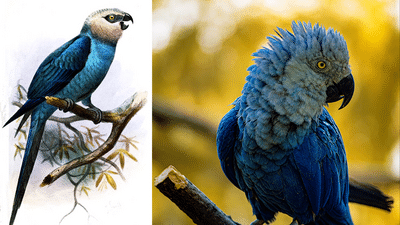
The last known Spix’s macaw disappeared from the wild around 2000. By then, the species had been pushed to the edge by the destruction of its specialised habitat and intense pressure from the illegal bird trade . What remained was a scattered captive population, a handful of birds carrying the future of an entire species.
Then, in 2022, something that had seemed almost impossible began to happen. Spix’s macaws were flying over their ancestral home again.
The remarkable return was documented by science journalist Kai Kupferschmidt in his Science feature 'A wild hope'. The story followed one of conservation’s most ambitious experiments: taking a bird that had disappeared from nature and teaching a captive-bred population how to live there again.
How habitat destruction and decades of trapping pushed the Spix’s macaw to extinction in Brazil’s Caatinga
According to Cromwell Purchase and colleagues’ 2024 study, '
,' the Spix’s macaw was historically restricted to a small area of northeastern Brazil, where it was associated with the dry Caatinga forest domain and, particularly, gallery forests along seasonal waterways. The species depended on this specialised habitat for feeding, nesting and shelter, making it especially vulnerable as the landscape was transformed by human activity.
The researchers explain that the macaw’s decline resulted from several pressures acting together. Its striking appearance and rarity made it a target for capture for the international pet trade, while agricultural expansion and livestock grazing contributed to widespread habitat destruction and degradation. By 1986, only three wild Spix’s macaws were known to remain, and despite conservation efforts, the species continued to decline. The last confirmed sighting in nature came in 2000, after which the bird was considered extinct in the wild.
Importantly, the disappearance of the Spix’s macaw from Brazil’s forests did not mean the species itself had vanished completely. Captive populations survived, providing conservationists with the genetic foundation needed to begin rebuilding the species. As Purchase and his colleagues describe, decades of captive breeding , conservation planning and habitat restoration eventually created the conditions for an ambitious next step: returning captive-bred Spix’s macaws to their former home in the Caatinga.
From a handful of birds to a possible wild population
Saving the species required far more than simply breeding parrots. The challenge was to produce enough healthy birds that could eventually survive outside cages, and then return them to a landscape that had changed dramatically since the species last lived there.
Captive breeding programmes therefore became the foundation of the recovery effort. The work was painstaking. Birds had to be bred, managed and assessed for health and behaviour, while conservationists also worked on restoring and protecting suitable habitat.
In 2022, the first major step finally arrived. Eight Spix’s macaws were released into the wild in June, more than 20 years after the species had disappeared from nature. A further 12 birds were planned for release later that year.
It was not an ordinary release. The birds had spent their lives in captivity. They had never needed to find food across the Caatinga, avoid predators or decide where to spend the night. So conservationists gave them an unusual set of companions.
How blue-winged macaws are helping captive-bred Spix’s macaws relearn survival skills
Alongside the Spix’s macaws, conservationists released blue-winged macaws (Primolius maracana), a species that naturally occurs in the region. The idea was ingenious: the captive-bred Spix’s macaws could learn from birds that already understood the landscape.
The blue-winged macaws could show them where to forage, how to move through the habitat and how to respond to dangers. Rather than expecting a captive-bred bird to rediscover every survival behaviour alone, researchers were effectively giving it a living guide.
Later research documented the broader reintroduction programme, 20 captive-reared Spix’s macaws and 15 blue-winged macaws were released during two events in 2022, with radio tracking and daily observations used to monitor how the birds adapted. For the first released birds, the early signs were encouraging.
They stayed together, explored their surroundings and began feeding on naturally occurring foods. For a species that had been absent from its native ecosystem for more than two decades, these seemingly ordinary behaviours represented something extraordinary. The birds were learning how to be wild again.
Bringing back a species means rebuilding its home
There was another problem. A bird cannot be returned to nature if the nature it needs no longer exists. The Spix’s macaw evolved around a highly specific landscape. Its recovery therefore depended not only on breeding birds but also on protecting and restoring the habitat around them. That meant preserving the remaining Caatinga vegetation, safeguarding nesting sites and creating conditions in which a population could eventually reproduce without human assistance.
The aim was never simply to release a few beautiful birds and declare victory. The real objective was much harder, create a self-sustaining wild population. That distinction matters.
A species can survive in captivity while being functionally absent from its ecosystem. True recovery requires animals that can reproduce, survive and pass their genes to future generations without humans having to maintain every stage of the process. The Spix’s macaw project was therefore attempting something much larger than a rescue operation. It was trying to reverse an extinction.
A return that still carries enormous risks
The first release was a historic achievement, but it was never going to guarantee success. The Spix’s macaw still faces many of the pressures that caused its original decline. Habitat loss, degradation and the continuing threat of illegal wildlife trafficking remain concerns. The Caatinga itself is also under pressure from human activity and a changing climate.
And captive breeding cannot continue indefinitely as a substitute for a functioning ecosystem. The birds must eventually become independent. Later monitoring showed just how difficult that transition can be. A 2024 study of the reintroduction found that the released birds faced substantial mortality and adaptation challenges, even while some established stable activity areas and maintained flock cohesion.
That is why conservationists monitor the birds so closely. Radio transmitters allow researchers to follow their movements and understand where they travel, what habitats they use and how they respond to their new surroundings. Every flight can provide information needed to make the next release safer.
Why the Spix’s macaw matters beyond one species
The story of the Spix’s macaw is often reduced to its spectacular blue feathers. But its importance goes much further. Its disappearance illustrates how the loss of a specialised habitat can push a species towards extinction even when suitable-looking landscapes remain nearby.
Its return demonstrates the opposite lesson, extinction in the wild does not always have to be the final chapter.
Captive breeding, habitat restoration, behavioural research, monitoring and cooperation between conservation organisations can sometimes create a bridge back to nature. But that bridge is fragile.
The first birds returning to the Caatinga were not proof that the problem had been solved. They were proof that recovery was possible. And perhaps that is what makes the Spix’s macaw story so compelling.
For years, the species survived only as a memory of the forests it had lost. Then conservationists opened the doors and watched the little blue parrots fly into a landscape that had once belonged to them. After more than 20 years of absence, the Spix’s macaw had finally been given something it had not possessed for a generation: a chance to become wild again.
The last known Spix’s macaw disappeared from the wild around 2000. By then, the species had been pushed to the edge by the destruction of its specialised habitat and intense pressure from the illegal bird trade . What remained was a scattered captive population, a handful of birds carrying the future of an entire species.
Then, in 2022, something that had seemed almost impossible began to happen. Spix’s macaws were flying over their ancestral home again.
How habitat destruction and decades of trapping pushed the Spix’s macaw to extinction in Brazil’s Caatinga
According to Cromwell Purchase and colleagues’ 2024 study, '
,' the Spix’s macaw was historically restricted to a small area of northeastern Brazil, where it was associated with the dry Caatinga forest domain and, particularly, gallery forests along seasonal waterways. The species depended on this specialised habitat for feeding, nesting and shelter, making it especially vulnerable as the landscape was transformed by human activity.
The researchers explain that the macaw’s decline resulted from several pressures acting together. Its striking appearance and rarity made it a target for capture for the international pet trade, while agricultural expansion and livestock grazing contributed to widespread habitat destruction and degradation. By 1986, only three wild Spix’s macaws were known to remain, and despite conservation efforts, the species continued to decline. The last confirmed sighting in nature came in 2000, after which the bird was considered extinct in the wild.
Importantly, the disappearance of the Spix’s macaw from Brazil’s forests did not mean the species itself had vanished completely. Captive populations survived, providing conservationists with the genetic foundation needed to begin rebuilding the species. As Purchase and his colleagues describe, decades of captive breeding , conservation planning and habitat restoration eventually created the conditions for an ambitious next step: returning captive-bred Spix’s macaws to their former home in the Caatinga.
From a handful of birds to a possible wild population
Saving the species required far more than simply breeding parrots. The challenge was to produce enough healthy birds that could eventually survive outside cages, and then return them to a landscape that had changed dramatically since the species last lived there.
Captive breeding programmes therefore became the foundation of the recovery effort. The work was painstaking. Birds had to be bred, managed and assessed for health and behaviour, while conservationists also worked on restoring and protecting suitable habitat.
In 2022, the first major step finally arrived. Eight Spix’s macaws were released into the wild in June, more than 20 years after the species had disappeared from nature. A further 12 birds were planned for release later that year.
It was not an ordinary release. The birds had spent their lives in captivity. They had never needed to find food across the Caatinga, avoid predators or decide where to spend the night. So conservationists gave them an unusual set of companions.
How blue-winged macaws are helping captive-bred Spix’s macaws relearn survival skills
Alongside the Spix’s macaws, conservationists released blue-winged macaws (Primolius maracana), a species that naturally occurs in the region. The idea was ingenious: the captive-bred Spix’s macaws could learn from birds that already understood the landscape.
The blue-winged macaws could show them where to forage, how to move through the habitat and how to respond to dangers. Rather than expecting a captive-bred bird to rediscover every survival behaviour alone, researchers were effectively giving it a living guide.
Later research documented the broader reintroduction programme, 20 captive-reared Spix’s macaws and 15 blue-winged macaws were released during two events in 2022, with radio tracking and daily observations used to monitor how the birds adapted. For the first released birds, the early signs were encouraging.
They stayed together, explored their surroundings and began feeding on naturally occurring foods. For a species that had been absent from its native ecosystem for more than two decades, these seemingly ordinary behaviours represented something extraordinary. The birds were learning how to be wild again.
Bringing back a species means rebuilding its home
There was another problem. A bird cannot be returned to nature if the nature it needs no longer exists. The Spix’s macaw evolved around a highly specific landscape. Its recovery therefore depended not only on breeding birds but also on protecting and restoring the habitat around them. That meant preserving the remaining Caatinga vegetation, safeguarding nesting sites and creating conditions in which a population could eventually reproduce without human assistance.
The aim was never simply to release a few beautiful birds and declare victory. The real objective was much harder, create a self-sustaining wild population. That distinction matters.
A species can survive in captivity while being functionally absent from its ecosystem. True recovery requires animals that can reproduce, survive and pass their genes to future generations without humans having to maintain every stage of the process. The Spix’s macaw project was therefore attempting something much larger than a rescue operation. It was trying to reverse an extinction.
A return that still carries enormous risks
The first release was a historic achievement, but it was never going to guarantee success. The Spix’s macaw still faces many of the pressures that caused its original decline. Habitat loss, degradation and the continuing threat of illegal wildlife trafficking remain concerns. The Caatinga itself is also under pressure from human activity and a changing climate.
And captive breeding cannot continue indefinitely as a substitute for a functioning ecosystem. The birds must eventually become independent. Later monitoring showed just how difficult that transition can be. A 2024 study of the reintroduction found that the released birds faced substantial mortality and adaptation challenges, even while some established stable activity areas and maintained flock cohesion.
That is why conservationists monitor the birds so closely. Radio transmitters allow researchers to follow their movements and understand where they travel, what habitats they use and how they respond to their new surroundings. Every flight can provide information needed to make the next release safer.
Why the Spix’s macaw matters beyond one species
The story of the Spix’s macaw is often reduced to its spectacular blue feathers. But its importance goes much further. Its disappearance illustrates how the loss of a specialised habitat can push a species towards extinction even when suitable-looking landscapes remain nearby.
Its return demonstrates the opposite lesson, extinction in the wild does not always have to be the final chapter.
Captive breeding, habitat restoration, behavioural research, monitoring and cooperation between conservation organisations can sometimes create a bridge back to nature. But that bridge is fragile.
The first birds returning to the Caatinga were not proof that the problem had been solved. They were proof that recovery was possible. And perhaps that is what makes the Spix’s macaw story so compelling.
For years, the species survived only as a memory of the forests it had lost. Then conservationists opened the doors and watched the little blue parrots fly into a landscape that had once belonged to them. After more than 20 years of absence, the Spix’s macaw had finally been given something it had not possessed for a generation: a chance to become wild again.
Next Story