
Congo Basin warming may be nudging tropical rain eastward, and scientists say the shift reaches from Africa to the western Pacific


People often think first of melting ice caps or warming seas when climate change comes up. But one region far from the tropics may also be influencing weather patterns. Climate systems are interconnected, so changes in one region can affect others.
According to a study published in the Journal of Climate, something remarkable is happening over Africa. A team of researchers discovered that rising temperatures over the Congo Basin are actively altering weather patterns across the world. The study suggests that land-surface warming in this specific African region may be pushing tropical rainfall eastward, creating a climate ripple effect that stretches from Africa to the western Pacific Ocean.
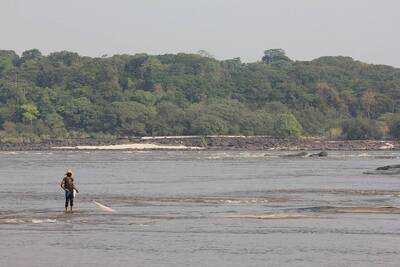
The paper frames the Congo Basin as a remote land-surface “forcing” experiment, using climate-model simulations to isolate how warming there reorganises tropical circulation. In the abstract, the authors say the response shows up as an eastward shift in rainfall and a weakening of ascent over parts of the Atlantic sector, linking African land warming to changes as far away as the western Pacific
For decades now, scientists have observed a change in the rainfall pattern of islands and seas on the Maritime Continent, including countries such as Indonesia and the Philippines. Scientists had always believed that this could be attributed to warming seas, especially the expansion of the Indo-Pacific warm pool. The study adds evidence that dry land can influence global climate patterns .
How atmospheric waves move rainfall eastward
To understand how a warm African rainforest can influence rainfall in Asia and the Pacific, it helps to understand how the atmosphere transports heat. Using observations, climate data and models, the E3SMv3 researchers found that unusual surface warmth in the Congo Basin warms the air directly above it.
This localised heating creates what scientists call an equatorial Kelvin-like response, an atmospheric wave that travels eastward through the air. As this wave moves, it forces air to gather and rise over the western Indian Ocean and the western Pacific. At the same time, it causes air to sink over the Maritime Continent.
Because rising air promotes clouds and rain while sinking air suppresses them, the pattern shifts where precipitation falls. In other words, it will have less rain over the Indonesian islands, but much heavier precipitation further east in the Pacific region. It is an example of teleconnection, showing that warm conditions in Central Africa can influence rainfall far away.
According to a study published in the Journal of Climate, something remarkable is happening over Africa. A team of researchers discovered that rising temperatures over the Congo Basin are actively altering weather patterns across the world. The study suggests that land-surface warming in this specific African region may be pushing tropical rainfall eastward, creating a climate ripple effect that stretches from Africa to the western Pacific Ocean.
The paper frames the Congo Basin as a remote land-surface “forcing” experiment, using climate-model simulations to isolate how warming there reorganises tropical circulation. In the abstract, the authors say the response shows up as an eastward shift in rainfall and a weakening of ascent over parts of the Atlantic sector, linking African land warming to changes as far away as the western Pacific
For decades now, scientists have observed a change in the rainfall pattern of islands and seas on the Maritime Continent, including countries such as Indonesia and the Philippines. Scientists had always believed that this could be attributed to warming seas, especially the expansion of the Indo-Pacific warm pool. The study adds evidence that dry land can influence global climate patterns .
How atmospheric waves move rainfall eastward
To understand how a warm African rainforest can influence rainfall in Asia and the Pacific, it helps to understand how the atmosphere transports heat. Using observations, climate data and models, the E3SMv3 researchers found that unusual surface warmth in the Congo Basin warms the air directly above it.
This localised heating creates what scientists call an equatorial Kelvin-like response, an atmospheric wave that travels eastward through the air. As this wave moves, it forces air to gather and rise over the western Indian Ocean and the western Pacific. At the same time, it causes air to sink over the Maritime Continent.
Because rising air promotes clouds and rain while sinking air suppresses them, the pattern shifts where precipitation falls. In other words, it will have less rain over the Indonesian islands, but much heavier precipitation further east in the Pacific region. It is an example of teleconnection, showing that warm conditions in Central Africa can influence rainfall far away.
Next Story