
8 Planets of the Solar System and One Fact That Sets Each Apart

Our solar system has eight planets, and not one of them is ordinary. They range from a scorched rock smaller than some moons to a blue giant so far from the Sun that its year outlasts a human lifetime. The one thing they share is that each carries at least one quality so extreme it redefines what a planet can be.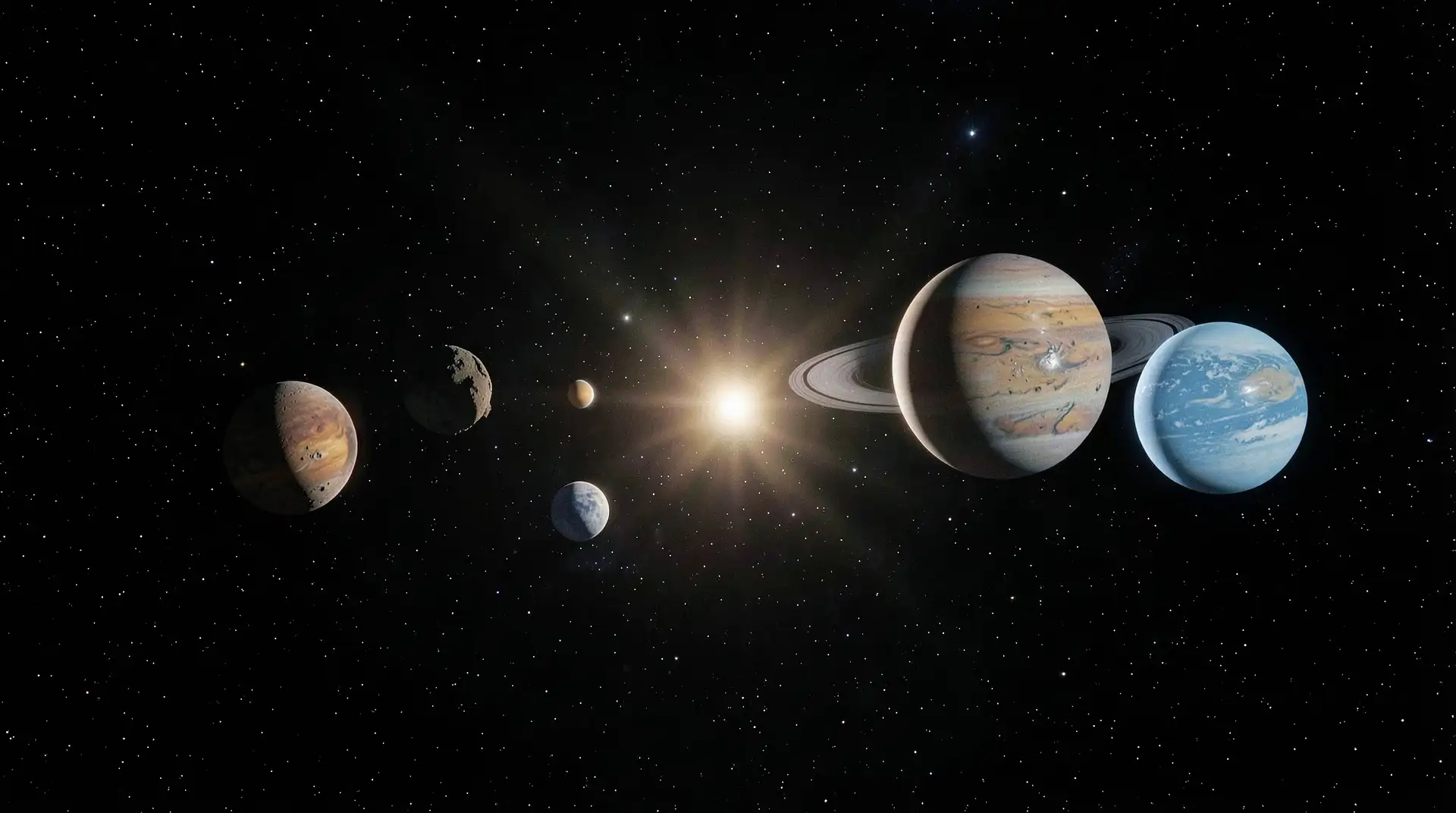
Scientists estimate Mercury has shrunk by several kilometres in radius over billions of years, and the process continues. No other planet in the solar system is doing this in a way we can measure.
More strangely, Venus rotates so slowly that one Venusian day, the time it takes to complete one full spin, is longer than one Venusian year. It completes its orbit around the Sun before it finishes a single rotation. This combination of retrograde spin and extreme slowness exists nowhere else in the solar system.
Scientists have looked for similar processes on Mars, Venus, and icy moons. None shows the same global, continuous system. Plate tectonics is considered one of the reasons Earth can sustain complex life, and as far as we know, it is unique to this planet.
It is a shield volcano, built up over billions of years by repeated lava flows from the same hotspot. Because Mars has no plate tectonics to move the crust away from the hotspot, the volcano just kept growing in one place.
The base is so wide that if you stood at the edge, the summit would be below the horizon. Nothing else in the solar system reaches its scale.
The storm has been shrinking slowly over the centuries of observation, but it persists. Jupiter's thick hydrogen atmosphere, with no solid surface to create friction and slow a storm down, allows weather systems to survive on timescales that have no parallel on Earth.
Saturn's average density is lower than that of liquid water. If you could find a bathtub large enough, Saturn would float. This happens because Saturn is composed almost entirely of hydrogen and helium, with no dense rocky core large enough to pull the average up.
The rings themselves are made mostly of water ice, and while they look solid from a distance, they are a collection of particles ranging from dust grains to chunks the size of a house.
One pole points almost directly at the Sun for roughly 42 years, then the other does the same. The result is the most extreme seasons in the solar system: a polar region in continuous sunlight for decades, then continuous darkness.
The leading explanation is that a large object struck Uranus early in its history and knocked it over. No other planet has a tilt anywhere near this extreme.
Wind speeds in its upper atmosphere reach around 2,000 kilometres per hour, faster than the speed of sound on Earth. Where this energy comes from is still not fully understood.
Neptune generates more heat internally than it receives from the Sun, and that internal heat source appears to drive the violent atmospheric circulation. It is the most energetically active of the ice giants, and its winds have no equal in the solar system.
Mercury, The Planet That Is Slowly Shrinking
Mercury is the smallest planet and the closest to the Sun, but neither of those is its most remarkable quality. Mercury has a large iron core that has been cooling and contracting since the planet formed. As the core shrinks, the crust wrinkles and buckles, creating long cliff-like formations called scarps.Scientists estimate Mercury has shrunk by several kilometres in radius over billions of years, and the process continues. No other planet in the solar system is doing this in a way we can measure.
Venus, The Planet That Spins Backwards and Slower Than It Orbits
Venus rotates on its axis in the opposite direction to most planets. Stand on its surface and the Sun would rise in the west and set in the east.More strangely, Venus rotates so slowly that one Venusian day, the time it takes to complete one full spin, is longer than one Venusian year. It completes its orbit around the Sun before it finishes a single rotation. This combination of retrograde spin and extreme slowness exists nowhere else in the solar system.
Earth, The Only Planet With Plate Tectonics
Earth is the only planet confirmed to have active plate tectonics, the slow movement of massive crustal sections across a partially molten mantle. This process recycles carbon, regulates the atmosphere, builds mountain ranges, and drives volcanic activity.Scientists have looked for similar processes on Mars, Venus, and icy moons. None shows the same global, continuous system. Plate tectonics is considered one of the reasons Earth can sustain complex life, and as far as we know, it is unique to this planet.
Mars, The Home of the Solar System's Tallest Volcano
Olympus Mons on Mars stands roughly 22 kilometres above the surrounding plain, nearly three times the height of Mount Everest above sea level.It is a shield volcano, built up over billions of years by repeated lava flows from the same hotspot. Because Mars has no plate tectonics to move the crust away from the hotspot, the volcano just kept growing in one place.
The base is so wide that if you stood at the edge, the summit would be below the horizon. Nothing else in the solar system reaches its scale.
Jupiter, The Planet With a Storm Older Than Modern Science
Jupiter's Great Red Spot is a storm that has been continuously observed since the seventeenth century, making it older than the steam engine, older than the theory of gravity as we formalised it, older than most nations. It is an anticyclone, a high-pressure system, wider than the diameter of Earth.The storm has been shrinking slowly over the centuries of observation, but it persists. Jupiter's thick hydrogen atmosphere, with no solid surface to create friction and slow a storm down, allows weather systems to survive on timescales that have no parallel on Earth.
Saturn, The Only Planet Less Dense Than Water
Saturn is the second-largest planet and the one with the most spectacular ring system, but its most counterintuitive quality is its density.Saturn's average density is lower than that of liquid water. If you could find a bathtub large enough, Saturn would float. This happens because Saturn is composed almost entirely of hydrogen and helium, with no dense rocky core large enough to pull the average up.
The rings themselves are made mostly of water ice, and while they look solid from a distance, they are a collection of particles ranging from dust grains to chunks the size of a house.
Uranus, The Planet That Orbits on Its Side
Uranus has an axial tilt of about 98 degrees, meaning it essentially rolls around the Sun on its side rather than spinning upright like a top.One pole points almost directly at the Sun for roughly 42 years, then the other does the same. The result is the most extreme seasons in the solar system: a polar region in continuous sunlight for decades, then continuous darkness.
The leading explanation is that a large object struck Uranus early in its history and knocked it over. No other planet has a tilt anywhere near this extreme.
Neptune, The Windiest Place in the Solar System
Neptune receives very little energy from the Sun, it is roughly 30 times farther from the Sun than Earth is, yet it has the fastest recorded winds of any planet.Wind speeds in its upper atmosphere reach around 2,000 kilometres per hour, faster than the speed of sound on Earth. Where this energy comes from is still not fully understood.
Neptune generates more heat internally than it receives from the Sun, and that internal heat source appears to drive the violent atmospheric circulation. It is the most energetically active of the ice giants, and its winds have no equal in the solar system.
Next Story