
Why a Day on Venus Is Longer Than Its Year

Of all the oddities in our solar system, Venus holds one of the strangest: a single spin on its axis lasts longer than its entire year. The planet takes about 243 Earth days to rotate once on its axis, yet it completes a full trip around the Sun in only about 225 Earth days. A Venusian year ends before a Venusian day does.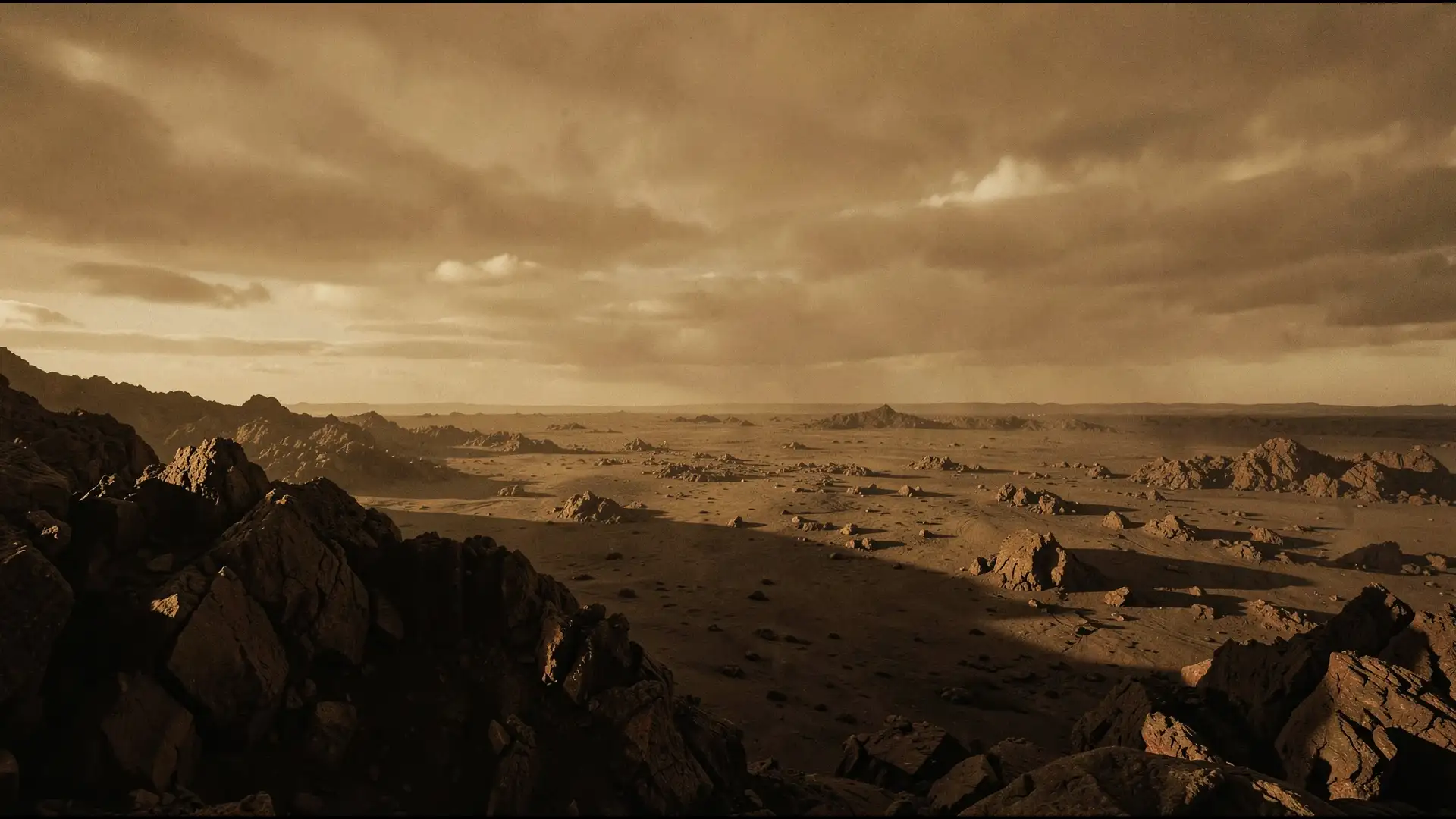
Venus has the relationship inverted. Its spin is extraordinarily sluggish, while its orbit clips along at a pace not very different from Earth's, since Venus sits only slightly closer to the Sun.
Over billions of years, the gravitational pull of the Sun acting on this dense atmosphere is thought to have applied a constant braking torque on the planet's rotation, gradually slowing the spin from whatever it once was.
A second factor may have been a large collision early in the solar system's history, one that could have altered both the spin rate and the direction. The two effects together produced the near-standstill we observe today.
The dense cloud cover scatters light into a permanent dim orange haze. The Sun, when visible at all through the clouds, would appear as a diffuse bright patch moving almost imperceptibly across the sky over weeks.
Earth's own spin is gradually slowing for similar reasons, though on a timescale so vast that a human lifetime registers no measurable change. Venus simply ran the same process further and faster, and arrived at an endpoint that looks, by our standards, completely upside down.
A day longer than a year is not a cosmic accident. It is what a planet looks like after billions of years of gravitational conversation with its star.
What a Day and a Year Actually Measure
These two cycles track completely different motions. A year measures how long a planet takes to travel around the Sun. A day measures how long the planet takes to spin once on its own axis. On Earth, the two are wildly mismatched in the other direction: we spin fast and orbit slowly, so a day is a tiny fraction of a year.Venus has the relationship inverted. Its spin is extraordinarily sluggish, while its orbit clips along at a pace not very different from Earth's, since Venus sits only slightly closer to the Sun.
Why Venus Spins So Slowly
The leading explanation involves the thick atmosphere Venus carries. Its atmosphere is roughly 90 times denser than Earth's, a crushing blanket of carbon dioxide and sulphuric acid clouds.Over billions of years, the gravitational pull of the Sun acting on this dense atmosphere is thought to have applied a constant braking torque on the planet's rotation, gradually slowing the spin from whatever it once was.
You may also like
- Jeff Bezos' ex-wife MacKenzie Scott donates another $12.5 million to Georgia nonprofits, helping students pursue higher education, with one organisation receiving its second $8 million gift
- China's navy to display new autonomous and aviation tech at the upcoming Zhuhai air show
- 'Sheikh Hasina is a terrorist, can only return in handcuffs': Bangladesh rejects ex-PM's homecoming request
- Flydubai's Tel Aviv flights to resume within weeks, 2 months after co-pilot's hijack bid
- 11 killed as bus collides with truck in UAE's Ras Al Khaimah
A second factor may have been a large collision early in the solar system's history, one that could have altered both the spin rate and the direction. The two effects together produced the near-standstill we observe today.
Venus Also Spins Backwards
The slow spin comes with a companion strangeness. Venus rotates in the opposite direction to most planets in the solar system, including Earth. On Venus, the Sun rises in the west and sets in the east. This retrograde rotation may be a legacy of that same ancient collision, or it may be the result of the atmospheric braking flipping the planet past a tipping point over geological time. Both explanations are plausible; neither is yet confirmed beyond doubt.What a Sunrise on Venus Would Actually Look Like
Because the planet spins so slowly and also rotates retrograde, a hypothetical observer on the Venusian surface would wait an enormous stretch of time between one sunrise and the next. That interval, called the solar day, works out to roughly 117 Earth days. The sky itself would never be blue.The dense cloud cover scatters light into a permanent dim orange haze. The Sun, when visible at all through the clouds, would appear as a diffuse bright patch moving almost imperceptibly across the sky over weeks.
What This Tells Us About Planets in General
The Venus case dismantles the assumption that a planet's spin rate is simply a leftover from its formation and stays roughly constant. Atmospheres exert torque. Collisions reset clocks. Gravitational interactions with a star reach across hundreds of millions of kilometres and slowly reshape a world.Earth's own spin is gradually slowing for similar reasons, though on a timescale so vast that a human lifetime registers no measurable change. Venus simply ran the same process further and faster, and arrived at an endpoint that looks, by our standards, completely upside down.
A day longer than a year is not a cosmic accident. It is what a planet looks like after billions of years of gravitational conversation with its star.






Loving Newspoint? Download the app now
