
Why Sloths Move So Slowly: The Science Behind Nature's Slowest Mammal

A sloth moves so slowly that algae grows on its fur. That single fact contains the whole story: an animal so committed to stillness that it becomes a habitat for other organisms, and survives because of it.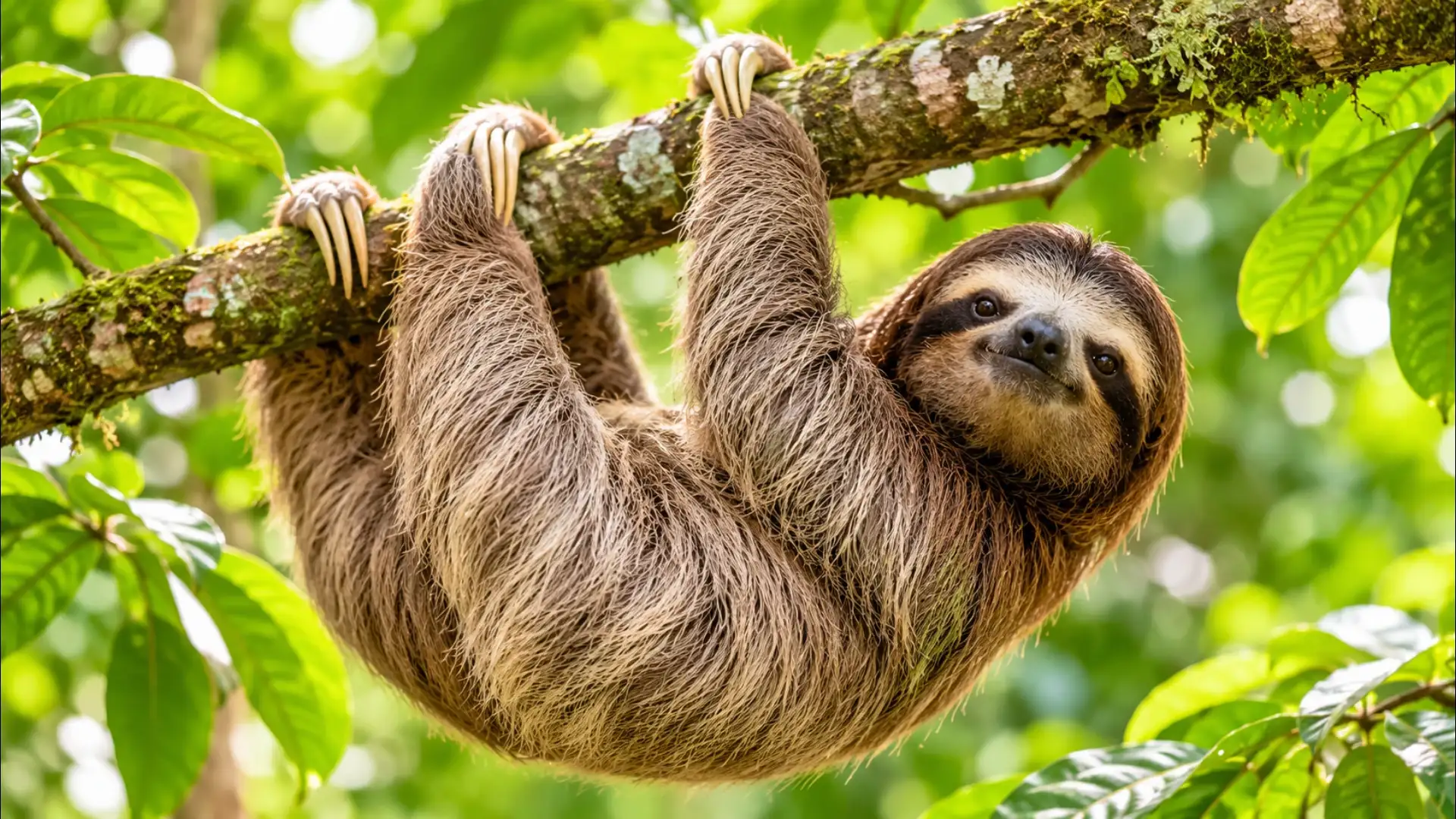
The problem is that leaves are extraordinarily poor fuel. They are low in calories, high in tough fibres, and loaded with chemical compounds that trees produce precisely to discourage animals from eating them.
To extract any nutrition at all, a sloth has a multi-chambered stomach and a digestive process that can take a month to move a single meal through.
The stomach of a well-fed sloth can account for nearly a third of its body weight. Even so, the caloric yield from all that digestion is small. The sloth's body has adapted to run on that small yield by doing as little as possible.
Those reduced muscles are part of why a sloth cannot move fast even if it tries. On the ground, dragging itself forward, it covers perhaps two to three metres in a minute.
In the canopy, where it spends almost its entire life, it moves with a slow, deliberate reach-and-grip that uses gravity and its own weight rather than muscle effort.
The curved claws that lock around a branch require no muscular effort to hold, the grip is passive, which is why sloths can sleep hanging upside down without falling.
But algae and a green tint are only useful camouflage if the animal is not moving. A predator, a harpy eagle scanning the canopy from above, or an ocelot working through the branches, detects prey primarily through motion. A sloth that stays still is a lump of bark.
A sloth that moves is a target. The slowness is the camouflage. The two adaptations reinforce each other so completely that separating them as cause and effect becomes difficult.
The tree-dwelling, leaf-eating, ultra-slow strategy of modern sloths is a later refinement, but the underlying plan, find an abundant, low-competition food source and spend as little energy as possible getting it, has proven durable across geological time.
There are two main groups alive today: two-toed sloths and three-toed sloths. They are not as closely related as they look; their similar bodies evolved separately in response to the same pressures, a pattern biologists call convergent evolution. Both arrived at the same answer: slow down, hang on, let the leaves do the work.
The sloth is not failing at being an animal. It has simply found a way to do almost nothing and call it survival, and the rainforest canopy, full of leaves that no one else wants to bother with, keeps rewarding that choice.
A Diet That Barely Powers Anything
Three-toed sloths eat leaves almost exclusively, and leaves, buds, and fruits make up the bulk of all sloths' diets. Leaves are abundant, require no chasing, and are never going to run away, which suits a sloth perfectly.The problem is that leaves are extraordinarily poor fuel. They are low in calories, high in tough fibres, and loaded with chemical compounds that trees produce precisely to discourage animals from eating them.
To extract any nutrition at all, a sloth has a multi-chambered stomach and a digestive process that can take a month to move a single meal through.
The stomach of a well-fed sloth can account for nearly a third of its body weight. Even so, the caloric yield from all that digestion is small. The sloth's body has adapted to run on that small yield by doing as little as possible.
A Metabolism Built for Stillness
The sloth has one of the lowest metabolic rates of any mammal relative to its body size. Its internal temperature fluctuates with the surrounding air in a way that is unusual for a warm-blooded animal, which saves the energy that most mammals burn keeping their core temperature steady. Its heart beats slowly. Its muscles are roughly a quarter of the mass you would expect in an animal its size.Those reduced muscles are part of why a sloth cannot move fast even if it tries. On the ground, dragging itself forward, it covers perhaps two to three metres in a minute.
In the canopy, where it spends almost its entire life, it moves with a slow, deliberate reach-and-grip that uses gravity and its own weight rather than muscle effort.
The curved claws that lock around a branch require no muscular effort to hold, the grip is passive, which is why sloths can sleep hanging upside down without falling.
You may also like
- Did JD Vance help Vitol secure Venezuela oil deal? US senator seeks answers
- Idaho man names two relatives as sole beneficiaries of his $746,000 life insurance policy during divorce proceedings before dying in a mining accident; estranged wife challenges payout after insurer hands entire sum to relatives
- Vance, Rubio meet with Qatari PM as uncertainty mounts over Trump's intentions with Iran
- Two Ohio island golf-cart rental companies paid $37,500 in disputed 2024 licence fees for 375 vehicles, although they operated outside the village taxing them; November 20 judges revived their challenge to the tax
- Fears Nvidia CEO Huang could have gone to China drove Trump's lobbying for him
Camouflage That Only Works If You Stay Still
The algae that grows in the grooves of a sloth's fur is not an accident or a hygiene problem. It is part of a system. The algae tints the fur greenish, which blends into the canopy. Certain moths and beetles also live in sloth fur, completing a tiny ecosystem that travels with the animal.But algae and a green tint are only useful camouflage if the animal is not moving. A predator, a harpy eagle scanning the canopy from above, or an ocelot working through the branches, detects prey primarily through motion. A sloth that stays still is a lump of bark.
A sloth that moves is a target. The slowness is the camouflage. The two adaptations reinforce each other so completely that separating them as cause and effect becomes difficult.
How Sloths Have Survived for Millions of Years
Sloths belong to a lineage that stretches back tens of millions of years. Their ancient relatives included ground sloths the size of elephants.The tree-dwelling, leaf-eating, ultra-slow strategy of modern sloths is a later refinement, but the underlying plan, find an abundant, low-competition food source and spend as little energy as possible getting it, has proven durable across geological time.
There are two main groups alive today: two-toed sloths and three-toed sloths. They are not as closely related as they look; their similar bodies evolved separately in response to the same pressures, a pattern biologists call convergent evolution. Both arrived at the same answer: slow down, hang on, let the leaves do the work.
The sloth is not failing at being an animal. It has simply found a way to do almost nothing and call it survival, and the rainforest canopy, full of leaves that no one else wants to bother with, keeps rewarding that choice.






Loving Newspoint? Download the app now
