
Midnight Sun: 6 Places Where Summer Nights Never Get Dark

The clock reads 1 a.m., but the sky outside is the colour of late afternoon. No stars, no darkness, just a low, amber sun sitting stubbornly above the horizon. This is the midnight sun, and it happens every summer in a handful of places close to the Arctic and Antarctic circles, where the tilt of the Earth tips one pole toward the sun for so long that night simply disappears.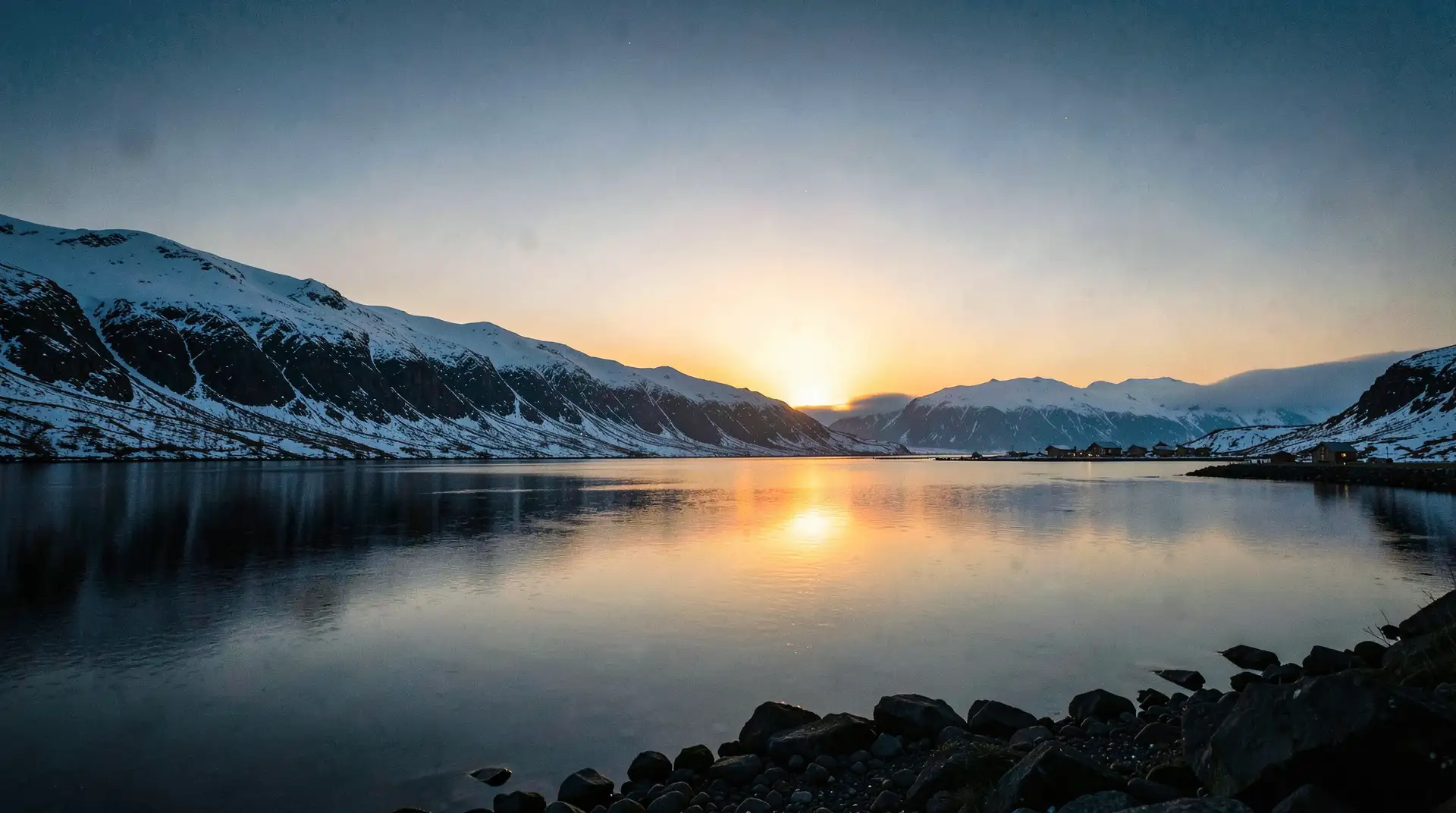
The further a place sits from the equator, and the closer it sits to a pole, the longer this lasts. Cross the Arctic Circle and you enter the zone where at least one full day each year sees the sun stay up continuously. Go further north, and those days stretch into weeks.
Residents pull blackout curtains tight and learn to sleep by the clock rather than the sky. Polar bears outnumber people on the archipelago, and in summer, researchers and adventurers arrive to hike under a sun that circles the sky like a slow, glowing carousel rather than rising and setting.
Tromsø is also one of the most accessible Arctic destinations, with regular flights from European cities, which is why it has become the reference point most people think of when the midnight sun comes up in conversation.
The Iñupiaq people developed their own ways of marking time through the endless summer light, by tides, by the behaviour of animals, by the smell of the air, long before mechanical clocks arrived. Today the town is a research hub, and scientists studying Arctic climate find the perpetual daylight both useful for fieldwork and genuinely disorienting to sleep through.
What Icelanders get instead is a phenomenon called the white night: a long, pale twilight that stretches from sunset to sunrise without ever reaching true night. In late June, the sky at midnight is a soft, luminous grey-blue, bright enough to read outside. The effect is gentler than the full midnight sun further north, but no less surreal to a visitor arriving from lower latitudes.
Dawson City marks the summer solstice each year with a midnight sun golf tournament, a tradition that has run for well over a century, teeing off in full daylight at the stroke of midnight.
Scientists working there describe the psychological challenge of continuous light as one of the less-discussed difficulties of polar research, the body's internal clock, which relies partly on light and darkness to regulate sleep, simply loses its anchor. Some stations use timed artificial darkness to help researchers sleep.
What all six places share is not just geography but a particular relationship with time. When darkness does not arrive to mark the end of the day, the ordinary structure of waking and sleeping, working and resting, becomes something each person has to build deliberately. The midnight sun is one of the clearest reminders that the rhythms most people treat as natural are, in fact, a product of where on Earth they happen to live.
Why the Sun Refuses to Set
Earth spins on an axis tilted roughly 23.5 degrees relative to its orbit around the sun. For most of the year, that tilt means every place on Earth gets a mix of day and night. But in summer, the pole tilted toward the sun stays in sunlight even as Earth rotates, because the sun's angle never drops far enough below the horizon to bring true darkness.The further a place sits from the equator, and the closer it sits to a pole, the longer this lasts. Cross the Arctic Circle and you enter the zone where at least one full day each year sees the sun stay up continuously. Go further north, and those days stretch into weeks.
Svalbard, Norway, Months Without Darkness
The Norwegian archipelago of Svalbard sits so far north that the midnight sun lasts from late April to late August, over four months of continuous daylight. The main settlement, Longyearbyen, is one of the northernmost permanently inhabited places on Earth.Residents pull blackout curtains tight and learn to sleep by the clock rather than the sky. Polar bears outnumber people on the archipelago, and in summer, researchers and adventurers arrive to hike under a sun that circles the sky like a slow, glowing carousel rather than rising and setting.
Tromsø, Norway, The Arctic Capital of the Midnight Sun
Further south than Svalbard but still well above the Arctic Circle, Tromsø experiences the midnight sun for roughly ten weeks each summer. The city has built a small industry around it, midnight sun concerts, midnight sun hikes, and boat trips timed so that the 11 p.m. sun lights the fjords in shades of copper.Tromsø is also one of the most accessible Arctic destinations, with regular flights from European cities, which is why it has become the reference point most people think of when the midnight sun comes up in conversation.
Barrow (Utqiaġvik), Alaska, Eighty Days of Daylight
The northernmost city in the United States, known by its traditional Iñupiaq name Utqiaġvik, experiences around eighty consecutive days when the sun does not set at all. The community has lived with this rhythm for thousands of years.The Iñupiaq people developed their own ways of marking time through the endless summer light, by tides, by the behaviour of animals, by the smell of the air, long before mechanical clocks arrived. Today the town is a research hub, and scientists studying Arctic climate find the perpetual daylight both useful for fieldwork and genuinely disorienting to sleep through.
Reykjavik, Iceland, The Softer Version
Iceland sits just below the Arctic Circle, so Reykjavik does not technically experience a midnight sun in the strict sense, the sun does set, briefly, in midsummer. But it barely dips below the horizon, and the sky never goes dark.What Icelanders get instead is a phenomenon called the white night: a long, pale twilight that stretches from sunset to sunrise without ever reaching true night. In late June, the sky at midnight is a soft, luminous grey-blue, bright enough to read outside. The effect is gentler than the full midnight sun further north, but no less surreal to a visitor arriving from lower latitudes.
Yukon, Canada, Wilderness Under a Sleepless Sky
The Yukon territory in northwestern Canada crosses the Arctic Circle in its northern reaches, and the town of Dawson City, a former gold-rush settlement, experiences several weeks of near-continuous daylight each summer. The Yukon's version of the midnight sun plays out over a landscape of boreal forest, wide rivers, and mountains that hold snow well into the warm months.Dawson City marks the summer solstice each year with a midnight sun golf tournament, a tradition that has run for well over a century, teeing off in full daylight at the stroke of midnight.
Antarctica, The Other Pole
The midnight sun is not only an Arctic phenomenon. Antarctica experiences it too, in the southern hemisphere's summer, roughly from October to February. Research stations like McMurdo, operated by the United States, and India's Maitri station sit in regions where the sun stays above the horizon for months.Scientists working there describe the psychological challenge of continuous light as one of the less-discussed difficulties of polar research, the body's internal clock, which relies partly on light and darkness to regulate sleep, simply loses its anchor. Some stations use timed artificial darkness to help researchers sleep.
What all six places share is not just geography but a particular relationship with time. When darkness does not arrive to mark the end of the day, the ordinary structure of waking and sleeping, working and resting, becomes something each person has to build deliberately. The midnight sun is one of the clearest reminders that the rhythms most people treat as natural are, in fact, a product of where on Earth they happen to live.
Next Story