
In Trishla Jain's US solo show, silence does the talking


Trishla Jain doesn’t do loud shows. Her art will not grab you by the collar, but it might make you turn off your phone notifications. Spend time with her tactile, meditative abstractions, and something shifts — a quieting, a silence, the particular peace of a mind that has stopped arguing with itself.
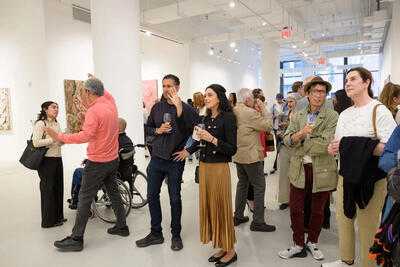
In her solo exhibition at the prestigious Sundaram Tagore Gallery in New York, aptly titled ‘ In Equilibrium ’, the California-based artist presents two bodies of work that together feel like a single, sustained exhale.
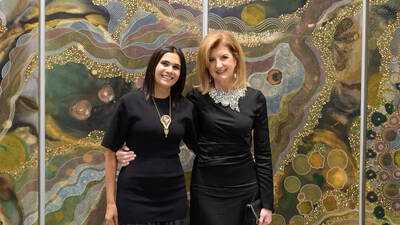
Jain says she came to painting the way many come to prayer — out of necessity. Growing up in Delhi in a large extended family, she was spiritually curious at a young age, immersing herself in ancient religious scriptures and meditation from the age of eight. Around the same time, she also learned to paint. When a series of family tragedies struck during her teenage years, painting became, in her own words, a refuge.
After Stanford and Columbia, she returned to India to paint full-time, producing vibrant mixed-media collages before an encounter with the work of minimalist painter Agnes Martin drew her toward something more distilled. “Her work holds the same paradox I strive for,” Jain says. “Emptiness that is somehow full, stillness that hums with life.” Soon, Jain had discovered her own distinctive visual language of dots, dashes, and lines.
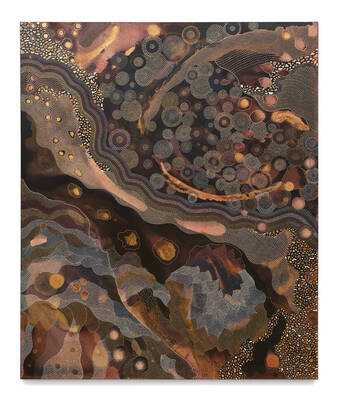
The new solo presents two series born from this mature, refined vocabulary. The Yantra paintings , begun in 2020, are named after the geometric grids used as aids for meditation. Each work is a feat of mathematical patience: Jain maps thousands of tiny cells in preliminary sketches, then fills them on canvas using ink and watercolour, building areas of light and shade that give the flat surface an almost embroidery-like texture. The process aligns with the Sanskrit concept of samadhi — the mind arriving at a state of undisturbed focus.
The Tantra paintings , begun in 2021, are the same impulse set free. Where the Yantras hold and contain, the Tantras spill and swirl spontaneously, coalescing into forms that evoke topographical maps, or colonies of microorganisms glimpsed under the microscope, or starry constellations. “The Yantras bring stillness and infinite space,” Jain says, “and the Tantras, movement and charge. Together they create a rhythm that feels whole.”
Both series are rendered in rich, earthy tones and light-reflecting gold — colours Jain describes as instinctive, pulled from nature. Her recent work has also introduced a vivid magenta known in India as rani pink, once favoured by royalty and still the colour of choice for brides. The watercolours, ink and acrylic paint are now supplemented by micaceous iron oxide that adds a subtle, mineral lustre. Together, the Yantra and the Tantra paintings, which share the same spiritual language, suggest there is an equilibrium that can exist between the opposing forces that reside within us.
Each work in the exhibition is paired with a poem from ‘The Radiance Sutras’, Lorin Roche’s contemporary interpretation of the Vijnana Bhairava Tantra, a Sanskrit scripture detailing 112 meditations. The verses urge readers to find the divine in ordinary moments, which is precisely what Jain’s paintings ask of their viewers. “I think of my paintings as spaces rather than objects,” she says. “Spaces where the viewer can slow down, feel their own breath, and maybe reconnect with some part of themselves that’s gotten lost in the noise.”
In an age where everything is engineered for speed, there is something different about Jain’s insistence on slowness and detail. Every dot is drawn by hand. Every brushstroke echoes a breath. “In the studio, time stretches,” she says. “It bends and slows and eventually dissolves. That slowness is part of the work — it’s embedded into every dot and dash.”
In her solo exhibition at the prestigious Sundaram Tagore Gallery in New York, aptly titled ‘ In Equilibrium ’, the California-based artist presents two bodies of work that together feel like a single, sustained exhale.
Jain says she came to painting the way many come to prayer — out of necessity. Growing up in Delhi in a large extended family, she was spiritually curious at a young age, immersing herself in ancient religious scriptures and meditation from the age of eight. Around the same time, she also learned to paint. When a series of family tragedies struck during her teenage years, painting became, in her own words, a refuge.
After Stanford and Columbia, she returned to India to paint full-time, producing vibrant mixed-media collages before an encounter with the work of minimalist painter Agnes Martin drew her toward something more distilled. “Her work holds the same paradox I strive for,” Jain says. “Emptiness that is somehow full, stillness that hums with life.” Soon, Jain had discovered her own distinctive visual language of dots, dashes, and lines.
The new solo presents two series born from this mature, refined vocabulary. The Yantra paintings , begun in 2020, are named after the geometric grids used as aids for meditation. Each work is a feat of mathematical patience: Jain maps thousands of tiny cells in preliminary sketches, then fills them on canvas using ink and watercolour, building areas of light and shade that give the flat surface an almost embroidery-like texture. The process aligns with the Sanskrit concept of samadhi — the mind arriving at a state of undisturbed focus.
The Tantra paintings , begun in 2021, are the same impulse set free. Where the Yantras hold and contain, the Tantras spill and swirl spontaneously, coalescing into forms that evoke topographical maps, or colonies of microorganisms glimpsed under the microscope, or starry constellations. “The Yantras bring stillness and infinite space,” Jain says, “and the Tantras, movement and charge. Together they create a rhythm that feels whole.”
Both series are rendered in rich, earthy tones and light-reflecting gold — colours Jain describes as instinctive, pulled from nature. Her recent work has also introduced a vivid magenta known in India as rani pink, once favoured by royalty and still the colour of choice for brides. The watercolours, ink and acrylic paint are now supplemented by micaceous iron oxide that adds a subtle, mineral lustre. Together, the Yantra and the Tantra paintings, which share the same spiritual language, suggest there is an equilibrium that can exist between the opposing forces that reside within us.
Each work in the exhibition is paired with a poem from ‘The Radiance Sutras’, Lorin Roche’s contemporary interpretation of the Vijnana Bhairava Tantra, a Sanskrit scripture detailing 112 meditations. The verses urge readers to find the divine in ordinary moments, which is precisely what Jain’s paintings ask of their viewers. “I think of my paintings as spaces rather than objects,” she says. “Spaces where the viewer can slow down, feel their own breath, and maybe reconnect with some part of themselves that’s gotten lost in the noise.”
In an age where everything is engineered for speed, there is something different about Jain’s insistence on slowness and detail. Every dot is drawn by hand. Every brushstroke echoes a breath. “In the studio, time stretches,” she says. “It bends and slows and eventually dissolves. That slowness is part of the work — it’s embedded into every dot and dash.”
Next Story