
India, UAE forge deep defence alliance: $5bn investment, joint production of drones, missiles and naval platforms


India and the United Arab Emirates have elevated their defence relationship to a new level in 2026, moving beyond symbolic cooperation into joint industrial production, maritime security, and cyber defence. The agreements signed during Prime Minister Narendra Modi ’s May visit to Abu Dhabi mark a decisive shift in the Comprehensive Strategic Partnership, positioning the UAE as a pivotal partner in India’s defence industrial growth.
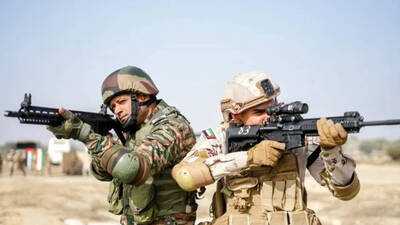
At the heart of the new framework is a Strategic Defence Industrial Partnership , which covers co‑production of unmanned aerial vehicles, precision missiles, naval platforms, and AI‑driven systems. Indian firms such as ICOMM have already partnered with UAE’s CARACAL to manufacture small arms, while broader collaboration is expected to extend into secure communications and advanced munitions. The UAE too has has pledged $5 billion in investments, demonstrating its intent to anchor long‑term cooperation. The defence dialogue mechanism has also been upgraded to the Secretary and Vice‑Minister level, ensuring institutional continuity.
Private industry too is working to expand this cooperation. The India–UAE Defence Industry Cooperation Forum has held meetings for the last two consecutive years, this provides a platform for industries of both the countries to expand cooperation and find areas of common interest. This comes at a time when India’s defence exports hit a record Rs 38,424 crore ($4 billion) in the last financial year.
Maritime security remains a critical pillar and the ongoing conflict in the Gulf has showcased the importance of critical waterways. With nearly half of India’s oil imports transiting the Strait of Hormuz, joint efforts to secure sea lanes in the Gulf and Indian Ocean are strategically vital. The recent drone and missile strikes on Fujairah, injured Indian workers, highlighting shared vulnerabilities. India’s swift condemnation of the attacks reinforced its alignment with UAE’s security concerns. The presence of 4.3 million Indians in the UAE adds a human dimension, making diaspora security a tangible factor in bilateral ties.
Beyond defence, the partnership is embedded in a wider economic and energy framework. Bilateral trade crossed $100 billion in the last financial year that ended on March 31st. Both the countries want the trade to grow to $200 billion by 2032. India also maintains crude storage facilities in Fujairah, linking energy resilience with defence cooperation .
As India pursues self‑reliance in defence manufacturing and the UAE seeks reliable partners amid Gulf tensions, with both Iran and Saudi Arabia. This convergence reflects a pragmatic, forward‑looking strategy. The challenge will be balancing technology transfer sensitivities and navigating regional fault lines, particularly Iran.
At the heart of the new framework is a Strategic Defence Industrial Partnership , which covers co‑production of unmanned aerial vehicles, precision missiles, naval platforms, and AI‑driven systems. Indian firms such as ICOMM have already partnered with UAE’s CARACAL to manufacture small arms, while broader collaboration is expected to extend into secure communications and advanced munitions. The UAE too has has pledged $5 billion in investments, demonstrating its intent to anchor long‑term cooperation. The defence dialogue mechanism has also been upgraded to the Secretary and Vice‑Minister level, ensuring institutional continuity.
Private industry too is working to expand this cooperation. The India–UAE Defence Industry Cooperation Forum has held meetings for the last two consecutive years, this provides a platform for industries of both the countries to expand cooperation and find areas of common interest. This comes at a time when India’s defence exports hit a record Rs 38,424 crore ($4 billion) in the last financial year.
Maritime security remains a critical pillar and the ongoing conflict in the Gulf has showcased the importance of critical waterways. With nearly half of India’s oil imports transiting the Strait of Hormuz, joint efforts to secure sea lanes in the Gulf and Indian Ocean are strategically vital. The recent drone and missile strikes on Fujairah, injured Indian workers, highlighting shared vulnerabilities. India’s swift condemnation of the attacks reinforced its alignment with UAE’s security concerns. The presence of 4.3 million Indians in the UAE adds a human dimension, making diaspora security a tangible factor in bilateral ties.
Beyond defence, the partnership is embedded in a wider economic and energy framework. Bilateral trade crossed $100 billion in the last financial year that ended on March 31st. Both the countries want the trade to grow to $200 billion by 2032. India also maintains crude storage facilities in Fujairah, linking energy resilience with defence cooperation .
As India pursues self‑reliance in defence manufacturing and the UAE seeks reliable partners amid Gulf tensions, with both Iran and Saudi Arabia. This convergence reflects a pragmatic, forward‑looking strategy. The challenge will be balancing technology transfer sensitivities and navigating regional fault lines, particularly Iran.
Next Story