
World's Deepest Lake Turns Into a Glass Wonderland: Why Lake Baikal's Ice Is So Clear

Stand on Lake Baikal in February and the ice beneath your boots looks less like frozen water and more like a pane of plate glass. The lake bed is visible tens of metres below. Cracks run in long, clean lines. Trapped air bubbles hang suspended mid-ice like frozen breath. No other large lake on Earth produces ice quite like this, and the reason sits in the water itself, long before the cold arrives.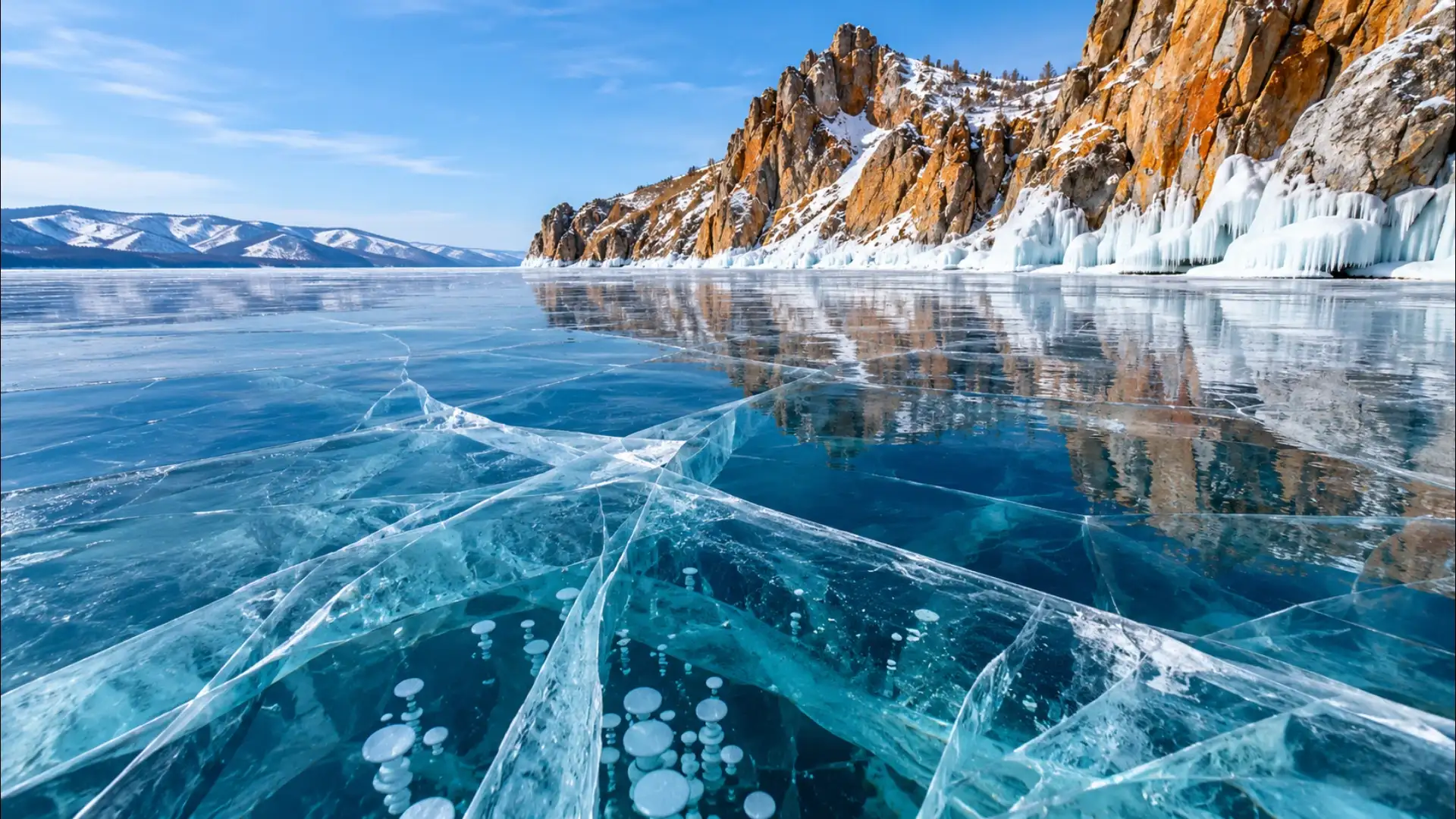
The Purest Water on the Planet
Baikal holds roughly one fifth of all the unfrozen fresh water on Earth's surface. It is also extraordinarily clean. The lake has no significant agricultural runoff feeding into it from the surrounding basin, and its primary inflow rivers carry relatively little sediment. More importantly, the lake hosts a tiny crustacean called Epischura baikalensis, which exists almost nowhere else. These animals filter the water continuously, consuming algae and bacteria before they can accumulate. The result is water with almost nothing suspended in it, no silt, no organic particles, no dissolved colour. When water contains nothing to scatter light, it transmits light instead. Ice made from this water inherits the same optical property.How Ice Traps Clarity or Kills It
Ice clarity depends almost entirely on what happens during freezing. When water freezes slowly and from the top down, dissolved gases and suspended particles have time to migrate ahead of the advancing ice front, pushed out rather than locked in. What remains is a crystalline lattice of water molecules with very little else inside it. Baikal freezes in exactly this way. The cold descends gradually over weeks, the surface chills first, and the ice thickens downward at a pace that allows impurities to escape. In contrast, ice formed quickly, in a shallow pond that freezes overnight, or in a river where turbulence mixes the water, traps gas bubbles and particles mid-crystal. That ice looks white or milky because the trapped inclusions scatter light in every direction. Baikal's slow freeze leaves almost nothing to scatter.You may also like
- 11 killed as bus collides with truck in UAE's Ras Al Khaimah
- Colorado parents raised nearly $14,000 on GoFundMe to sue their school board, alleging that it decided school closures in secret meetings despite their repeated letters demanding transparency
- Drone strikes in Sudan threaten humanitarian operations: UN
- 20 Pakistani personnel killed in series of attacks across Balochistan, claims BLA
- A Delaware man trying to sell his family's $125,000 land found neighbour had been using nearly two-thirds of an acre for over 20 years, building a goat pen and garden; he took her to court, but she won ownership of the property
Why Depth Matters
Baikal is the deepest lake on Earth, reaching more than 1,600 metres at its lowest point. That depth matters for ice clarity in a way that is not immediately obvious. Deep water holds an enormous thermal mass. The lake does not cool quickly or unevenly. The surface temperature drops steadily through autumn, the water column turns over as denser cold water sinks, and by the time the surface is ready to freeze, the entire upper layer has reached a uniform temperature close to zero. There are no warm pockets pushing up from below to disturb the freezing front, no sudden cold snaps that rush the process. The depth enforces patience, and patience produces clear ice.The Cracks That Let You See Even Further
Baikal's ice is famous not just for its transparency but for the long, straight fractures that run across its surface each winter. These form because ice expands and contracts with temperature changes, and the lake is large enough that the stresses cannot be absorbed without splitting. The cracks are actually useful: they allow fresh oxygenated air to reach the water below, which keeps the ecosystem alive through winter. They also create natural windows. Where a crack has refrozen cleanly, the new ice is often the clearest of all, formed from water that welled up from depth and froze in a single, rapid, uncontaminated sheet. Locals and photographers seek these refrozen cracks out deliberately.What the Ice Reveals About the Lake
The transparency of Baikal's ice is not a decorative feature. It is a direct measurement of the lake's ecological health. When the filtering organisms are thriving and the watershed is clean, the water stays clear and the ice follows. Scientists use ice clarity alongside other indicators to track the lake's condition across years. A murkier winter, all else being equal, points to something changing in the water below. The ice is, in this sense, a seasonal report written in frozen light, legible to anyone willing to lie flat on its surface and look down.





Loving Newspoint? Download the app now
