
Why Santorini's Houses Are Painted White and Blue

Few images travel as far as Santorini's whitewashed walls and cobalt domes stacked above the caldera. Tourists photograph them by the million. But the colours were not chosen for beauty. They arrived through necessity, politics, and the physics of heat, and the story behind them is more interesting than the postcard.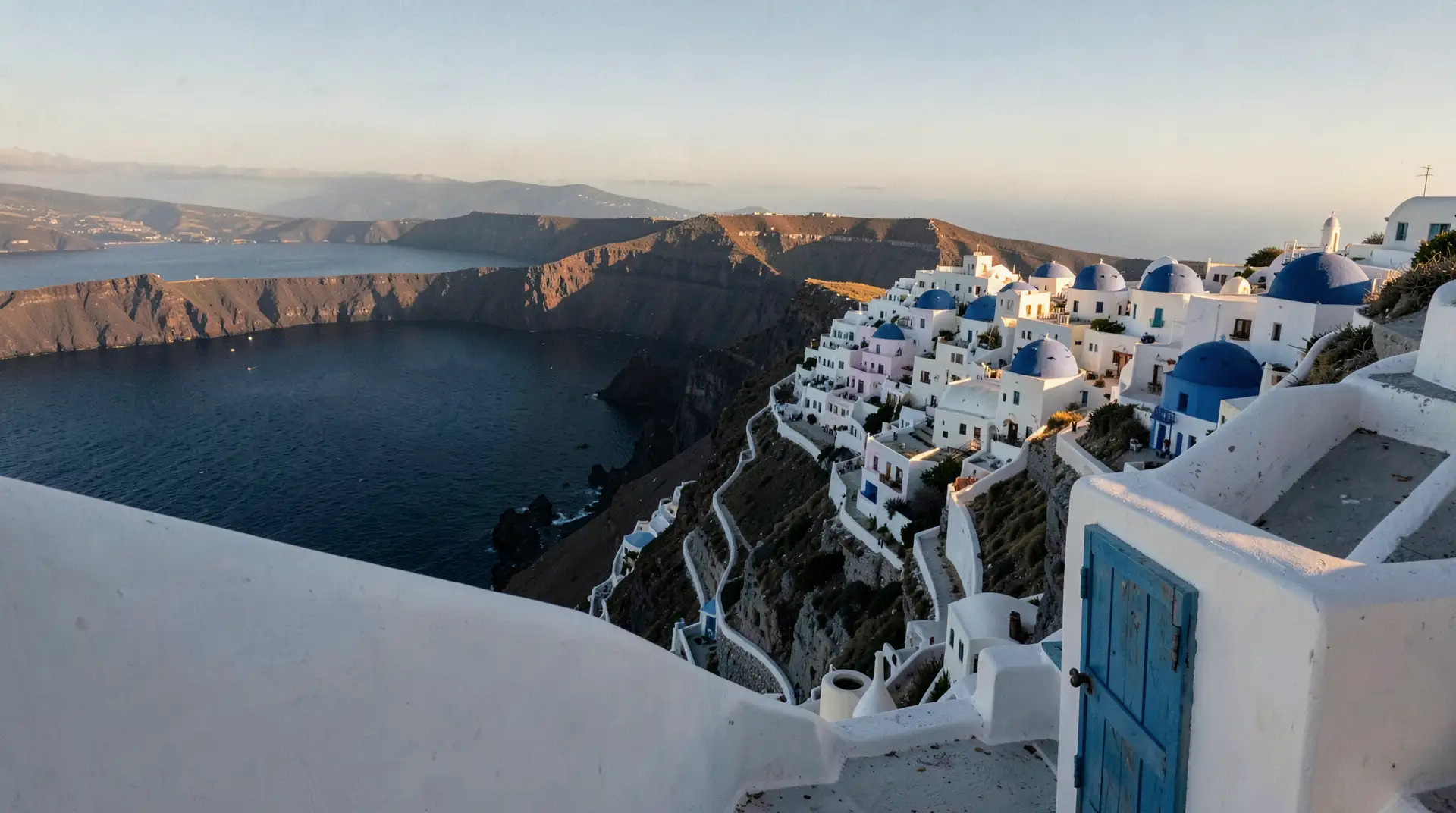
Lime wash is strongly alkaline. When applied to stone and plaster walls, it kills bacteria and fungi on contact, and the effect renews itself slightly each time rain wets the surface.
Whitewashing was, in effect, a public-health measure imposed across the islands, not an aesthetic choice made by individual homeowners. The practice was already common in the Mediterranean, similar logic drove whitewashing in parts of North Africa and the Middle East, but in Greece it became policy.
During the military junta that governed Greece from 1967 to 1974, the regime issued a directive requiring that buildings in the Cyclades, the island group that includes Santorini, Mykonos, and Paros, be painted in the colours of the Greek flag: white and blue.
The order was partly nationalist symbolism and partly an early recognition that tourism was becoming economically important. A visually unified island was a more marketable island. The blue that visitors see today on domes, shutters, and doors is a direct legacy of that decree. Before it, shutters and doors came in a wider range of colours: terracotta, ochre, green.
White surfaces reflect a large share of incoming solar radiation rather than absorbing it, keeping interior temperatures substantially lower than they would be behind dark stone. This is the same principle that makes white clothing cooler in the sun.
On a volcanic island with little shade and almost no trees on the exposed caldera rim, the reflective surface of a whitewashed wall is not decoration, it is insulation working in reverse, pushing heat away rather than trapping it. The thick walls of Cycladic architecture do the rest, storing the cool of the night and releasing it slowly through the day.
The island is the remaining arc of what was once a roughly circular landmass. The caldera is the sunken centre of the old volcano, now filled with seawater. Building on that rim meant working with volcanic stone, dark, porous, and abundant, and the lime wash that covers it creates the visual contrast between the black rock of the cliff face and the blinding white of the structures above. The blue of the sea below completes the palette that no designer could have planned.
What began as a health measure, was fixed by political decree, and was sustained by physics has become self-perpetuating through economics. The colours are now the product as much as the island itself. The white walls and blue domes are not a tradition stretching back to antiquity.
They are a twentieth-century invention that became, within a few generations, inseparable from how the world pictures Greece.
A Practical Answer to a Killing Disease
For centuries, the Aegean islands suffered repeated outbreaks of cholera. In the early twentieth century, Greek health authorities ordered that buildings be whitewashed with a lime-based paint called ασβέστης, asvestis.Lime wash is strongly alkaline. When applied to stone and plaster walls, it kills bacteria and fungi on contact, and the effect renews itself slightly each time rain wets the surface.
Whitewashing was, in effect, a public-health measure imposed across the islands, not an aesthetic choice made by individual homeowners. The practice was already common in the Mediterranean, similar logic drove whitewashing in parts of North Africa and the Middle East, but in Greece it became policy.
The Dictatorship That Fixed the Blue
White became the rule across many Greek islands, but the specific combination of white walls and blue domes is more recent than most visitors assume.During the military junta that governed Greece from 1967 to 1974, the regime issued a directive requiring that buildings in the Cyclades, the island group that includes Santorini, Mykonos, and Paros, be painted in the colours of the Greek flag: white and blue.
The order was partly nationalist symbolism and partly an early recognition that tourism was becoming economically important. A visually unified island was a more marketable island. The blue that visitors see today on domes, shutters, and doors is a direct legacy of that decree. Before it, shutters and doors came in a wider range of colours: terracotta, ochre, green.
What the White Actually Does to Heat
Santorini sits in one of the sunniest parts of Europe. Summer temperatures regularly climb high enough to make dark-walled buildings genuinely dangerous to inhabit.White surfaces reflect a large share of incoming solar radiation rather than absorbing it, keeping interior temperatures substantially lower than they would be behind dark stone. This is the same principle that makes white clothing cooler in the sun.
On a volcanic island with little shade and almost no trees on the exposed caldera rim, the reflective surface of a whitewashed wall is not decoration, it is insulation working in reverse, pushing heat away rather than trapping it. The thick walls of Cycladic architecture do the rest, storing the cool of the night and releasing it slowly through the day.
The Volcanic Ground Beneath It All
Santorini's particular drama, the sheer drop of the caldera, the stacked villages of Oia and Fira clinging to the rim, is the result of one of the largest volcanic eruptions in recorded human history, which occurred roughly 3,600 years ago and may have contributed to the collapse of the Minoan civilisation on Crete.The island is the remaining arc of what was once a roughly circular landmass. The caldera is the sunken centre of the old volcano, now filled with seawater. Building on that rim meant working with volcanic stone, dark, porous, and abundant, and the lime wash that covers it creates the visual contrast between the black rock of the cliff face and the blinding white of the structures above. The blue of the sea below completes the palette that no designer could have planned.
Why the Colours Have Stayed
The junta's decree is long gone, but the colours remain because the island's economy now depends on the image those colours project. Local building codes in Santorini enforce the white-and-blue palette. Property owners who paint outside the approved range face fines.What began as a health measure, was fixed by political decree, and was sustained by physics has become self-perpetuating through economics. The colours are now the product as much as the island itself. The white walls and blue domes are not a tradition stretching back to antiquity.
They are a twentieth-century invention that became, within a few generations, inseparable from how the world pictures Greece.
Next Story