
How the Northern Lights Form and Why They Glow Green

The sun is not the calm, steady lamp it appears to be from Earth. Its surface churns with magnetic storms that fling streams of charged particles, mostly electrons and protons, outward in every direction. This constant outflow is called the solar wind, and Earth sits squarely in its path.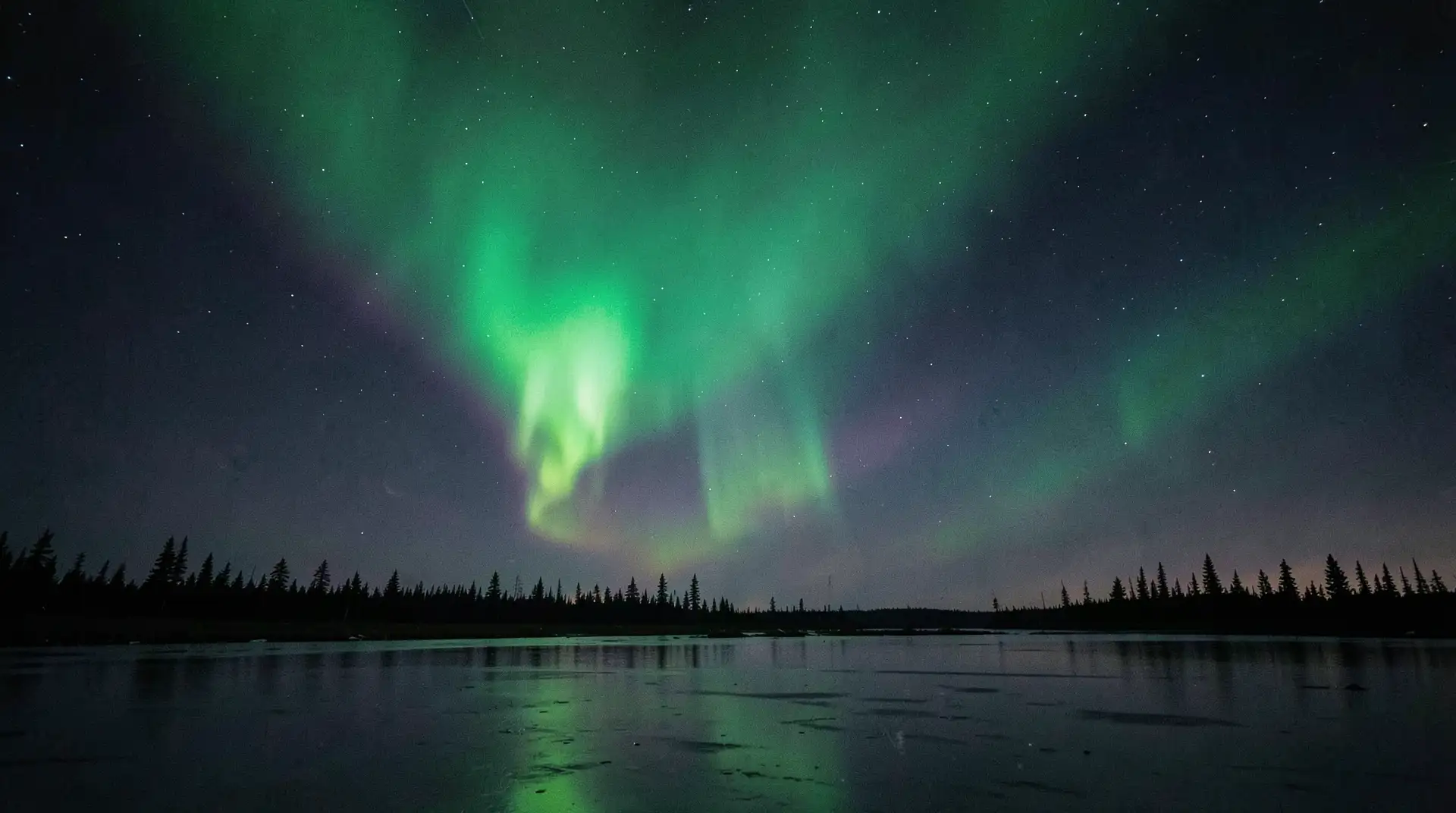
The northern lights are, at their core, a collision, the sun's restless energy meeting Earth's quiet defence, with light as the only evidence left behind. Green is just the colour oxygen makes when it absorbs the blow.
Earth's Magnetic Shield Does the Sorting
Earth is wrapped in an invisible magnetic field generated by molten iron churning in its core. When the solar wind reaches Earth, this field deflects most of it around the planet the way a rock splits a river. But the field is not a perfect shell. At the poles, the field lines curve inward and funnel some of those charged particles down toward the atmosphere. That funnelling is why auroras appear in rings around the magnetic poles, not scattered randomly across the sky.The Collision That Makes Light
As the particles descend, they slam into gas molecules in the upper atmosphere at altitudes roughly between 100 and 300 kilometres above the ground. The collision excites the gas atoms, it pushes their electrons into a higher energy state. When those electrons drop back to their normal state, they release the borrowed energy as light. This is the same principle that makes a neon sign glow: electricity excites gas, gas releases colour.Why Green Is the Dominant Colour
The colour depends on which gas is hit and at what altitude. Oxygen at around 100 to 150 kilometres produces the most common aurora colour: a vivid yellow-green. That altitude is where oxygen is dense enough to be hit frequently and where the collision energy matches the green wavelength almost exactly. Higher up, above 200 kilometres, oxygen thins out and the collisions produce red, the rarest and most dramatic aurora colour, sometimes visible only in photographs. Nitrogen, which makes up most of the atmosphere, contributes blues and purples, usually at the lower edges of the display where the particles have driven deepest. The green dominates simply because oxygen at mid-altitude is the most common target in the collision zone.Why the Lights Move and Ripple
The aurora is not a fixed curtain. It shifts because the solar wind is not constant. Gusts of particles arrive in pulses, and Earth's magnetic field flexes in response. When a particularly strong burst, called a coronal mass ejection, leaves the sun, it can compress the magnetic field enough to push the aurora ring further from the poles, making it visible from latitudes that rarely see it. The rippling, curtain-like motion comes from variations in the particle stream hitting different parts of the atmosphere at slightly different moments, like wind moving through tall grass at different speeds across a field.Why Some Places See It and Others Don't
The aurora follows the magnetic poles, not the geographic ones. The magnetic north pole sits over the Canadian Arctic and drifts slowly over time. The band where auroras appear most reliably, called the auroral oval, runs through northern Norway, Iceland, northern Canada, Alaska, and the northern tip of Russia. Observers further south see it only when solar activity is unusually high and the oval expands. In the Southern Hemisphere, the same phenomenon plays out as the aurora australis, visible from the southern tip of South America, Antarctica, and occasionally Tasmania and New Zealand.The northern lights are, at their core, a collision, the sun's restless energy meeting Earth's quiet defence, with light as the only evidence left behind. Green is just the colour oxygen makes when it absorbs the blow.
Next Story