
How the Sahara Transformed from a Green Land to Earth's Largest Desert

The Sahara stretches across roughly nine million square kilometres today, a landscape so arid that less than a centimetre of rain may fall in a year across large parts of it. Yet beneath its dunes lie the dried beds of ancient rivers, the bones of crocodiles and hippos, and rock paintings left by people who once herded cattle across open savanna. The desert is not a permanent condition. It is a phase.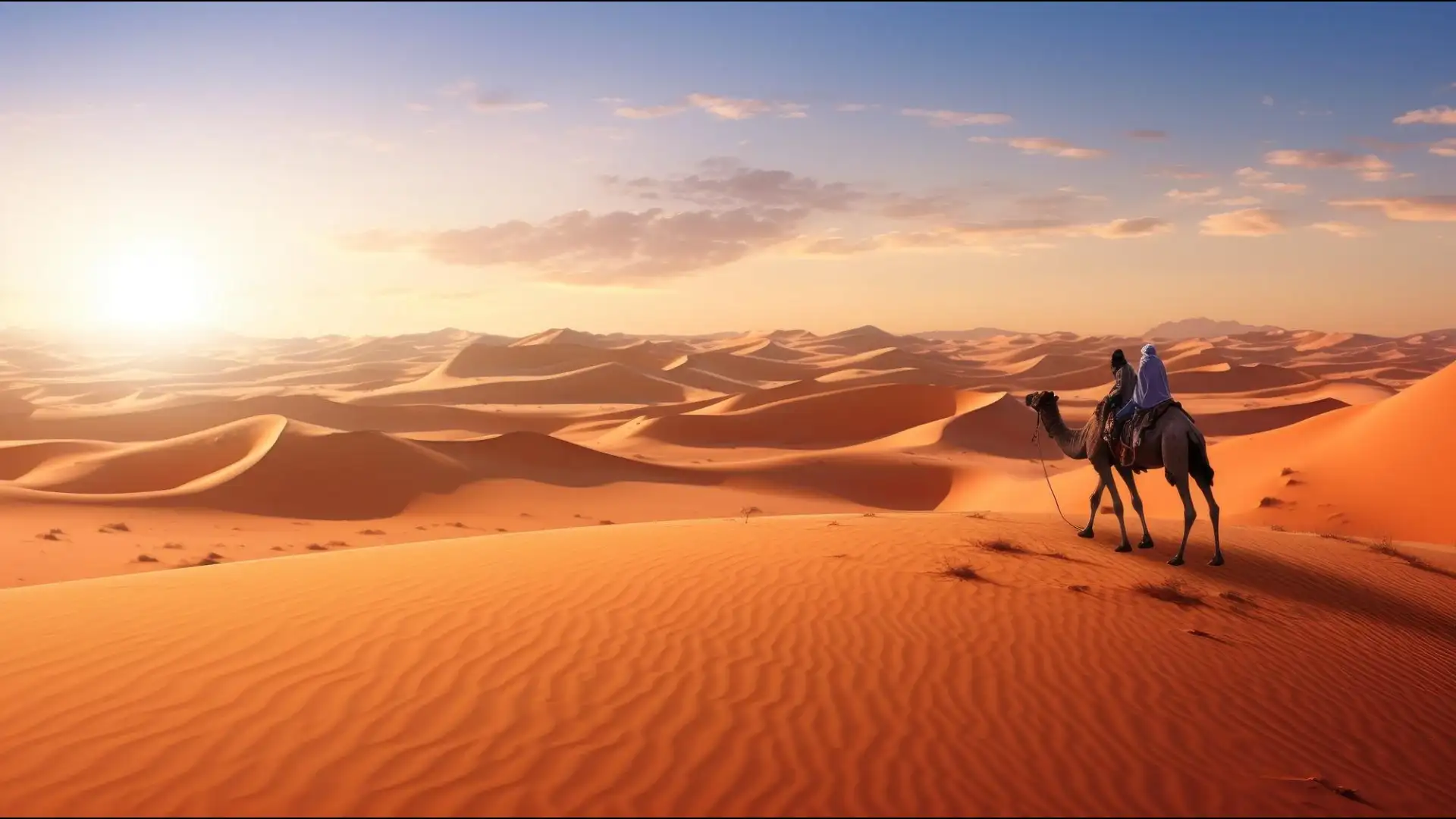
Evidence comes from multiple directions. Pollen preserved in ancient lake sediments shows species that require reliable rainfall. Fossils of fish, crocodiles, and water buffalo have been found hundreds of kilometres inside the present desert boundary. And the rock art, etched and painted across cliff faces in Algeria, Libya, Niger, and Chad, shows elephants, giraffes, and cattle in landscapes that look nothing like the region today.
Around eleven thousand years ago, the particular configuration of Earth's orbit meant that the Northern Hemisphere received more solar energy during summer than it does today. That extra heat warmed the land surface of North Africa more intensely than the ocean surface. Warm land pulls moisture-laden air inland from the ocean, this is the basic mechanism of a monsoon. The West African monsoon, which today barely reaches the southern edge of the Sahara, extended deep into the continent. Rain followed.
This was not a small shift. The monsoon boundary moved northward by hundreds of kilometres. The rains that today fall on the Sahel, the semi-arid belt just south of the Sahara, once fell on what is now deep desert.
Vegetation holds soil moisture and releases water vapour into the air through transpiration. It also changes how the land surface reflects sunlight, bare sand reflects a great deal of heat back into the atmosphere, while plant cover absorbs more of it, warming the surface and encouraging the convection that draws in moist air. As grasslands spread, they reinforced the conditions that kept the rains coming. The green Sahara sustained itself partly through the presence of the vegetation it had created.
The reverse is also true. As Earth's orbital configuration gradually shifted back, the process takes thousands of years, the monsoon began to retreat. Vegetation thinned. More bare soil appeared. Bare soil reflected more heat and held less moisture.
The monsoon retreated further. The feedback that had sustained the green Sahara now accelerated its drying. Some researchers believe this collapse happened faster than the orbital change alone would predict, precisely because of these vegetation feedbacks.
The most widely discussed hypothesis is that many moved toward the Nile Valley, concentrating people, agricultural knowledge, and social complexity in a narrow fertile corridor. Some researchers connect this population pressure to the conditions that gave rise to early Egyptian civilisation, though the relationship between Saharan drying and Nile Valley cultures is still an active area of research with competing interpretations.
What is clear is that the drying was not instantaneous. It unfolded over centuries, and people adapted, moved, and reorganised across generations. The Sahara did not empty overnight.
The Sahara also illustrates that the planet's climate has multiple stable states, not just one. A large region of Earth spent thousands of years in a fundamentally different configuration. The transition between those states was driven by a relatively modest change in how much sunlight reached the surface at a particular time of year. Understanding those transitions, and the feedbacks that made them so complete, remains one of the more productive areas of Earth science.
The sand dunes covering ancient riverbeds are not evidence that the Sahara was always a desert. They are evidence that it was not, and that the conditions shaping any landscape are far less permanent than they appear from a single human lifetime.
When the Sahara Was Green
Geologists and climate scientists call it the African Humid Period , sometimes the Green Sahara . It lasted roughly from eleven thousand to five thousand years ago, a stretch of time when the Sahara received far more rainfall than it does today. Lakes filled basins that are now cracked salt flats. The Niger River extended further north. Forests edged into what is now open desert, and savanna grasses covered plains where almost nothing grows today.Evidence comes from multiple directions. Pollen preserved in ancient lake sediments shows species that require reliable rainfall. Fossils of fish, crocodiles, and water buffalo have been found hundreds of kilometres inside the present desert boundary. And the rock art, etched and painted across cliff faces in Algeria, Libya, Niger, and Chad, shows elephants, giraffes, and cattle in landscapes that look nothing like the region today.
The Orbital Trigger
The cause begins with a slow wobble in Earth's orbit. Earth does not circle the Sun in a perfectly fixed path or at a perfectly fixed tilt. Over cycles spanning thousands of years, the tilt of Earth's axis shifts, and the shape of its orbit stretches and contracts. These are called Milankovitch cycles , named after the Serbian mathematician who calculated them in the early twentieth century.Around eleven thousand years ago, the particular configuration of Earth's orbit meant that the Northern Hemisphere received more solar energy during summer than it does today. That extra heat warmed the land surface of North Africa more intensely than the ocean surface. Warm land pulls moisture-laden air inland from the ocean, this is the basic mechanism of a monsoon. The West African monsoon, which today barely reaches the southern edge of the Sahara, extended deep into the continent. Rain followed.
This was not a small shift. The monsoon boundary moved northward by hundreds of kilometres. The rains that today fall on the Sahel, the semi-arid belt just south of the Sahara, once fell on what is now deep desert.
How Vegetation Amplified the Change
Once rain arrived, plants followed. And plants changed the land in ways that brought more rain. This is a feedback loop that climate scientists find important for understanding how the Sahara's transformation was so dramatic.Vegetation holds soil moisture and releases water vapour into the air through transpiration. It also changes how the land surface reflects sunlight, bare sand reflects a great deal of heat back into the atmosphere, while plant cover absorbs more of it, warming the surface and encouraging the convection that draws in moist air. As grasslands spread, they reinforced the conditions that kept the rains coming. The green Sahara sustained itself partly through the presence of the vegetation it had created.
The reverse is also true. As Earth's orbital configuration gradually shifted back, the process takes thousands of years, the monsoon began to retreat. Vegetation thinned. More bare soil appeared. Bare soil reflected more heat and held less moisture.
The monsoon retreated further. The feedback that had sustained the green Sahara now accelerated its drying. Some researchers believe this collapse happened faster than the orbital change alone would predict, precisely because of these vegetation feedbacks.
What Happened to the People
Human populations had spread across the green Sahara during the humid period. Archaeological sites cluster around what were once lake shores and river banks, places where people fished, herded animals, and made tools. As the desert returned, those populations moved.The most widely discussed hypothesis is that many moved toward the Nile Valley, concentrating people, agricultural knowledge, and social complexity in a narrow fertile corridor. Some researchers connect this population pressure to the conditions that gave rise to early Egyptian civilisation, though the relationship between Saharan drying and Nile Valley cultures is still an active area of research with competing interpretations.
What is clear is that the drying was not instantaneous. It unfolded over centuries, and people adapted, moved, and reorganised across generations. The Sahara did not empty overnight.
What This Tells Us About Climate
The green Sahara is one of the clearest examples in the geological record of how profoundly Earth's climate system can reorganise itself without any human involvement. Orbital mechanics, atmospheric circulation, and vegetation feedbacks combined to turn a desert into a grassland and then back again. The same feedback mechanisms, where a change in one part of the system amplifies changes elsewhere, are central to how scientists think about climate today.The Sahara also illustrates that the planet's climate has multiple stable states, not just one. A large region of Earth spent thousands of years in a fundamentally different configuration. The transition between those states was driven by a relatively modest change in how much sunlight reached the surface at a particular time of year. Understanding those transitions, and the feedbacks that made them so complete, remains one of the more productive areas of Earth science.
The sand dunes covering ancient riverbeds are not evidence that the Sahara was always a desert. They are evidence that it was not, and that the conditions shaping any landscape are far less permanent than they appear from a single human lifetime.
Next Story