
Why the Sky Is Blue by Day and Red at Sunset

Sunlight looks white, but it is every colour packed together. Each colour travels as a wave, and those waves differ in length. Violet and blue are short and choppy. Red and orange are long and slow. That difference in wavelength is everything.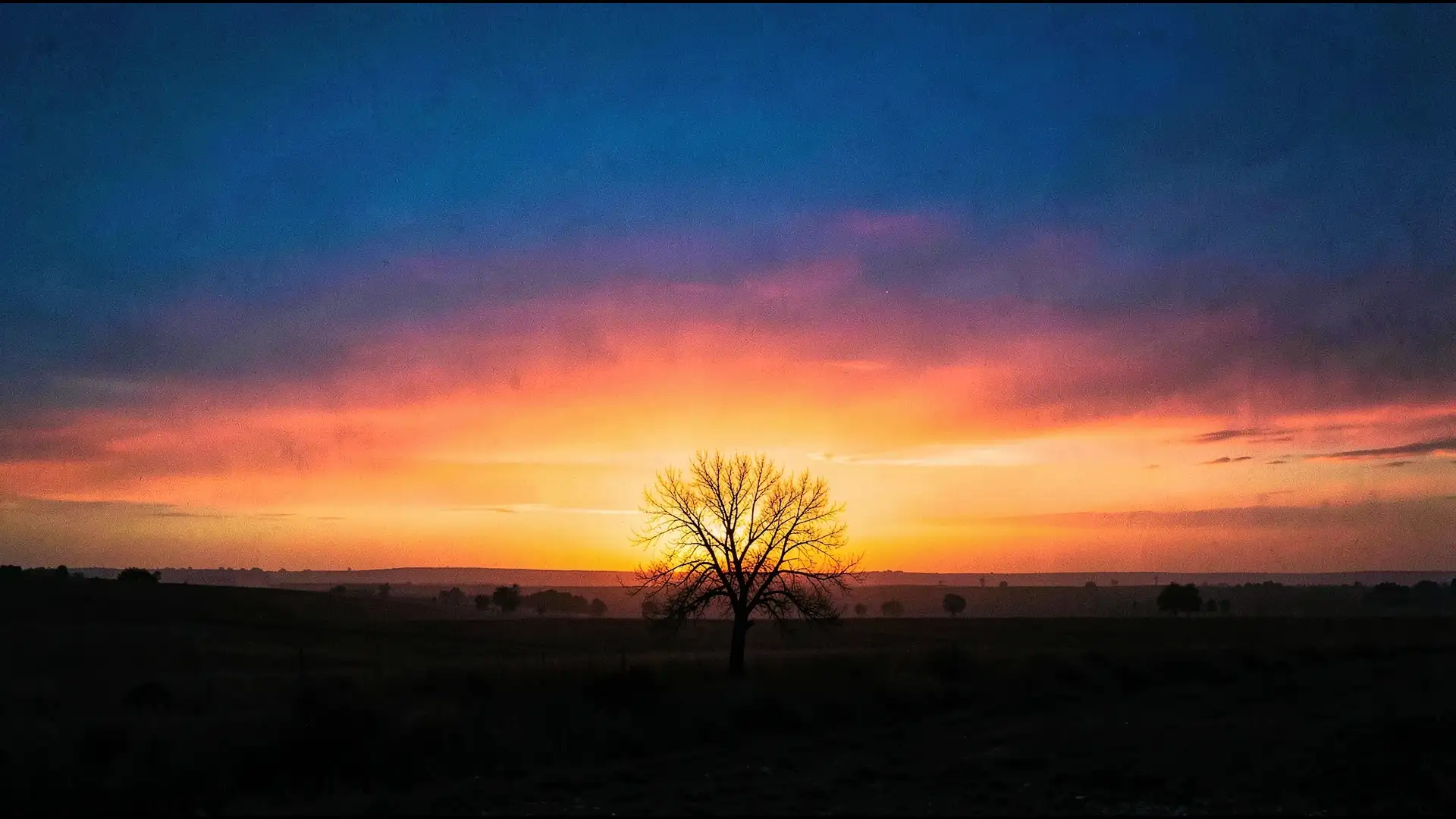
The key finding: shorter wavelengths scatter far more readily than longer ones. Blue light scatters roughly ten times more than red light across the same stretch of air. So when sunlight enters overhead and travels a relatively short path through the atmosphere to reach your eyes, blue light has been flung sideways in all directions across the whole sky.
You look up anywhere, straight overhead, toward the horizon, anywhere except directly at the sun, and scattered blue light is arriving at your eye from every angle. The sky looks blue.
The eye has three types of colour receptors, and the combination that fires when scattered sky-light hits them reads as blue, not violet. The sky is doing its violet thing. Your eye is just not built to report it that way.
What remains is the light that was always bad at scattering: the long-wavelength reds and oranges. They travel the full path with far less deflection and arrive at the horizon intact. The sky near the setting sun turns orange, then red, then deep crimson as the path length grows and the blue loss compounds.
The same effect colours clouds from below, because the light illuminating their undersides has already run the same long gauntlet.
A dusty desert evening or the air after a distant wildfire can produce sunsets so saturated they look edited. The cleaner the air, the purer but often the quieter the colour. A clear sky after rain tends to give a sharp, clean blue by day and a relatively soft sunset. Haze and particulates push the display toward the dramatic.
The same piece of physics, one rule about how wave size determines how easily a wave bounces off a molecule, writes both the calm blue of noon and the burning horizon of evening. The sky is not switching between two different phenomena. It is running the same process at two different path lengths, and the difference in distance does all the work.
What Scattering Actually Means
When sunlight enters the atmosphere, it collides with the tiny nitrogen and oxygen molecules that make up air. Those collisions do not absorb the light, they bounce it sideways in every direction. The technical name is Rayleigh scattering, after the physicist who worked it out in the nineteenth century.The key finding: shorter wavelengths scatter far more readily than longer ones. Blue light scatters roughly ten times more than red light across the same stretch of air. So when sunlight enters overhead and travels a relatively short path through the atmosphere to reach your eyes, blue light has been flung sideways in all directions across the whole sky.
You look up anywhere, straight overhead, toward the horizon, anywhere except directly at the sun, and scattered blue light is arriving at your eye from every angle. The sky looks blue.
Why Not Violet, Since Violet Is Even Shorter
This is the question that stops people. Violet wavelengths scatter even more than blue, so the sky should look violet by that logic. Two things prevent it. First, the sun puts out less violet light than blue light to begin with. Second, and more importantly, human eyes are far more sensitive to blue than to violet.You may also like
- New York City proposes ban on restaurants boiling live lobsters, crabs and other crustaceans, with repeat violations attracting fines of up to $100 amid concerns over whether the creatures feel pain
- US nonprofit chief Abraham Jaipaul Papabathini accused of sexually abusing minor girls in India; FBI seeks potential victims
- Quinnipiac University lockdown lifted after possible gunman report turns out to be hoax; classes cancelled
- India Condemns Attacks on Commercial Ships, Emphasizes Sailors Safety
- A Texas woman alleged her three brothers divided gold and silver coins from their mother's safe while she was in hospice; a jury valued the coins at $630,603, and a November 19 appeals court restored its damages finding
The eye has three types of colour receptors, and the combination that fires when scattered sky-light hits them reads as blue, not violet. The sky is doing its violet thing. Your eye is just not built to report it that way.
What Changes at Sunset
When the sun is low on the horizon, its light travels through a much longer diagonal slice of atmosphere to reach you, many times longer than the midday path. Over that extended distance, the blue light scatters so many times, in so many directions, that almost none of it survives the journey to your eye. It has been scattered away.What remains is the light that was always bad at scattering: the long-wavelength reds and oranges. They travel the full path with far less deflection and arrive at the horizon intact. The sky near the setting sun turns orange, then red, then deep crimson as the path length grows and the blue loss compounds.
The same effect colours clouds from below, because the light illuminating their undersides has already run the same long gauntlet.
Why Some Sunsets Are More Vivid Than Others
Particles in the air beyond oxygen and nitrogen, dust, smoke, sea salt, fine water droplets, add their own scattering. They are larger than air molecules and scatter light differently, pulling in more of the middle wavelengths and deepening the reds that remain.A dusty desert evening or the air after a distant wildfire can produce sunsets so saturated they look edited. The cleaner the air, the purer but often the quieter the colour. A clear sky after rain tends to give a sharp, clean blue by day and a relatively soft sunset. Haze and particulates push the display toward the dramatic.
The same piece of physics, one rule about how wave size determines how easily a wave bounces off a molecule, writes both the calm blue of noon and the burning horizon of evening. The sky is not switching between two different phenomena. It is running the same process at two different path lengths, and the difference in distance does all the work.






Loving Newspoint? Download the app now
