
How Emperor Penguins Survive the Harshest Winter on Earth

The Antarctic winter is not simply cold. It is a months-long darkness where temperatures fall to minus 60 degrees Celsius and winds gust past 200 kilometres per hour. No other bird on the planet chooses this as a breeding season. The emperor penguin does, and the reason comes down to timing, physics, and one of the most effective collective behaviours in nature.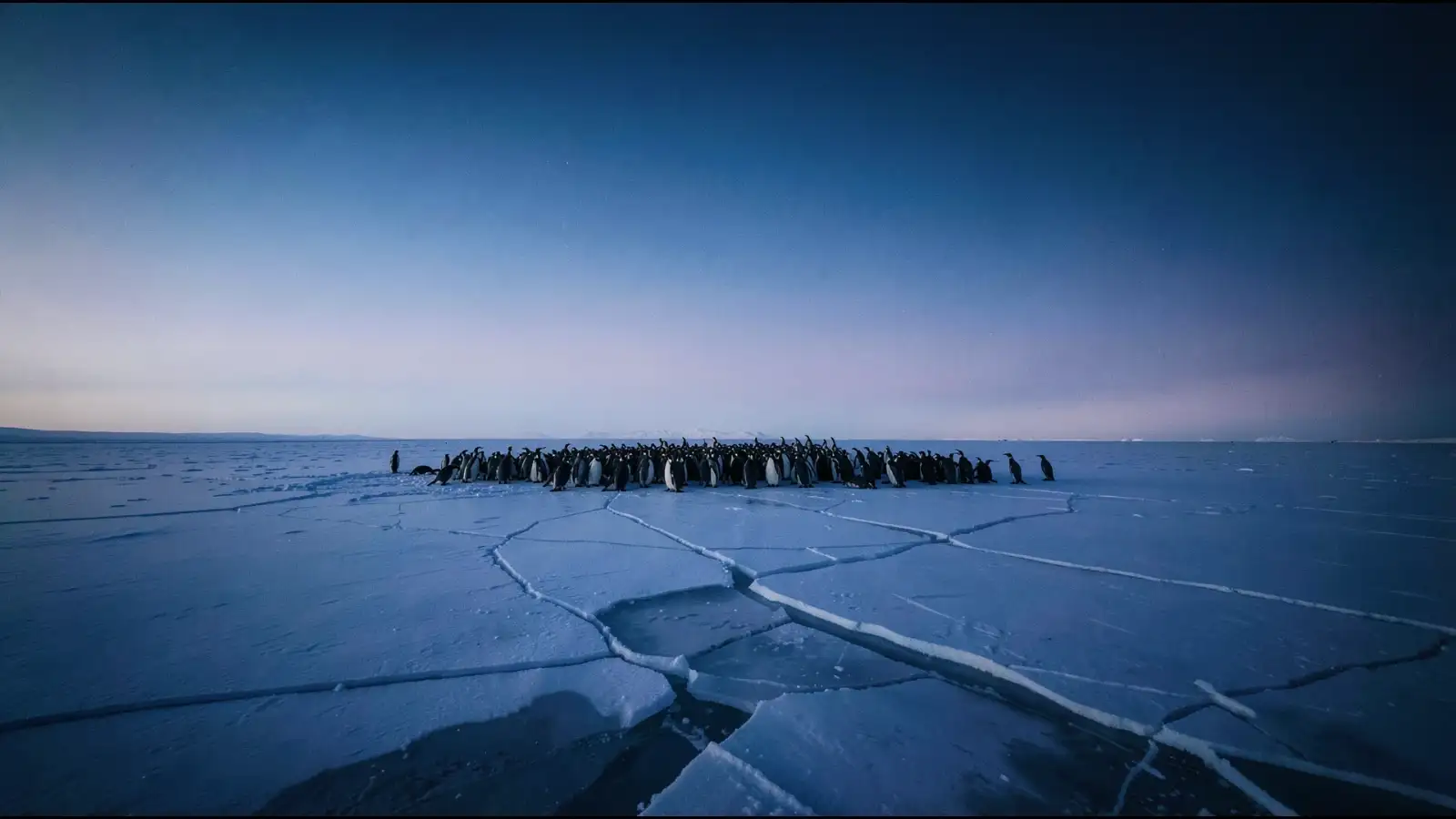
The huddle is not static. Birds on the windward edge, where heat loss is greatest, slowly shuffle inward. Birds at the warm centre drift outward. The whole mass rotates continuously, so no individual stays exposed for long. Scientists studying huddle dynamics have found the interior temperature can reach 37 degrees Celsius even when the air outside sits at minus 40. The huddle functions as a single thermal mass, and the shuffling keeps it alive.
Their feathers add a second layer of protection. Emperor penguin feathers are unusually short, stiff, and densely packed, around 100 feathers per square centimetre, more than any other bird species. They trap a layer of warm air against the skin and shed wind and water at the outer surface. Underneath, a layer of down adds insulation before the outer feathers even begin their work.
Blood vessels in the legs and feet run in a countercurrent arrangement: warm arterial blood flowing down sits directly alongside cold venous blood returning from the feet. Heat transfers from the warm channel to the cold one before it is lost to the ice. The feet stay just above freezing, cold enough to limit heat loss, warm enough to avoid tissue damage. The same mechanism appears in the flippers.
The handoff is precise. If the female is late and the chick hatches before she arrives, the male can produce a small secretion from his oesophagus, sometimes called penguin milk, to keep the chick alive for a few extra days. It is a narrow margin, and it does not last long.
The emperor penguin's winter is a chain of interlocking solutions: the huddle solves heat loss, fat solves fuel, the brood pouch solves egg temperature, countercurrent circulation solves extremity cold, and individual calls solve reunion in a crowd. Remove any one link and the chain breaks. That every link holds, in the worst weather on the planet, is what makes the emperor penguin's winter one of the more remarkable things a living animal does.
Why Breed in Winter at All?
Emperor penguins lay their single egg in May or June, the start of the Antarctic winter. The chick hatches after roughly 65 days and must grow large enough to survive its first summer by the time the sea ice breaks up and food becomes accessible. Work backward from that date and the egg has to be laid in the coldest, darkest part of the year. The birds have no choice. The season is fixed by the chick's growth calendar, not by comfort.The Huddle: A Living Furnace
The male emperor penguin incubates the egg alone while the female travels up to 80 kilometres across ice to reach open water and feed. The male eats nothing for the entire incubation period, which can stretch past two months. To survive, thousands of males press together into a huddle so dense that each bird occupies less than a square foot of space.The huddle is not static. Birds on the windward edge, where heat loss is greatest, slowly shuffle inward. Birds at the warm centre drift outward. The whole mass rotates continuously, so no individual stays exposed for long. Scientists studying huddle dynamics have found the interior temperature can reach 37 degrees Celsius even when the air outside sits at minus 40. The huddle functions as a single thermal mass, and the shuffling keeps it alive.
Feathers, Fat, and Countercurrent Heat
Before the winter march inland, emperor penguins spend months at sea eating. They arrive at the breeding colony carrying roughly 40 percent of their body weight as fat. This fat is the only fuel available for the entire incubation period.You may also like
- 'Look outside, Jack!' Who was the man called out by female pilot Nathalia in final moments of Learjet crash?
- Meet Yip Ward and Paul Mappley, couple who couldn't afford a UK home buy French hamlet for £26,000, with seven cottages, two barns and more; save over £100,000 by renovating themselves
- Trump's Justice dept steps into US midterm battles before votes are counted, breaks decades-old practice
- Pakistan: Seven schools in Khyber Pakhtunkhwa shut due to lack of teachers, security concerns
- A New Zealand couple bought 13 hectares of land for NZ$122,500 in 1992 and found giant old church doors; three decades later, their recycled-brick castle has towers, battlements and a secret dungeon trapdoor
Their feathers add a second layer of protection. Emperor penguin feathers are unusually short, stiff, and densely packed, around 100 feathers per square centimetre, more than any other bird species. They trap a layer of warm air against the skin and shed wind and water at the outer surface. Underneath, a layer of down adds insulation before the outer feathers even begin their work.
Blood vessels in the legs and feet run in a countercurrent arrangement: warm arterial blood flowing down sits directly alongside cold venous blood returning from the feet. Heat transfers from the warm channel to the cold one before it is lost to the ice. The feet stay just above freezing, cold enough to limit heat loss, warm enough to avoid tissue damage. The same mechanism appears in the flippers.
The Egg on the Feet
The male never sets the egg on the ice. He balances it on the tops of his feet and covers it with a fold of warm abdominal skin called a brood pouch. The egg sits in contact with blood vessels and stays at roughly 38 degrees Celsius while the air around it is lethal. If a male drops the egg for more than a few minutes in extreme cold, the embryo dies. The huddle helps here too: inside the mass, wind chill is negligible and the temperature is manageable enough for a bird to shift position without risking the egg.When the Female Returns
The female returns around the time of hatching, navigating back across the featureless ice by sound. Emperor penguin calls are individually distinct, and a pair locates each other in a colony of tens of thousands through voice alone. The female brings a stomach full of partially digested fish and squid, which she regurgitates to feed the new chick. The male, having lost up to 45 percent of his body weight, then makes his own journey to the sea to feed.The handoff is precise. If the female is late and the chick hatches before she arrives, the male can produce a small secretion from his oesophagus, sometimes called penguin milk, to keep the chick alive for a few extra days. It is a narrow margin, and it does not last long.
The emperor penguin's winter is a chain of interlocking solutions: the huddle solves heat loss, fat solves fuel, the brood pouch solves egg temperature, countercurrent circulation solves extremity cold, and individual calls solve reunion in a crowd. Remove any one link and the chain breaks. That every link holds, in the worst weather on the planet, is what makes the emperor penguin's winter one of the more remarkable things a living animal does.






Loving Newspoint? Download the app now
