
Why Pluto Lost Its Planet Status in 2006

Pluto was discovered in 1930 by a 24-year-old American astronomer named Clyde Tombaugh, working at the Lowell Observatory in Arizona. For the next seven decades, it sat on every classroom poster as the solar system's ninth and outermost planet, small, icy, and distant, but a planet nonetheless. Then, on 24 August 2006, the International Astronomical Union held a vote in Prague and reclassified it as a 'dwarf planet'. Schoolbooks had to be reprinted. Children wrote letters of protest. Scientists argued in public. What actually happened?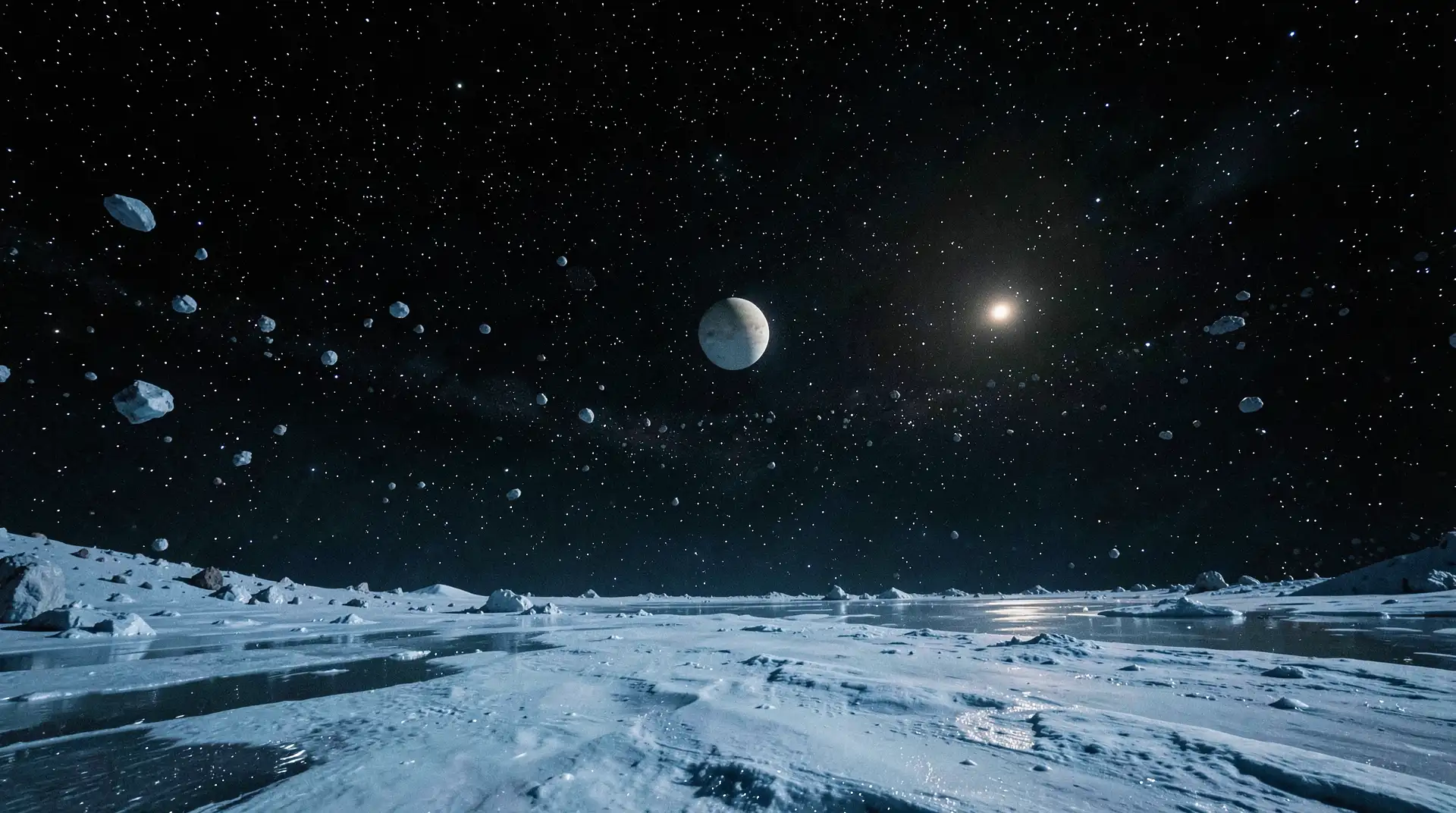
That worked until the 1990s, when surveys of the Kuiper Belt, a vast ring of icy debris beyond Neptune, began turning up dozens of Pluto-sized objects. The question could no longer be avoided: if Pluto is a planet, are all of these planets too?
The IAU faced a choice: expand the solar system to include potentially hundreds of planets, or draw a line that kept the number manageable and scientifically meaningful. It chose the line.
Pluto fails the third test completely. It sits inside the Kuiper Belt, surrounded by thousands of similar icy bodies. Its gravity has not cleared anything. By this measure, Pluto is one member of a crowded family, not a lone world commanding its own lane around the Sun.
A handful of planetary scientists continue to argue that the 2006 definition is imprecise and that Pluto deserves reconsideration. The debate has never fully closed, though the IAU classification still stands.
Pluto is now understood as one of the largest known dwarf planets, sharing the Kuiper Belt with Eris, Makemake, Haumea, and others still being catalogued. The solar system did not shrink in 2006, the category of 'planet' sharpened, and what lay beyond Neptune turned out to be far richer and stranger than anyone had mapped.
The IAU Had to Define What a Planet Is
Before 2006, no formal scientific definition of the word 'planet' existed. It was a category inherited from ancient Greek astronomy and never precisely drawn. As telescopes improved through the twentieth century, astronomers kept finding smaller and stranger objects in the outer solar system and simply called them planets if they seemed large enough.That worked until the 1990s, when surveys of the Kuiper Belt, a vast ring of icy debris beyond Neptune, began turning up dozens of Pluto-sized objects. The question could no longer be avoided: if Pluto is a planet, are all of these planets too?
The Discovery That Forced the Issue
The immediate trigger was Eris, discovered in 2005 by astronomer Mike Brown and his team at Caltech. Eris, orbiting far beyond Pluto, was initially measured as slightly larger than Pluto. If Pluto was a planet, Eris had to be one too, and the list of candidates in the Kuiper Belt ran to dozens more.The IAU faced a choice: expand the solar system to include potentially hundreds of planets, or draw a line that kept the number manageable and scientifically meaningful. It chose the line.
The Three-Part Definition
At the 2006 General Assembly in Prague, the IAU adopted a three-part definition. A planet must orbit the Sun. It must have enough mass for its own gravity to pull it into a roughly spherical shape. And, the condition that ended Pluto's status, it must have 'cleared the neighbourhood' around its orbit, meaning its gravity dominates that region and has either absorbed or flung away other objects sharing its path.Pluto fails the third test completely. It sits inside the Kuiper Belt, surrounded by thousands of similar icy bodies. Its gravity has not cleared anything. By this measure, Pluto is one member of a crowded family, not a lone world commanding its own lane around the Sun.
Why the Decision Was Controversial
The vote itself was contentious. Of the roughly 10,000 members of the IAU, only about 424 were present in Prague for the final vote, and some felt the wording of the third criterion was vague or unfair. Critics pointed out that by a strict reading of 'clearing the neighbourhood', even Earth would struggle to qualify if placed at Pluto's distance from the Sun, because clearing ability depends on both a body's mass and how far it sits from the Sun.A handful of planetary scientists continue to argue that the 2006 definition is imprecise and that Pluto deserves reconsideration. The debate has never fully closed, though the IAU classification still stands.
What Pluto Actually Is
Reclassification did not make Pluto less interesting. NASA's New Horizons spacecraft flew past it in July 2015 and sent back images that surprised everyone: a heart-shaped plain of nitrogen ice, mountains of water ice rising three kilometres high, a thin atmosphere of nitrogen and methane, and signs of geological activity on a world once assumed to be a frozen, featureless rock.Pluto is now understood as one of the largest known dwarf planets, sharing the Kuiper Belt with Eris, Makemake, Haumea, and others still being catalogued. The solar system did not shrink in 2006, the category of 'planet' sharpened, and what lay beyond Neptune turned out to be far richer and stranger than anyone had mapped.
Next Story