
How the Pyramids of Giza Were Built Without Modern Machines

More than two million stone blocks, some weighing as much as eighty tonnes, were cut, moved, and stacked to a height of nearly 147 metres across roughly two decades. No blueprint survives. No foreman's manual was found. What survives are the physical traces, tool marks in quarry walls, a worker's logbook on papyrus, the remains of a harbour, and the bones of men who spent their lives on the plateau.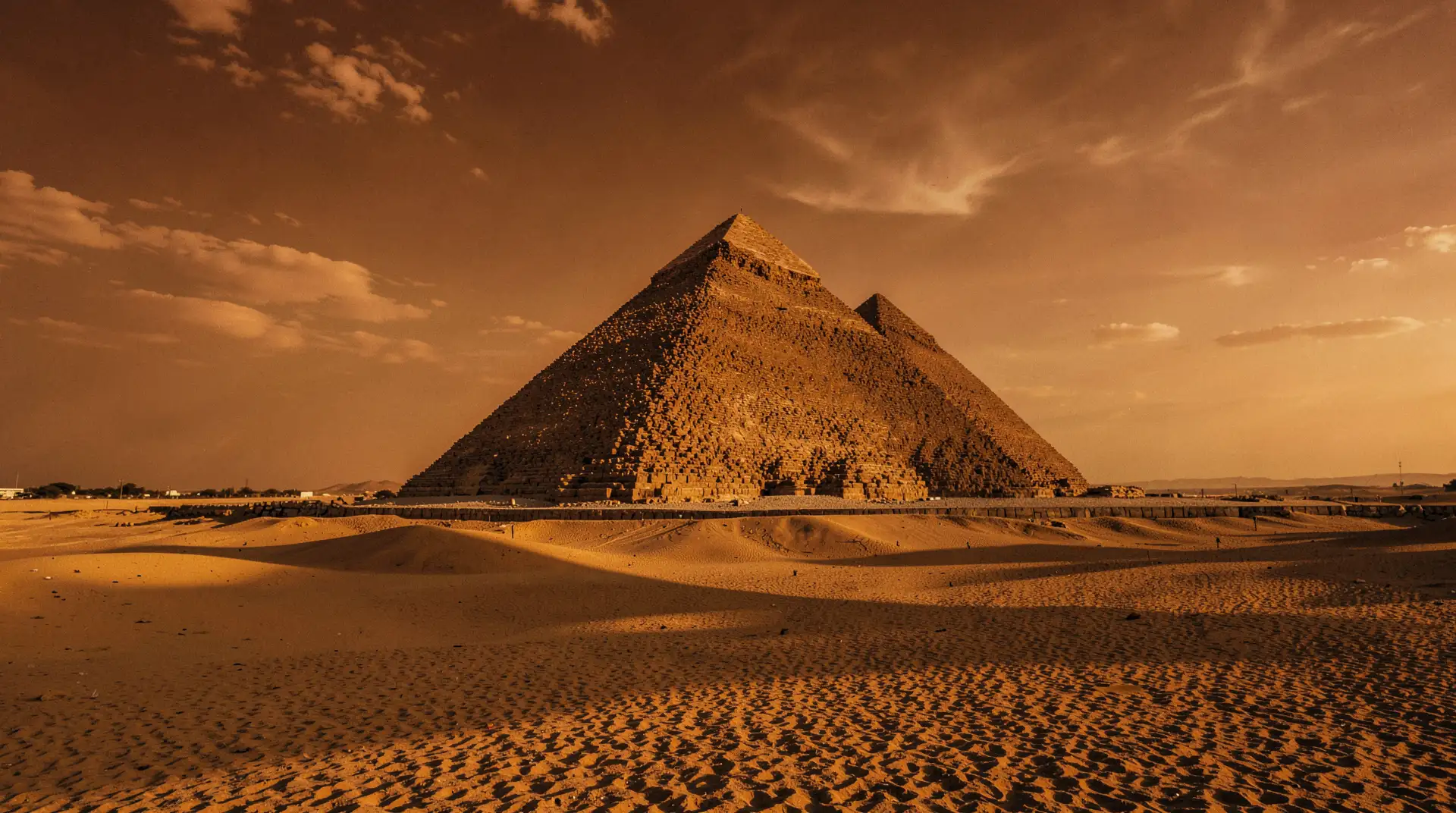
Where the Stone Came From
Most of the pyramid's core blocks are limestone cut from the Giza plateau itself, directly beneath where the pyramid stands. This reduced hauling distance dramatically. The white outer casing, almost entirely stripped away over centuries for building material in Cairo, came from Tura, across the Nile, about thirteen kilometres south. The granite used in the King's Chamber and its relieving chambers was quarried at Aswan, roughly 800 kilometres upriver. The Wadi al-Jarf papyri, discovered in 2013 and the oldest papyri ever found, record an inspector named Merer moving casing stones by boat from Tura to Giza. The Nile and a network of canals did the long-distance work. Stone did not travel overland any further than it had to.How Blocks Were Moved on Land
Experimental archaeology has tested several methods, and the evidence points to sledges pulled over wetted ground. A painting from the tomb of Djehutihotep, an Egyptian official from a later period, shows a colossal statue on a sledge, with a worker pouring liquid in front of the runners. Physicists studying this image calculated that wetting sand reduces the friction coefficient enough to allow a team of workers to pull loads that would otherwise be impossible. The Giza plateau had a harbour fed by a canal from the Nile, which means heavy blocks could be floated close to the construction site before the final land haul. Wooden sledges, ropes of twisted plant fibre, and organised pulling teams are all consistent with tool marks and wear patterns found at the site.You may also like
- 'Will be game over for America': Elon Musk raises three 'concerns' against Democrats ahead of midterms
- Lahore ranks as world's most polluted city with AQI of 419, Pakistan's air crisis deepens
- Did Lacy misunderstand his Japan restaurant bill? Streamer reveals what actually happened
- 'A win is a win': Israel opposition leader Lapid reacts to Netanyahu's poll setback
- Hasina video, RAW allegations: What ex-Bangladesh officer revealed in podcast before mysterious death
Getting Blocks to Height
This is where the debate has run longest. No ramp survives intact, but evidence for ramps exists: a mudbrick ramp was found at the unfinished pyramid of Sekhemkhet, and ramp debris appears at several quarry sites. The argument is about shape. A single straight ramp long enough to reach the pyramid's upper courses would itself have required more material than the pyramid. An internal spiral ramp, a theory advanced after scans revealed internal voids, is possible but unproven. The most widely supported model among archaeologists is a combination: a large frontal ramp for the lower two-thirds of the structure, where volume is greatest and the angle of approach is manageable, then a smaller wrap-around or internal ramp for the upper third, where the volume of stone is much smaller but the height is extreme. No single model has closed the question. What the evidence rules out is any method requiring technology Egypt did not have.Who Actually Built It
The image of slaves building the pyramids, repeated in popular culture for generations, is not supported by the archaeology. The worker village excavated south of the pyramid complex from the 1990s onwards contains bakeries, breweries, a fish-processing area, and medical facilities. Skeletal remains show signs of healed fractures, injuries that received treatment. Workers were buried with care near the pyramid, an honour not given to slaves. Administrative records suggest a rotating workforce of skilled and semi-skilled labourers, fed and housed by the state. The Greek historian Herodotus, writing two thousand years after the fact, is the source most often cited for the slave narrative. The physical evidence at Giza tells a different story: a massive, organised workforce sustained by a state with the administrative capacity to feed tens of thousands of people.Precision Without Instruments
The Great Pyramid's base is level to within 2.1 centimetres across its entire 230-metre span. Its sides align to the cardinal directions with an error of less than four minutes of arc. These are not accidents. Egyptians used a tool called a merkhet, a sighting instrument made from a split palm rib, alongside plumb bobs, set squares, and stretched cords to establish level and alignment. The north alignment was likely achieved by bisecting the arc of a circumpolar star as it rose and set around true north. None of this required instruments that Egypt lacked. It required patience, skill, and repeated checking, which is precisely what a workforce of this scale and duration would have time to do.The pyramids were not built by lost technology, alien intervention, or methods beyond human capacity. They were built by a state that had mastered logistics, by workers who were fed and organised, and by engineers who understood geometry well enough to hold a tolerance across a structure the size of a city block. The mystery was never the method. It was the scale of the will behind it.





Loving Newspoint? Download the app now
