
Why Some Sand Dunes Sing, Boom, and Roar

Stand at the slip face of a singing dune and push a wall of sand over the edge. Within seconds, a low, steady hum rises from beneath your feet, somewhere between a cello and a distant propeller. The sound can hold a single note for several minutes. Ancient travellers heard it and assumed the desert was alive. They were not entirely wrong.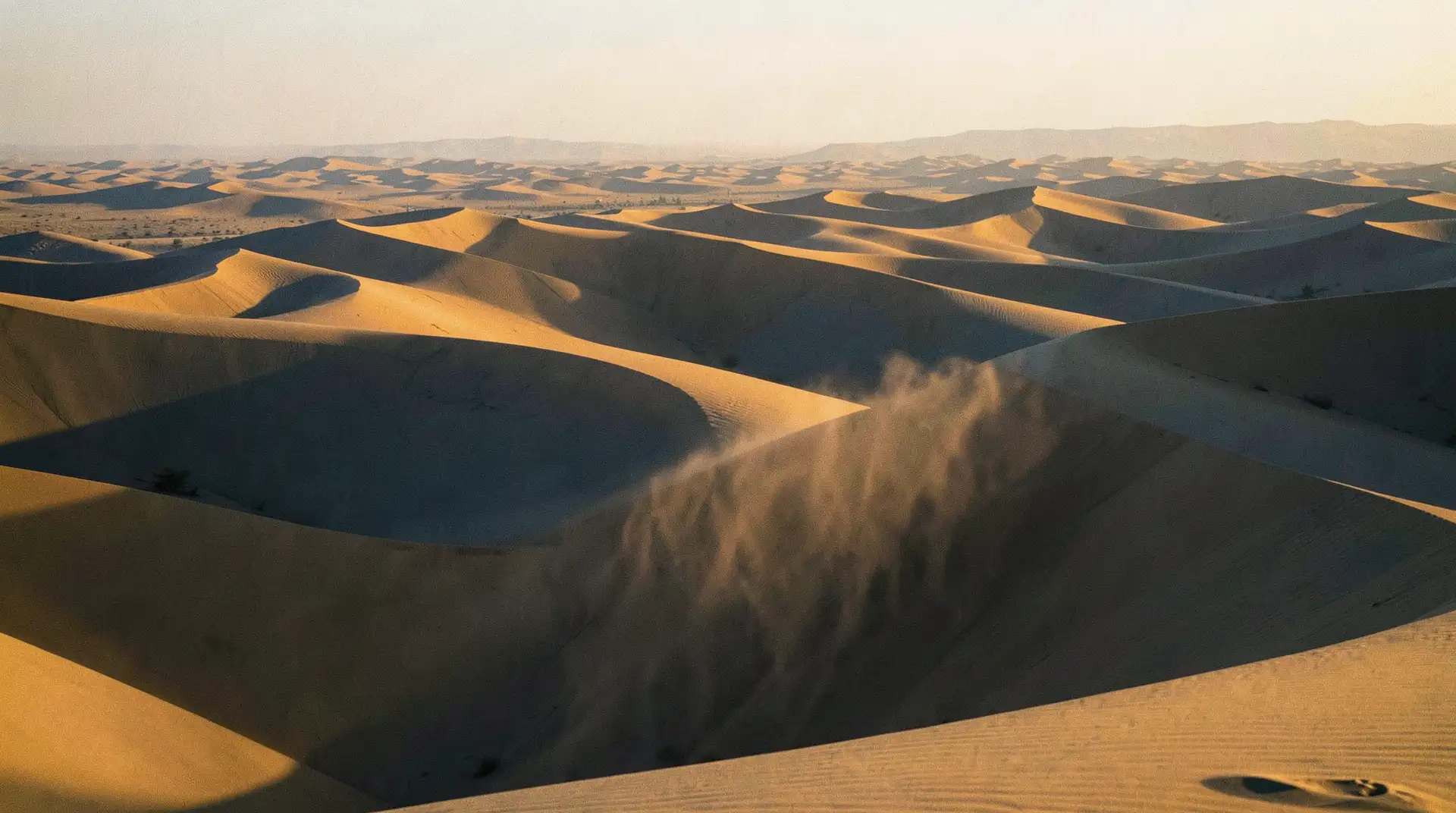
The dune's body acts as a resonating chamber, amplifying the wave and projecting it outward. The pitch, usually between 70 and 105 hertz, roughly the low register of a bass guitar, is set by the size of the grains, not by the size of the dune.
The grains also need a thin silica coat, a film of silicon dioxide deposited over thousands of years of weathering. That coat gives each grain a specific surface friction. Too rough, and the grains scrape without synchronising. Too smooth, and they slip past each other without coupling. The coat sits in a narrow band where synchrony becomes possible. This is why singing dunes are rare: the sorting and the coating both have to be right at once.
The grains still slide; they simply slide out of step with each other. Researchers testing dunes in Morocco found that wetting the top few centimetres of the slip face was enough to kill the sound entirely, while the dry sand below continued to avalanche normally. This is also why the same dune can sing on one afternoon and stay quiet the next: local humidity, not the dune's structure, flips the switch.
The Kelso Dunes tend toward a low rumble. The dunes near Dunhuang in China produce a sound that old Silk Road accounts compared to the beating of drums, which is where the site gets one of its names, Mingsha Shan, the Mountain of Singing Sands. Marco Polo passed through the region and recorded the noise without being able to explain it. The explanation waited about seven centuries.
The grain-synchrony model, built on careful measurements of grain size, shape, coating, and avalanche dynamics, held up across multiple desert sites on different continents. It is now the accepted explanation, though researchers still debate the precise role of the silica coat versus grain shape in setting the exact pitch. The desert kept its secret for a long time, and the answer, when it came, was not a geological accident. It was physics working itself out grain by grain over thousands of years of wind.
What the Sound Actually Is
The booming is not a single grain vibrating. It is millions of grains moving in synchrony down the avalanche face of a dune, and the synchrony is what matters. When dry, well-rounded grains of similar size slide together, they lock into a collective rhythm. Each grain collides with its neighbour at the same frequency, and those tiny collisions add up into a coherent acoustic wave.The dune's body acts as a resonating chamber, amplifying the wave and projecting it outward. The pitch, usually between 70 and 105 hertz, roughly the low register of a bass guitar, is set by the size of the grains, not by the size of the dune.
Why Most Dunes Stay Silent
Not every desert produces the sound. A singing dune needs grains that are unusually uniform in diameter, typically between 0.1 and 0.5 millimetres, and unusually round and smooth. Wind sorts grains over long periods, rolling away the irregular ones and leaving behind the rounded survivors.The grains also need a thin silica coat, a film of silicon dioxide deposited over thousands of years of weathering. That coat gives each grain a specific surface friction. Too rough, and the grains scrape without synchronising. Too smooth, and they slip past each other without coupling. The coat sits in a narrow band where synchrony becomes possible. This is why singing dunes are rare: the sorting and the coating both have to be right at once.
Humidity Is the Enemy
Bring water into the picture and the sound vanishes. A light mist, a morning of high humidity, or a layer of dew is enough to silence a dune that roared the day before. Water films between grains disrupt the surface friction that drives synchrony.The grains still slide; they simply slide out of step with each other. Researchers testing dunes in Morocco found that wetting the top few centimetres of the slip face was enough to kill the sound entirely, while the dry sand below continued to avalanche normally. This is also why the same dune can sing on one afternoon and stay quiet the next: local humidity, not the dune's structure, flips the switch.
Where to Hear Them
The best-documented singing dunes sit in the Namib Desert of Namibia, the Gobi Desert across Mongolia and China, the Rub' al Khali of Arabia, and the Kelso Dunes in California's Mojave. Each location produces a slightly different note because the local grain size differs.The Kelso Dunes tend toward a low rumble. The dunes near Dunhuang in China produce a sound that old Silk Road accounts compared to the beating of drums, which is where the site gets one of its names, Mingsha Shan, the Mountain of Singing Sands. Marco Polo passed through the region and recorded the noise without being able to explain it. The explanation waited about seven centuries.
The Science That Took Centuries to Arrive
Systematic study of booming dunes began seriously only in the late twentieth century, when physicists started recording the sounds and measuring grain properties side by side. Early hypotheses blamed underground caverns, trapped air pockets, and static electricity. Each failed when tested.The grain-synchrony model, built on careful measurements of grain size, shape, coating, and avalanche dynamics, held up across multiple desert sites on different continents. It is now the accepted explanation, though researchers still debate the precise role of the silica coat versus grain shape in setting the exact pitch. The desert kept its secret for a long time, and the answer, when it came, was not a geological accident. It was physics working itself out grain by grain over thousands of years of wind.
Next Story