
Why Lake Hillier in Australia Is Bubblegum Pink

Middle Island, off the coast of Western Australia, holds a lake about 600 metres long that stays the colour of strawberry milk. Fly over it and the contrast is immediate: deep blue Southern Ocean on one side, dense green eucalyptus on the other, and in between, a strip of unmistakable pink. The colour does not wash out in rain, does not fade in winter, and does not change when you scoop the water into a bottle. It travels with the water.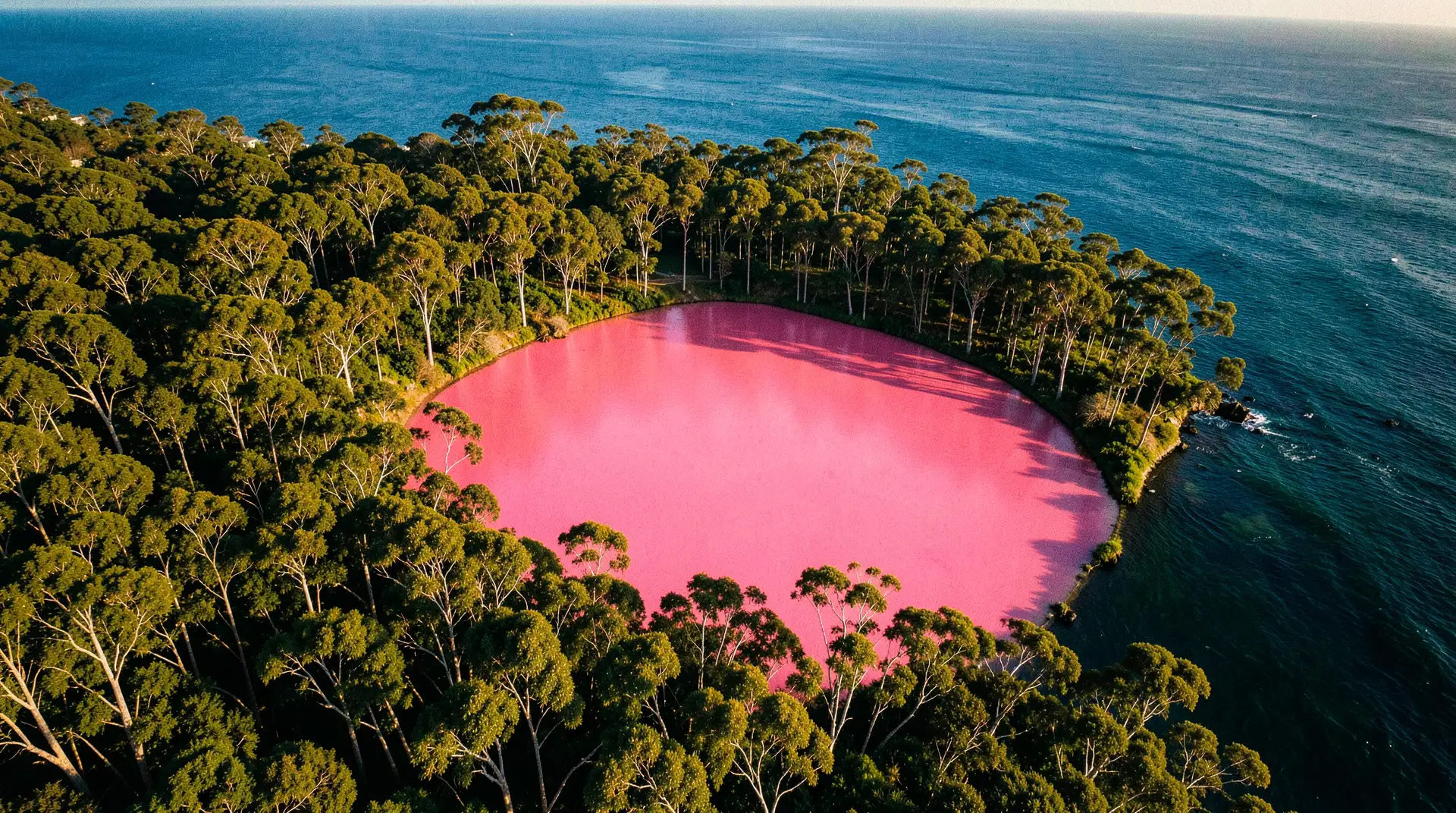
Beta-carotene is a protective response: the pigment shields the alga's photosynthetic machinery from the intense light bouncing off a highly reflective brine surface. The alga does not turn pink because it is stressed. It turns pink because it is working.
Halobacteria, salt-loving bacteria distinct from the alga, are also present and contribute their own red and orange pigments through a different biochemical pathway involving a light-harvesting protein called bacteriorhodopsin. The pink is a layered effect, not a single cause.
The lake sits on a narrow island reachable only by boat or seaplane, which has kept it from heavy foot traffic. The water is not harmful to touch, and people have swum in it, though access is now restricted to protect the ecosystem. The organisms responsible are the reason the colour exists, and they are worth keeping undisturbed.
The Organism Behind the Colour
The pink comes primarily from a microalga called Dunaliella salina. This single-celled organism thrives in water with extreme salt concentrations, conditions that kill most other life. When salt levels rise high enough, Dunaliella produces large quantities of beta-carotene, the same pigment that makes carrots orange and flamingos pink.Beta-carotene is a protective response: the pigment shields the alga's photosynthetic machinery from the intense light bouncing off a highly reflective brine surface. The alga does not turn pink because it is stressed. It turns pink because it is working.
Salt as the Starting Condition
Lake Hillier is a hypersaline lake, meaning its salt concentration sits far above that of seawater. Ordinary seawater runs at roughly 3.5 percent salinity. Lake Hillier's water is estimated to be around ten times saltier. That level of salinity comes partly from the lake's isolation, it has no river feeding it fresh water, and evaporation concentrates whatever minerals are present, and partly from its geology, which sits on ancient marine sediment. The high salt creates the selective pressure that allows Dunaliella to dominate. Most competitors cannot survive. The alga fills the space.Why the Colour Holds in a Bottle
When you take water from a typical coloured lake, one tinted by tannins or suspended sediment, the colour can settle, separate, or fade. Lake Hillier's water stays pink in a clear bottle because the pigment is inside living cells suspended throughout the water, and because the dissolved minerals in the brine scatter light in a way that reinforces the pink tone.Halobacteria, salt-loving bacteria distinct from the alga, are also present and contribute their own red and orange pigments through a different biochemical pathway involving a light-harvesting protein called bacteriorhodopsin. The pink is a layered effect, not a single cause.
What Makes It Rare
Pink and red lakes exist elsewhere, the Hutt Lagoon north of Perth, Lake Retba in Senegal, several salt pans in Spain and Bolivia. What makes Lake Hillier visually striking even among these is the intensity and consistency of the colour against its surrounding landscape, and its accessibility from the air.The lake sits on a narrow island reachable only by boat or seaplane, which has kept it from heavy foot traffic. The water is not harmful to touch, and people have swum in it, though access is now restricted to protect the ecosystem. The organisms responsible are the reason the colour exists, and they are worth keeping undisturbed.
Next Story