
What a Shooting Star Really Is: The Science Behind the Streak

Most people have wished on one. Few know what they were actually looking at. A shooting star is not a star, and it is not falling, it is a tiny fragment of rock or metal, often no bigger than a grain of sand, colliding with Earth's atmosphere at tens of thousands of kilometres per hour.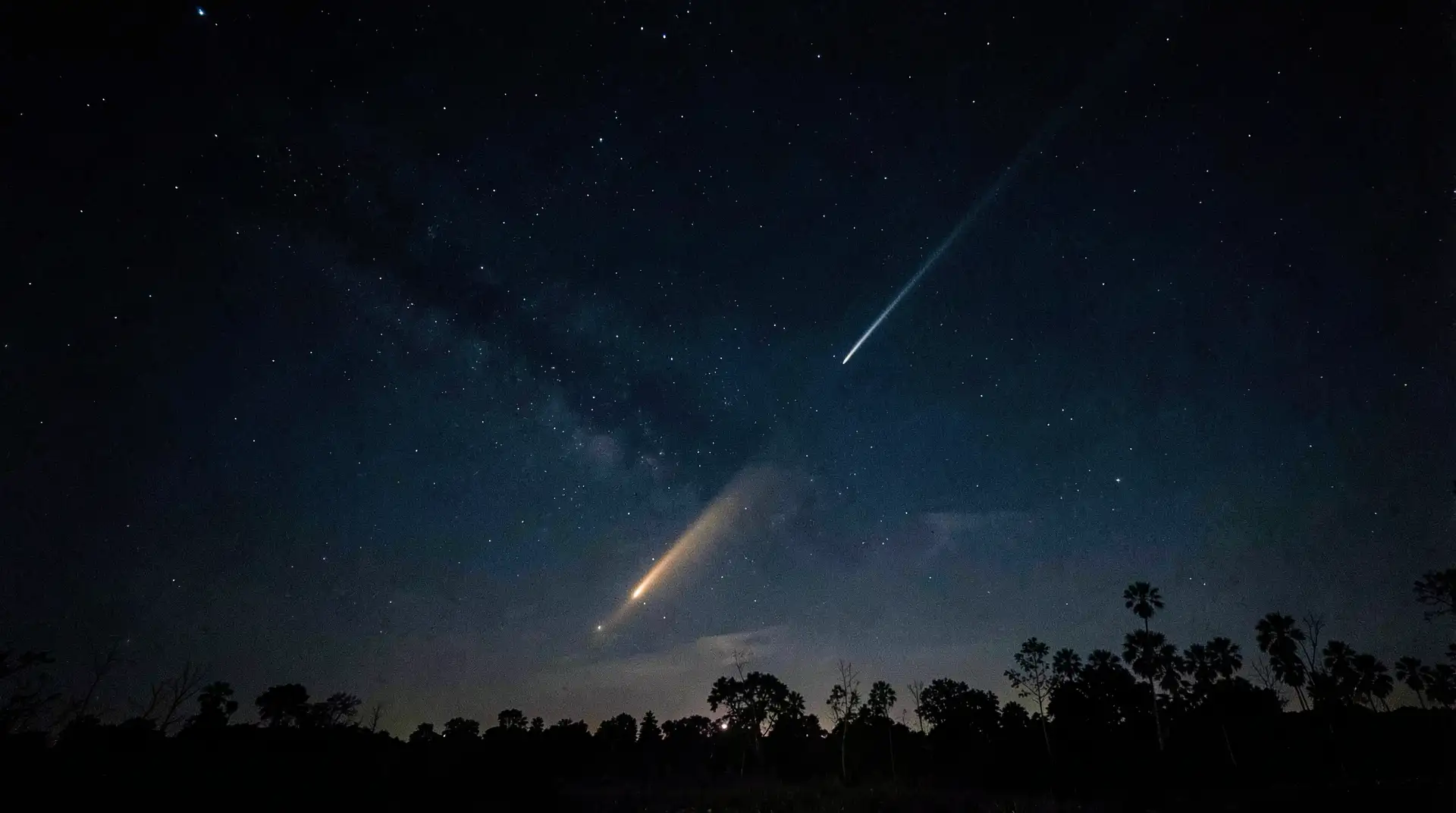
At the altitudes where the streak appears, roughly 80 to 120 kilometres above the ground, the air is thin but not absent. When a meteoroid plunges in at high speed, it rams into air molecules faster than those molecules can move out of the way. The air in front of the particle compresses violently, heats up, and glows. The particle itself heats from the outside in and begins to ablate, its surface vaporises layer by layer. The light you see is not the rock burning like a match. It is superheated plasma: air and vaporised mineral glowing together as the energy of motion converts almost entirely into heat and light.
Speed determines brightness more than size does. A slow meteoroid entering at around 11 kilometres per second produces a faint, brief streak. A fast one, entering at 70 kilometres per second, compresses the air far more violently and can outshine every star in the sky for a moment. These bright events are called fireballs or bolides, and they are the same phenomenon, just a larger or faster piece of the same debris field.
On nights between showers, the streaks still come, but sporadically. These are sporadic meteors: lone particles with no known parent body, wandering the inner solar system until they encounter a planet.
Most land in the ocean or in uninhabited terrain. A small number are recovered each year, and the oldest among them predate Earth itself.
The streak across a dark sky is one of the few moments when the deep history of the solar system becomes visible to anyone willing to look up. The particle doing the burning may have been drifting through space since before the Sun's planets existed, and it ends in a second of light above a field or a rooftop, seen and then gone.
The Particle and the Atmosphere
Space is not empty. Between the planets, the solar system is threaded with debris: dust shed by comets, chips broken off asteroids, and fragments left over from the formation of the planets themselves. These particles are called meteoroids when they drift through space. When one crosses paths with Earth, the atmosphere becomes its obstacle.At the altitudes where the streak appears, roughly 80 to 120 kilometres above the ground, the air is thin but not absent. When a meteoroid plunges in at high speed, it rams into air molecules faster than those molecules can move out of the way. The air in front of the particle compresses violently, heats up, and glows. The particle itself heats from the outside in and begins to ablate, its surface vaporises layer by layer. The light you see is not the rock burning like a match. It is superheated plasma: air and vaporised mineral glowing together as the energy of motion converts almost entirely into heat and light.
Why It Lasts Only a Second
The streak is short because the particle is small and the process is brutal. A sand-grain-sized meteoroid loses all its mass to ablation within a fraction of a second. Slightly larger fragments, a pebble, a marble, last a few seconds and can leave a glowing trail that persists for a moment after the streak ends. That lingering glow is called a meteor train: excited molecules in the particle's wake, slowly releasing the energy they absorbed.Speed determines brightness more than size does. A slow meteoroid entering at around 11 kilometres per second produces a faint, brief streak. A fast one, entering at 70 kilometres per second, compresses the air far more violently and can outshine every star in the sky for a moment. These bright events are called fireballs or bolides, and they are the same phenomenon, just a larger or faster piece of the same debris field.
You may also like
- Germany conference launches Anti-Colonial Alliance to challenge political domination, human rights violation in Pakistan: Report
- 'No intention of keeping promises': Biden's explosive revelations about Netanyahu's Gaza war
- Farage says Britain faces 'defencelessness', singles out Russia as top threat
- Ukraine Faces Escalating Attacks as Russia Targets Energy Infrastructure
- Bangladesh measles outbreak claims eight more lives, death toll crosses 1,310
Where the Debris Comes From
Most of the meteoroids that produce shooting stars on any given night are cometary dust. As a comet swings close to the Sun, its ice vaporises and carries embedded dust outward into space. That dust spreads along the comet's orbital path over thousands of years, forming a diffuse stream. When Earth's orbit crosses one of these streams, the planet sweeps through millions of particles in a matter of days. This is a meteor shower: dozens of streaks per hour, all appearing to originate from the same point in the sky, the radiant, because Earth is moving into the stream head-on, just as raindrops seem to converge on a windscreen when a car drives through them.On nights between showers, the streaks still come, but sporadically. These are sporadic meteors: lone particles with no known parent body, wandering the inner solar system until they encounter a planet.
When the Rock Survives
Occasionally a fragment is large enough that ablation cannot consume it entirely. The outer layers burn away, but the core survives the passage and falls to the ground. At this point the terminology shifts: it becomes a meteorite. The surface of a meteorite is glassy and dark, a fusion crust formed by the brief, intense melting of its exterior. The interior is often unchanged since the solar system formed, making meteorites among the oldest solid material a person can hold.Most land in the ocean or in uninhabited terrain. A small number are recovered each year, and the oldest among them predate Earth itself.
The streak across a dark sky is one of the few moments when the deep history of the solar system becomes visible to anyone willing to look up. The particle doing the burning may have been drifting through space since before the Sun's planets existed, and it ends in a second of light above a field or a rooftop, seen and then gone.






Loving Newspoint? Download the app now
