
Why Do Electric Vehicles Charge Slowly After 80%? Here's What Drivers Should Know

Plug an electric vehicle into a fast charger and the first 80 percent arrives quickly enough to feel almost unremarkable. Then the bar slows to a crawl and suddenly that last stretch takes as long as everything before it combined. Most drivers assume something is wrong. Nothing is wrong. The slowdown is deliberate, and the reason sits inside the battery itself.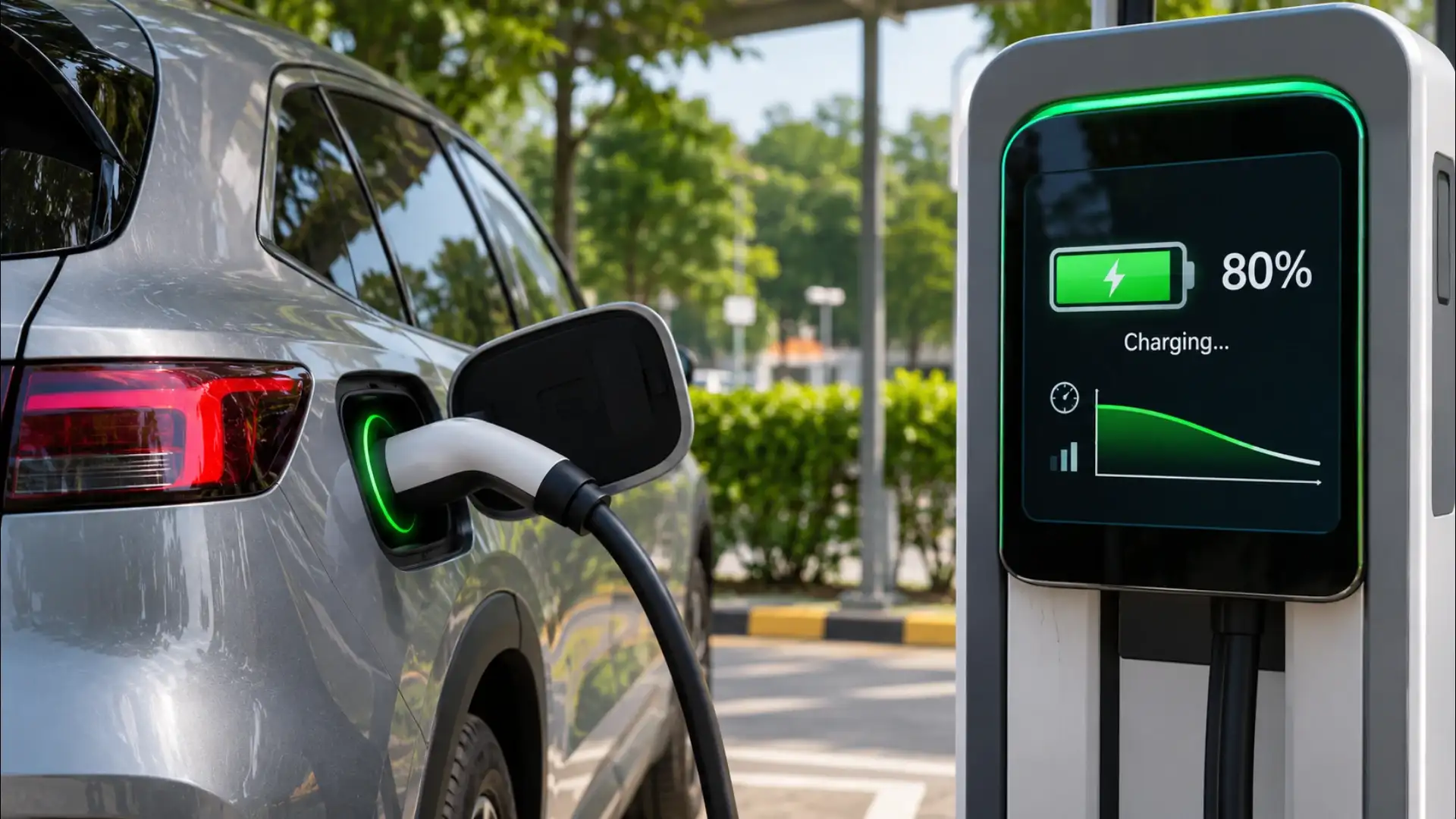
When the cell is nearly empty, there are plenty of open slots and ions move in quickly. A fast charger can push a large current because the electrode absorbs it without stress. As the cell fills, available slots become scarce. Ions arriving faster than the electrode can absorb them start to pile up on the surface rather than slotting in cleanly. That surface buildup, called lithium plating, is damaging. It can form metallic deposits that reduce capacity permanently and, in extreme cases, create internal short circuits.
In the first phase of charging, the system holds current steady and lets voltage rise, fast filling of empty slots. Past a threshold, it holds voltage steady instead and lets current fall, slow, careful topping-up of the remaining space. The charger does not slow down because it is tired or because the cable is struggling. It slows because the battery management system has instructed it to.
For a long journey where every kilometre of range matters, charging to 100 percent is entirely reasonable, the system still protects the cells, just more slowly. For a commuter who returns to a charger every night, stopping at 80 percent means faster sessions and a battery that holds its capacity longer across years of use.
Many electric vehicles now include battery pre-conditioning, a feature that warms or cools the pack before a charging stop, using energy from the existing charge. A pre-conditioned battery arrives at the charger already in its preferred temperature window, which means the management system can allow higher currents for longer before it begins its protective slowdown. The difference in session time between a pre-conditioned and a cold battery can be significant.
This is why two identical vehicles on the same charger can show different charging speeds if one started the session at 30 percent and the other at 60 percent. The one with more room in its cells draws more power. The one already near the top draws less, not because of any fault, but because its management system is doing exactly what it was designed to do.
The slowdown past 80 percent is the battery management system keeping a promise: that the pack will still hold most of its original capacity years from now. Every minute of that cautious top-up is the car choosing longevity over speed.
What a Lithium-Ion Cell Is Actually Doing
Charging a lithium-ion battery is not like filling a bucket with water. It is closer to pushing guests into a stadium that is already three-quarters full. Each cell contains a negative electrode, usually made of graphite, and a positive electrode, usually a lithium-metal-oxide compound. During charging, lithium ions travel from the positive side through a liquid electrolyte and slot into the graphite on the negative side. The graphite holds these ions in layers, the way a stack of pages holds pressed flowers.When the cell is nearly empty, there are plenty of open slots and ions move in quickly. A fast charger can push a large current because the electrode absorbs it without stress. As the cell fills, available slots become scarce. Ions arriving faster than the electrode can absorb them start to pile up on the surface rather than slotting in cleanly. That surface buildup, called lithium plating, is damaging. It can form metallic deposits that reduce capacity permanently and, in extreme cases, create internal short circuits.
How the Battery Management System Responds
Every electric vehicle carries a battery management system that watches cell voltage, temperature, and state of charge in real time. It does not wait for damage to happen. As the charge climbs past roughly 80 percent, the system begins reducing the current the charger is allowed to deliver. This is called the constant-voltage phase, and it is the same principle used in every lithium-ion device from a smartphone to a grid-scale storage unit.In the first phase of charging, the system holds current steady and lets voltage rise, fast filling of empty slots. Past a threshold, it holds voltage steady instead and lets current fall, slow, careful topping-up of the remaining space. The charger does not slow down because it is tired or because the cable is struggling. It slows because the battery management system has instructed it to.
You may also like
- Maserati Grecale: 2026 facelift launches at Rs 1.14 crore, but will the new V6 variant impress?
- Can You Drive at 144 kmph Without Getting a Challan? Nitin Gadkari's Highway Speeding Remark Explained
- Has Your Car Crossed 2 Lakh Kilometres? Don't Sell It Just Yet! Here's What Actually Determines a Car's Life
- 100% Ethanol-Powered Cars Get Government Approval, But Where Will the Fuel Come From? Supreme Court Raises Big Questions
- Maruti Suzuki e-Vitara Creates History in Global Markets! Exports Cross 50,000 Units as Indian EV Demand Grows
Why 80 Percent Has Become the Practical Ceiling for Daily Use
Most electric vehicle manufacturers and charging networks recommend stopping at 80 percent for everyday driving. The physics behind this is straightforward: the energy gained in the final 20 percent takes disproportionately long to deliver safely, and that portion of the battery also ages faster under repeated full charges. Lithium-ion cells experience more stress at the top and bottom of their range. Keeping a battery between roughly 20 and 80 percent extends the number of cycles it can complete before capacity noticeably degrades.For a long journey where every kilometre of range matters, charging to 100 percent is entirely reasonable, the system still protects the cells, just more slowly. For a commuter who returns to a charger every night, stopping at 80 percent means faster sessions and a battery that holds its capacity longer across years of use.
Temperature and Its Role in the Slowdown
The battery management system does not only watch state of charge. Temperature shapes its decisions just as much. Lithium-ion cells charge most efficiently in a moderate temperature band. In cold conditions, the electrolyte becomes more viscous and ion movement slows, so the system reduces current to avoid plating even earlier than it would at an ideal temperature. In high heat, the risk shifts to accelerated chemical degradation, and the system again pulls back current to keep the cell from cooking itself.Many electric vehicles now include battery pre-conditioning, a feature that warms or cools the pack before a charging stop, using energy from the existing charge. A pre-conditioned battery arrives at the charger already in its preferred temperature window, which means the management system can allow higher currents for longer before it begins its protective slowdown. The difference in session time between a pre-conditioned and a cold battery can be significant.
The Charger Is Not the Whole Story
A common assumption is that a more powerful charger will always mean a faster charge. It will, up to the point where the battery management system takes over. A 150 kW charger connected to a vehicle whose pack is at 85 percent and whose management system has already begun throttling will deliver far less than 150 kW. The charger's output is a ceiling, not a guarantee. The battery decides what it will accept at any moment.This is why two identical vehicles on the same charger can show different charging speeds if one started the session at 30 percent and the other at 60 percent. The one with more room in its cells draws more power. The one already near the top draws less, not because of any fault, but because its management system is doing exactly what it was designed to do.
The slowdown past 80 percent is the battery management system keeping a promise: that the pack will still hold most of its original capacity years from now. Every minute of that cautious top-up is the car choosing longevity over speed.






Loving Newspoint? Download the app now
