
Word Of The Day: Ambivalence - Meaning, Usage And Examples

Have you ever found yourself excited about a new opportunity while also feeling nervous about it at the same time? You are not alone. People often assume that emotions are straightforward, but in reality, we can experience conflicting feelings about the same person, situation, or decision. We may feel hopeful and enthusiastic one moment, only to be filled with doubt and hesitation the next. This state of having mixed emotions is known as 'ambivalence'.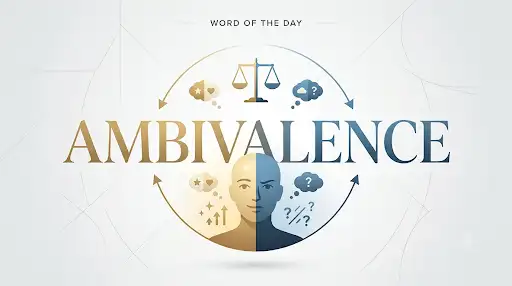
It is a noun that refers to the experience of having conflicting or contradictory feelings about something. It commonly occurs when a person simultaneously experiences both positive and negative emotions towards the same situation, making it difficult to form a clear opinion or make a decision. The word is frequently used in discussions related to emotions, relationships, psychology, and decision-making.
Origin
The word 'ambivalence' originated from the German term 'Ambivalenz', introduced in the early 20th century by Swiss psychiatrist Eugen Bleuler. It was first used in 1909. The term was formed from the Latin prefix 'ambi-', meaning "both" or "on both sides", and 'valentia', meaning "strength" or "value".
Initially, the word was used in psychology to describe the coexistence of opposing emotions or impulses towards the same person, object, or situation. Over time, its usage expanded beyond psychology and entered everyday language. Today, 'ambivalence' is commonly used to describe mixed or conflicting feelings that make it difficult for someone to reach a clear opinion or decision.
Pronunciation Of Ambivalence
Synonyms of Ambivalence
Antonyms Of Ambivalence
How Can You Use 'Ambivalence' In A Sentence
She felt a sense of ambivalence about moving abroad, excited by the opportunity but sad to leave her family behind.
His ambivalence towards the job offer made it difficult for him to make a final decision.
The film captured the character's ambivalence about returning to a place filled with both happy and painful memories.
Many people experience ambivalence when faced with major life changes that involve both risks and rewards.
Despite her ambivalence about the project, she eventually decided to give it a chance.
Avoid These Mistakes
While using ambivalence, avoid some common mistakes, such as treating it as a synonym for simple indecision. Although an ambivalent person may struggle to make a choice, the word specifically refers to having mixed or conflicting feelings about something rather than simply being unable to decide. Another common mistake is confusing ambivalence with apathy. Remember that an apathetic person lacks interest or concern, whereas an ambivalent person cares about the situation but experiences opposing emotions at the same time. Lastly, avoid using ambivalence to describe uncertainty caused by a lack of information. The term is best used when someone feels both positive and negative emotions towards the same person, situation or decision.
It is a noun that refers to the experience of having conflicting or contradictory feelings about something. It commonly occurs when a person simultaneously experiences both positive and negative emotions towards the same situation, making it difficult to form a clear opinion or make a decision. The word is frequently used in discussions related to emotions, relationships, psychology, and decision-making.
Origin
The word 'ambivalence' originated from the German term 'Ambivalenz', introduced in the early 20th century by Swiss psychiatrist Eugen Bleuler. It was first used in 1909. The term was formed from the Latin prefix 'ambi-', meaning "both" or "on both sides", and 'valentia', meaning "strength" or "value".You may also like
- Indian engineer left ₹9 LPA job offer for US Master's, now survives on part-time work with education loan burden
- Singapore: IIT alumni to provide AI, digital skills to migrants
- Planning to study in India? Bureau of Immigration shares registration, visa extension rules for international students
- CBSE issues revised Class 12 result for Vedant Srivastava; Physics marks unchanged after answer sheet mix-up
- UP Home Guard result 2026 released at uppbpb.gov.in; 1,07,221 candidates shortlisted for PST: Direct link here
Initially, the word was used in psychology to describe the coexistence of opposing emotions or impulses towards the same person, object, or situation. Over time, its usage expanded beyond psychology and entered everyday language. Today, 'ambivalence' is commonly used to describe mixed or conflicting feelings that make it difficult for someone to reach a clear opinion or decision.
Pronunciation Of Ambivalence
- It is pronounced as am-BIV-uh-luhns.
- The phonetic spelling is /æmˈbɪv.ə.ləns/.
Synonyms of Ambivalence
- Confusion
- Uncertainty
- Hesitation
- Conflicted feelings
- Doubt
Antonyms Of Ambivalence
- Certainty
- Conviction
- Confidence
- Decisiveness
- Assurance
How Can You Use 'Ambivalence' In A Sentence
She felt a sense of ambivalence about moving abroad, excited by the opportunity but sad to leave her family behind.
His ambivalence towards the job offer made it difficult for him to make a final decision.
The film captured the character's ambivalence about returning to a place filled with both happy and painful memories.
Many people experience ambivalence when faced with major life changes that involve both risks and rewards.
Despite her ambivalence about the project, she eventually decided to give it a chance.
Avoid These Mistakes
While using ambivalence, avoid some common mistakes, such as treating it as a synonym for simple indecision. Although an ambivalent person may struggle to make a choice, the word specifically refers to having mixed or conflicting feelings about something rather than simply being unable to decide. Another common mistake is confusing ambivalence with apathy. Remember that an apathetic person lacks interest or concern, whereas an ambivalent person cares about the situation but experiences opposing emotions at the same time. Lastly, avoid using ambivalence to describe uncertainty caused by a lack of information. The term is best used when someone feels both positive and negative emotions towards the same person, situation or decision. 





More from our partners


Loving Newspoint? Download the app now
