
PM Modi Flags Off India’s First Hydrogen Train: Everything to Know About Route, Technology and Future Plans

India has taken a monumental step towards sustainable public transport as Prime Minister Narendra Modi officially flagged off the nation's first-ever Hydrogen Fuel Cell Trainset. The historic launch took place at the Jind railway station in Haryana, marking a pivotal chapter in the country's transition to green energy and placing India within an elite league of global nations pioneering hydrogen-based rail travel.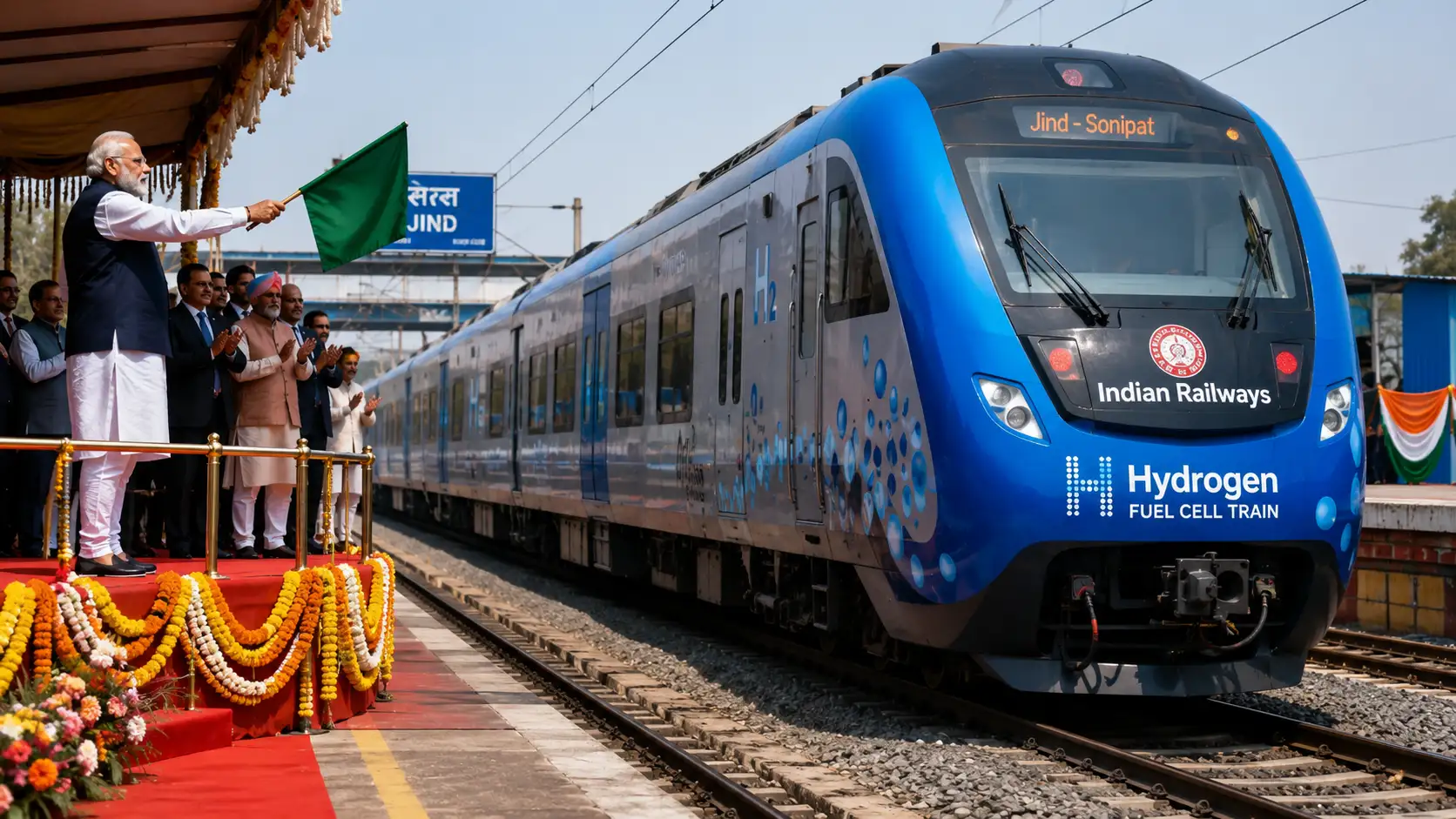
The launch coincides with the near-completion of one of the world's most expansive railway electrification drives, with over 99 per cent of India's broad gauge network now fully electrified. The introduction of the hydrogen train represents the logical next step in erasing fossil-fuel dependence entirely, especially across regional and heritage routes where traditional overhead electrification might prove challenging.
Understanding the Route, Schedule, and Stoppages
Operating under the Northern Railway zone, the country’s premier hydrogen train will ply the 89-kilometre Jind–Sonipat section in Haryana. The service has been meticulously scheduled to serve daily commuters seamlessly.
To support intermediate local towns, the train features an extensive list of structural stoppages and proposed halts. En route, passengers can board or deboard at Jind City, Pandu Pindara Junction, Lalit Khera Halt, Bhambhewa, Isapur Kheri Halt, Butana Halt, Khandrai Halt, Gohana Junction, Rabrah Halt, Lath Halt, Mohana, and Barwasni Halt.
Breathtaking Scale: The World’s Longest Hydrogen Passenger Train
While hydrogen-powered trains operating across parts of Europe and Asia typically feature minimal setups of only two to four coaches for minor regional links, India has scaled up the technology significantly.
The newly inaugurated train is a 10-coach marvel, consisting of eight passenger trailer coaches bordered by two specialized Hydrogen Driving Power Cars (DPCs) at either end. With a massive total capacity to safely transport approximately 2,600 passengers per trip, it stands out as one of the largest functional hydrogen passenger trains anywhere in the world.
Under the Bonnet: How the Technology Works
Unlike conventional electric locomotives that pull power directly from overhead cables, the Hydrogen Fuel Cell Trainset acts as its own rolling power station.
Each DPC generates 1,200 kilowatts (equivalent to 1,600 horsepower) by utilising an internal Proton Exchange Membrane (PEM) fuel cell. Inside this fuel cell, hydrogen stored in high-pressure cylinders merges with oxygen pulled from the surrounding atmosphere. This chemical reaction creates electricity to feed the train's traction motors, producing absolutely zero smoke or carbon emissions. The only bi-products released from the roof are harmless water vapour and heat.
Though it will run at an initial operational speed of 75 kmph on the Jind–Sonipat route to establish baseline safety data, the train has been physically engineered to reach a top speed of 110 kmph.
The Infrastructure: Fueling the Ecosystem
To power this pilot project, Indian Railways has built its largest integrated hydrogen refuelling ecosystem at the primary maintenance hub in Jind. This facility generates green hydrogen on-site via water electrolysis, compresses it to 500 bar, and features two independent dispensers that refuel both power cars simultaneously at 350 bar to compress turnaround times.
Safety remains paramount. Since hydrogen gas is completely invisible and odourless, the train is wrapped in layers of protection, incorporating specialized hydrogen leak detectors, flame sensors, and automated safety overrides within the Loco Pilot's dashboard. Following the success of this trial, the government plans to expand the green technology onto scenic heritage rail networks, including the iconic Kalka–Shimla route.
The launch coincides with the near-completion of one of the world's most expansive railway electrification drives, with over 99 per cent of India's broad gauge network now fully electrified. The introduction of the hydrogen train represents the logical next step in erasing fossil-fuel dependence entirely, especially across regional and heritage routes where traditional overhead electrification might prove challenging.
Understanding the Route, Schedule, and Stoppages
Operating under the Northern Railway zone, the country’s premier hydrogen train will ply the 89-kilometre Jind–Sonipat section in Haryana. The service has been meticulously scheduled to serve daily commuters seamlessly.
- Outbound Journey (Train Number 74010): The train will depart from Jind Junction every morning at 07:40 AM, completing its journey to Sonipat by 09:40 AM taking exactly two hours.
- Return Journey (Train Number 74009): On its return leg, the train is scheduled to leave Sonipat at 10:40 AM and pull back into Jind Junction at 01:00 PM, clocking a slightly longer running time of 2 hours and 20 minutes.
To support intermediate local towns, the train features an extensive list of structural stoppages and proposed halts. En route, passengers can board or deboard at Jind City, Pandu Pindara Junction, Lalit Khera Halt, Bhambhewa, Isapur Kheri Halt, Butana Halt, Khandrai Halt, Gohana Junction, Rabrah Halt, Lath Halt, Mohana, and Barwasni Halt.
Breathtaking Scale: The World’s Longest Hydrogen Passenger Train
You may also like
- Congress rejects BJP-DMK alliance buzz as Stalin weighs stand on delimitation bill
- PM Modi lays foundation stone of development projects worth Rs 14,700 cr in Haryana
- PM Modi unveils healthcare, other projects worth Rs 4,700 cr in Chandigarh
- HC seeks Delhi police's stand on Sharjeel Imam's bail plea
- 'Don't mix politics with ED': Madan Mitra denies notices to family prompted TMC faction switch
While hydrogen-powered trains operating across parts of Europe and Asia typically feature minimal setups of only two to four coaches for minor regional links, India has scaled up the technology significantly.
The newly inaugurated train is a 10-coach marvel, consisting of eight passenger trailer coaches bordered by two specialized Hydrogen Driving Power Cars (DPCs) at either end. With a massive total capacity to safely transport approximately 2,600 passengers per trip, it stands out as one of the largest functional hydrogen passenger trains anywhere in the world.
Under the Bonnet: How the Technology Works
Unlike conventional electric locomotives that pull power directly from overhead cables, the Hydrogen Fuel Cell Trainset acts as its own rolling power station.
Each DPC generates 1,200 kilowatts (equivalent to 1,600 horsepower) by utilising an internal Proton Exchange Membrane (PEM) fuel cell. Inside this fuel cell, hydrogen stored in high-pressure cylinders merges with oxygen pulled from the surrounding atmosphere. This chemical reaction creates electricity to feed the train's traction motors, producing absolutely zero smoke or carbon emissions. The only bi-products released from the roof are harmless water vapour and heat.
Though it will run at an initial operational speed of 75 kmph on the Jind–Sonipat route to establish baseline safety data, the train has been physically engineered to reach a top speed of 110 kmph.
The Infrastructure: Fueling the Ecosystem
To power this pilot project, Indian Railways has built its largest integrated hydrogen refuelling ecosystem at the primary maintenance hub in Jind. This facility generates green hydrogen on-site via water electrolysis, compresses it to 500 bar, and features two independent dispensers that refuel both power cars simultaneously at 350 bar to compress turnaround times.
Safety remains paramount. Since hydrogen gas is completely invisible and odourless, the train is wrapped in layers of protection, incorporating specialized hydrogen leak detectors, flame sensors, and automated safety overrides within the Loco Pilot's dashboard. Following the success of this trial, the government plans to expand the green technology onto scenic heritage rail networks, including the iconic Kalka–Shimla route.






Loving Newspoint? Download the app now
