
6 Indian Animals That Smell With Their Tongues and How They Do It

Indian animals that smell with their tongues use a fascinating sensory system to understand their surroundings, locate food and follow chemical trails. While humans mainly depend on their noses to detect smells, several reptiles use their tongues to collect tiny chemical particles from the air and nearby surfaces. These particles are then analysed by a specialised sensory organ inside the mouth. From the Indian cobra to the Bengal monitor lizard, here are six Indian reptiles that use this remarkable ability and how it helps them survive.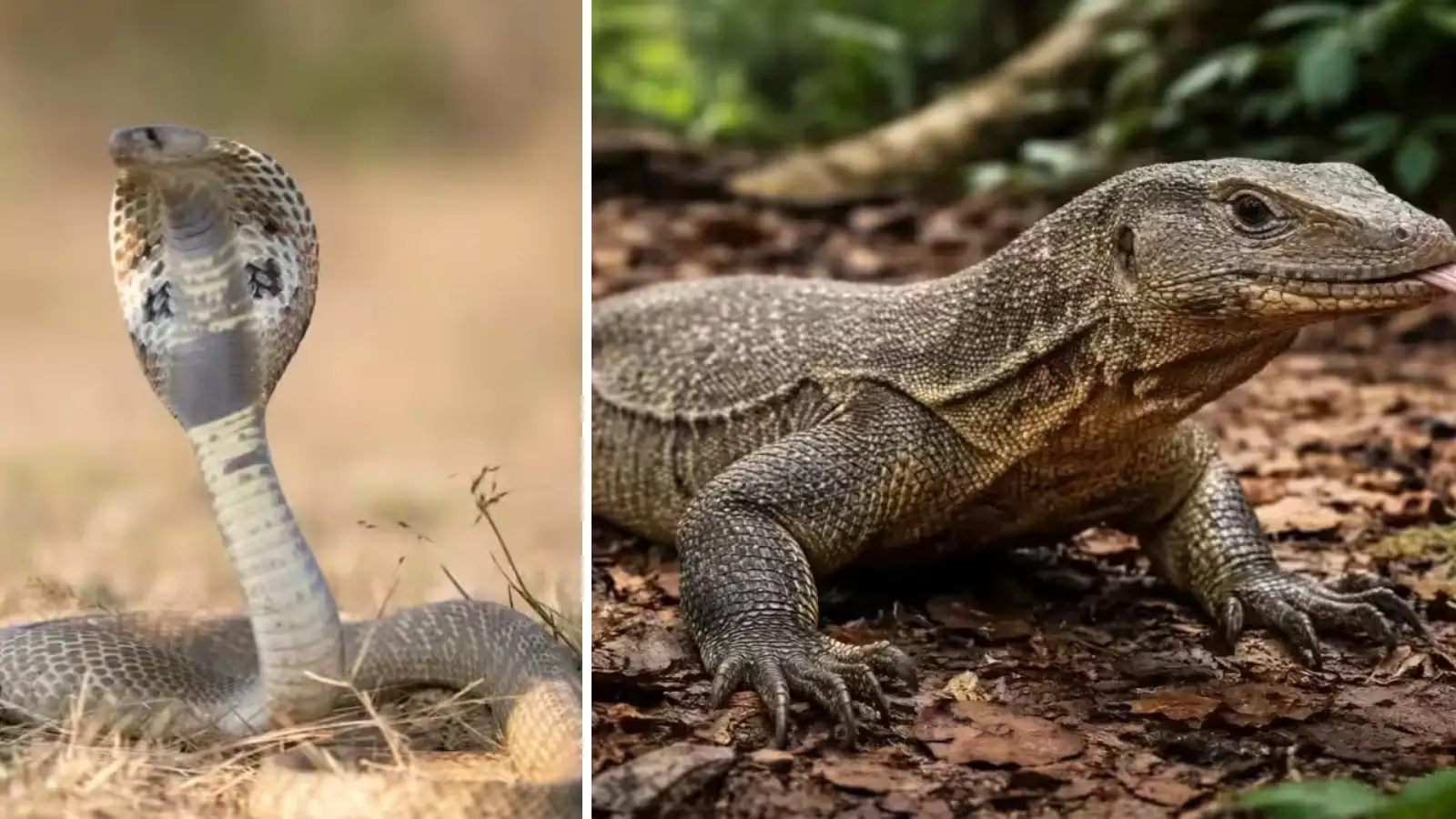
The cobra repeatedly flicks its forked tongue in and out to collect chemical particles from the air and surfaces. It then transfers these particles to the vomeronasal organ, also known as Jacobson's organ, located in the roof of its mouth.
This organ helps the snake interpret chemical signals from its surroundings. These cues can help the Indian cobra locate prey, recognise other snakes and navigate its habitat. In areas with dense vegetation, this ability is particularly useful because the snake cannot always rely on its eyesight to gather information.
Despite its unusual appearance, this snake uses a sensory system similar to that of larger snakes. It flicks its tongue to collect chemical particles and transfers them to Jacobson's organ. This helps it investigate its surroundings and locate food, including the larvae and eggs of ants and termites.
The Brahminy blind snake has another unusual characteristic: its populations are made up almost entirely of females, and the species reproduces through parthenogenesis. This means an egg can develop without fertilisation by a male. Its tiny size and ability to live in soil make it a fascinating example of how reptiles adapt to their environment.
Like other snakes, the Malabar pit viper uses its forked tongue to collect chemical particles from the air and nearby surfaces. These particles are delivered to Jacobson's organ, which processes the chemical information.
This ability helps the snake gather information about its surroundings and detect chemical trails associated with potential prey. The Malabar pit viper also possesses heat-sensitive pit organs, which help it detect infrared radiation from warm-bodied animals. Together, these sensory abilities help it hunt and survive in the forests of the Western Ghats.
Because visibility can be limited in darkness, chemical sensing plays an important role in helping the common krait understand its surroundings. The snake flicks its forked tongue to collect chemical particles and delivers them to Jacobson's organ for interpretation.
The two tips of its tongue sample chemical cues from slightly different positions. By comparing these signals, the snake can gather information about the direction of a scent trail. This helps it investigate its surroundings and locate prey, including other snakes and small animals.
Unlike snakes, monitor lizards have long, slender tongues that they repeatedly flick in and out while exploring their surroundings. Their tongues collect chemical particles, which are then transferred to the vomeronasal organ.
The Bengal monitor can use this information to investigate potential food sources and follow chemical trails. By comparing the signals collected by the two tips of its tongue, it can also gather clues about the direction from which a scent originates.
This ability is especially useful for a ground-dwelling predator that searches for a variety of food, including insects, small vertebrates, eggs and carrion.
Despite its size, the python depends on subtle sensory information to find food and assess its surroundings. It flicks its forked tongue to collect chemical particles from the environment before transferring them to Jacobson's organ.
The organ helps the python interpret these chemical signals, allowing it to follow scent trails and investigate the presence of potential prey. This is particularly helpful when light is limited or when an animal is hidden by vegetation.
The Indian rock python also relies on other senses, including vision and its ability to detect vibrations, to understand its surroundings. Its tongue-based chemical sensing is therefore one part of a broader system that supports its hunting behaviour.
Here is how the process works:
This ability can be especially useful at night, underground or in thick vegetation, where visibility is limited. Combined with other senses, it gives these reptiles an effective way to understand their environment.
The next time you see a snake flicking its tongue, remember that it is doing more than simply moving it in and out. It is collecting chemical clues that help it make sense of the world around it.
1. Indian Cobra
The Indian cobra is one of India's best-known venomous snakes. It is easily recognised by its distinctive hood, which expands when the snake feels threatened. However, its sensory abilities are just as fascinating as its appearance.The cobra repeatedly flicks its forked tongue in and out to collect chemical particles from the air and surfaces. It then transfers these particles to the vomeronasal organ, also known as Jacobson's organ, located in the roof of its mouth.
This organ helps the snake interpret chemical signals from its surroundings. These cues can help the Indian cobra locate prey, recognise other snakes and navigate its habitat. In areas with dense vegetation, this ability is particularly useful because the snake cannot always rely on its eyesight to gather information.
2. Brahminy Blind Snake
The Brahminy blind snake is a tiny, slender reptile that is often mistaken for an earthworm because of its smooth body and small size. It is also called the flowerpot snake because it frequently travels to new locations in the soil of potted plants.Despite its unusual appearance, this snake uses a sensory system similar to that of larger snakes. It flicks its tongue to collect chemical particles and transfers them to Jacobson's organ. This helps it investigate its surroundings and locate food, including the larvae and eggs of ants and termites.
The Brahminy blind snake has another unusual characteristic: its populations are made up almost entirely of females, and the species reproduces through parthenogenesis. This means an egg can develop without fertilisation by a male. Its tiny size and ability to live in soil make it a fascinating example of how reptiles adapt to their environment.
3. Malabar Pit Viper
Found in the Western Ghats of India, the Malabar pit viper is known for its varied colours and excellent camouflage. Depending on the individual, its appearance can include shades of green, brown or other colours that help it blend into vegetation.Like other snakes, the Malabar pit viper uses its forked tongue to collect chemical particles from the air and nearby surfaces. These particles are delivered to Jacobson's organ, which processes the chemical information.
This ability helps the snake gather information about its surroundings and detect chemical trails associated with potential prey. The Malabar pit viper also possesses heat-sensitive pit organs, which help it detect infrared radiation from warm-bodied animals. Together, these sensory abilities help it hunt and survive in the forests of the Western Ghats.
4. Common Krait
The common krait, also known as the Indian krait, is a highly venomous snake recognised by its glossy body and pale bands. It is found in several parts of the Indian subcontinent and is often active at night.Because visibility can be limited in darkness, chemical sensing plays an important role in helping the common krait understand its surroundings. The snake flicks its forked tongue to collect chemical particles and delivers them to Jacobson's organ for interpretation.
The two tips of its tongue sample chemical cues from slightly different positions. By comparing these signals, the snake can gather information about the direction of a scent trail. This helps it investigate its surroundings and locate prey, including other snakes and small animals.
5. Bengal Monitor Lizard
The Bengal monitor lizard is a large reptile found across much of the Indian subcontinent. It inhabits a variety of environments, including forests, grasslands, farmland and areas close to human settlements.Unlike snakes, monitor lizards have long, slender tongues that they repeatedly flick in and out while exploring their surroundings. Their tongues collect chemical particles, which are then transferred to the vomeronasal organ.
The Bengal monitor can use this information to investigate potential food sources and follow chemical trails. By comparing the signals collected by the two tips of its tongue, it can also gather clues about the direction from which a scent originates.
This ability is especially useful for a ground-dwelling predator that searches for a variety of food, including insects, small vertebrates, eggs and carrion.
6. Indian Rock Python
The Indian rock python is one of the largest snake species found in India. Known for its muscular body and powerful constriction, it hunts by seizing prey and wrapping its body around the animal.Despite its size, the python depends on subtle sensory information to find food and assess its surroundings. It flicks its forked tongue to collect chemical particles from the environment before transferring them to Jacobson's organ.
You may also like
- “I was denied entry to a temple for wearing shorts”: Meet Nehaa Bhatt, who lost a leg in a bus accident in 2021 but rebuilt her life with Ampu-Tea, dances Garba and takes on Himalayan pilgrimages with a prosthetic leg
- Dr. Surakasi Raviteja: The professor who completed 16 NPTEL courses while teaching full-time and is still learning eight more, proving that education need not end at graduation
- Can You Drive During Pregnancy? Safety Tips for Every Trimester
- “Everyone thought I was crazy”: 26-year-old super-commuter flies from Los Angeles to San Francisco for work 3 days a week, and calls it the “best of both worlds”
- EPFO New Update: Deadline for filing PF returns extended; complete the task by October 31..
The organ helps the python interpret these chemical signals, allowing it to follow scent trails and investigate the presence of potential prey. This is particularly helpful when light is limited or when an animal is hidden by vegetation.
The Indian rock python also relies on other senses, including vision and its ability to detect vibrations, to understand its surroundings. Its tongue-based chemical sensing is therefore one part of a broader system that supports its hunting behaviour.
How Do Animals Smell With Their Tongues?
Although these reptiles use their tongues to collect scent particles, the tongue itself does not actually detect or interpret smells. Instead, it works as a chemical-sampling tool that delivers information to a specialised sensory structure.Here is how the process works:
- Collecting chemical particles: The reptile flicks its tongue into the air or touches it against nearby surfaces to pick up chemical molecules.
- Delivering the particles: The forked tongue brings these particles into contact with openings connected to Jacobson's organ.
- Processing the signals: Sensory cells in the vomeronasal organ detect the chemicals and send information to the brain.
- Following chemical trails: The brain interprets the signals, helping the animal investigate its surroundings, identify potential prey or follow a trail.
Why Is This Ability Important?
For snakes and monitor lizards, chemical sensing provides valuable information that may not be available through sight alone. It helps them search for food, investigate other animals and navigate complex habitats.This ability can be especially useful at night, underground or in thick vegetation, where visibility is limited. Combined with other senses, it gives these reptiles an effective way to understand their environment.
The next time you see a snake flicking its tongue, remember that it is doing more than simply moving it in and out. It is collecting chemical clues that help it make sense of the world around it.






Loving Newspoint? Download the app now
