
7 Regional Rotis of India and the Flour Behind Each One

Wheat roti is not India's only flatbread. It is simply the one that travelled farthest on the back of the Green Revolution. Before hybrid wheat flooded the plains, every region baked with whatever grain its soil could carry, and those grains produced breads with textures, flavours, and cooking methods that wheat simply cannot replicate. Seven rotis, seven flours, seven reasons the dough behaves exactly the way it does.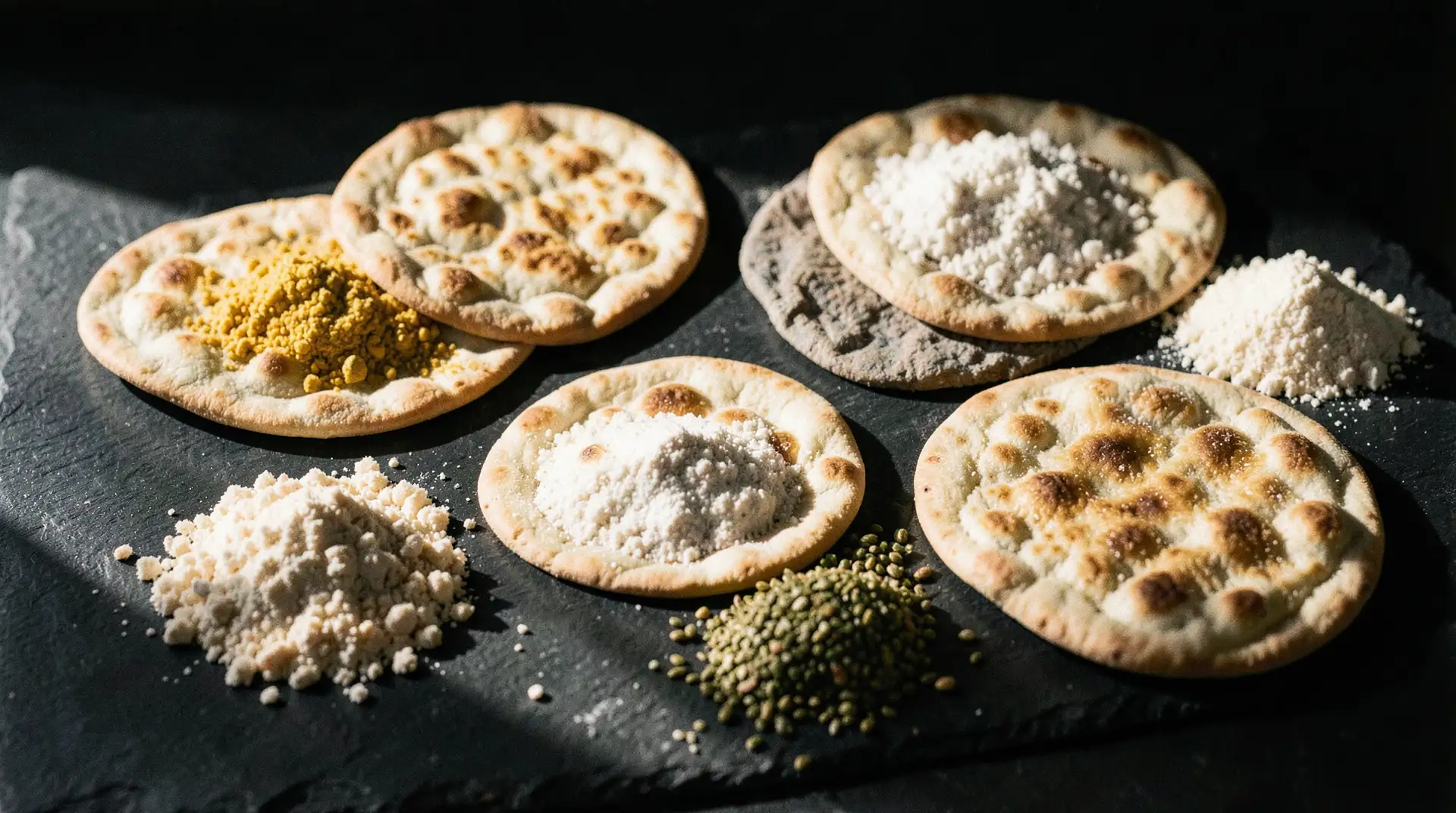
Bajra Roti, Pearl Millet, Rajasthan and Haryana
Bajra has no gluten. That single fact explains everything about how bajra roti is made. The dough cannot be rolled thin and stretched without tearing, so it is patted between wet palms into a thick, slightly uneven disc and placed directly on a tawa or an open flame. The result is dense, earthy, and slightly smoky at the edges. Pearl millet is a drought-resistant crop that thrives in sandy, low-rainfall soil, which is exactly what Rajasthan and the Haryana plains offer. The grain is high in iron and phosphorus, and the body absorbs its nutrients more readily when the roti is eaten warm with ghee, a pairing that has nothing to do with indulgence and everything to do with fat-soluble absorption. Bajra roti goes hard and gummy as it cools, which is why it is always eaten fresh off the flame.Makki di Roti, Maize, Punjab
Maize flour behaves much like bajra: no gluten, no elasticity, no tolerance for a rolling pin. Makki di roti is also hand-patted, but maize gives a slightly coarser, grittier texture than pearl millet and a faint sweetness that bajra lacks. The roti is thicker than a wheat chapati and chars quickly on a dry tawa because maize starch browns fast at high heat. The classic pairing with sarson da saag, mustard greens cooked down with ginger, is not an accident of tradition alone. The fat in butter and ghee slows the absorption of the greens' bitter compounds, and the density of the roti holds up to a wet, heavy side dish that would turn a thin wheat chapati to paste.You may also like
- No fees, no separate application required! Specialized AI training begins in schools.
- Indian doctors are often mocked for saying 'gastroenterologist' differently; linguistics explains why they aren't wrong
- Air Pollution: Could strict guidelines save nine million lives, or will policy lag?
- Three Generations Under One Roof: The One Rule Every Family Has to Agree On
- The Room That Stays Made for a Week After a Child Leaves for Hostel
Thalipeeth, Multi-Grain Bhajani Flour, Maharashtra
Thalipeeth is made from bhajani, a roasted multi-grain flour that typically combines jowar, bajra, wheat, rice, and several pulses, chana, urad, and sometimes coriander seeds, all dry-roasted before grinding. Roasting drives off moisture and develops Maillard compounds that give bhajani its deep, nutty flavour before a drop of water touches it. The dough is pressed directly onto a wet tawa, not rolled, and a small hole is poked in the centre to let steam escape so the inside cooks through. Because bhajani contains pulses, thalipeeth is nutritionally more complete than a single-grain roti, the pulse proteins complement the grain amino acids in a way that a plain jowar roti cannot match on its own.Jolada Roti, Jowar, Northern Karnataka
Sorghum, jowar in Hindi, jola in Kannada, is the staple grain of the Deccan plateau, where the black cotton soil retains moisture long enough for the crop but drains fast enough that wheat cannot compete. Jolada roti is made from jowar flour with hot water, which partially gelatinises the starch and gives the dough just enough cohesion to be rolled on a flat stone or board. The roti is thinner than bajra or makki versions, with a slightly chalky surface and a mild, clean flavour that carries the heat of the accompanying ennegayi, small brinjals stuffed with peanut and coconut masala, without competing with it. Jowar flour absorbs water differently depending on how finely it is milled; coarser stone-ground flour makes a denser roti, while fine-milled flour produces something closer to a soft, pliable disc.Thepla, Whole Wheat with Methi, Gujarat
Thepla is technically a wheat roti, but what makes it a distinct regional bread is what goes into the dough: fresh fenugreek leaves, turmeric, chilli, yoghurt, and sometimes a small amount of besan. The yoghurt's lactic acid tenderises the gluten slightly, making the dough more extensible than plain wheat dough and giving the finished roti a softer, more pliable texture. Fenugreek leaves release moisture as they cook, which keeps the interior soft even as the surface crisps. Because of the yoghurt and the low water content, thepla stays soft for longer than a plain chapati, it is the roti that Gujaratis carry on trains and long journeys, and it is still edible a day after cooking in a way that a wheat chapati is not.Pathiri, Raw Rice Flour, Kerala
Pathiri is made from raw rice flour, not idli rice, not parboiled rice, but raw white rice ground fine and mixed with boiling water. The boiling water gelatinises the rice starch on contact, turning the flour into a soft, pliable dough that can be rolled thin without cracking. The finished roti is white, delicate, and almost translucent at the edges, with a neutral flavour that makes it the natural companion to Kerala's coconut milk-based curries and fish stews. Rice flour has no protein network at all, so the entire structure of pathiri depends on gelatinised starch. If the water is not hot enough, the starch does not gelatinise fully and the dough cracks when rolled. If it is overcooked on the tawa, the starch sets too hard and the pathiri becomes brittle.Missi Roti, Besan and Wheat, Uttar Pradesh and Punjab
Missi roti combines whole wheat flour with besan, roasted chickpea flour, along with ajwain, dried fenugreek, onion, and chilli. Besan adds protein and a pronounced nuttiness, and because chickpea flour absorbs fat readily, missi roti is typically cooked with ghee pressed into the surface while it cooks on the tawa. The besan also makes the dough slightly denser and less elastic than plain wheat dough, which is why missi rotis are rolled thicker and cooked more slowly than a chapati. The ajwain, carom seed, is not there for flavour alone. It contains thymol, a compound that aids digestion of the heavier, pulse-rich dough, which is why the spice appears in most pulse-forward breads across North India. Each of these seven rotis is the answer to the same question asked in a different landscape: what does the grain we have, cooked the way our climate allows, produce when it meets fire?





Loving Newspoint? Download the app now
