
Why Breaking a Coconut Is Sacred in Indian Traditions

Walk into almost any Hindu temple in India and you will find coconuts stacked near the entrance, waiting to be offered. Drive past a construction site on its first day and you will likely see one broken at the foundation. Launch a new business, begin a sea voyage, buy a car, the coconut arrives before the first real step is taken. It is so common that it becomes invisible, but the reasoning behind it is worth following.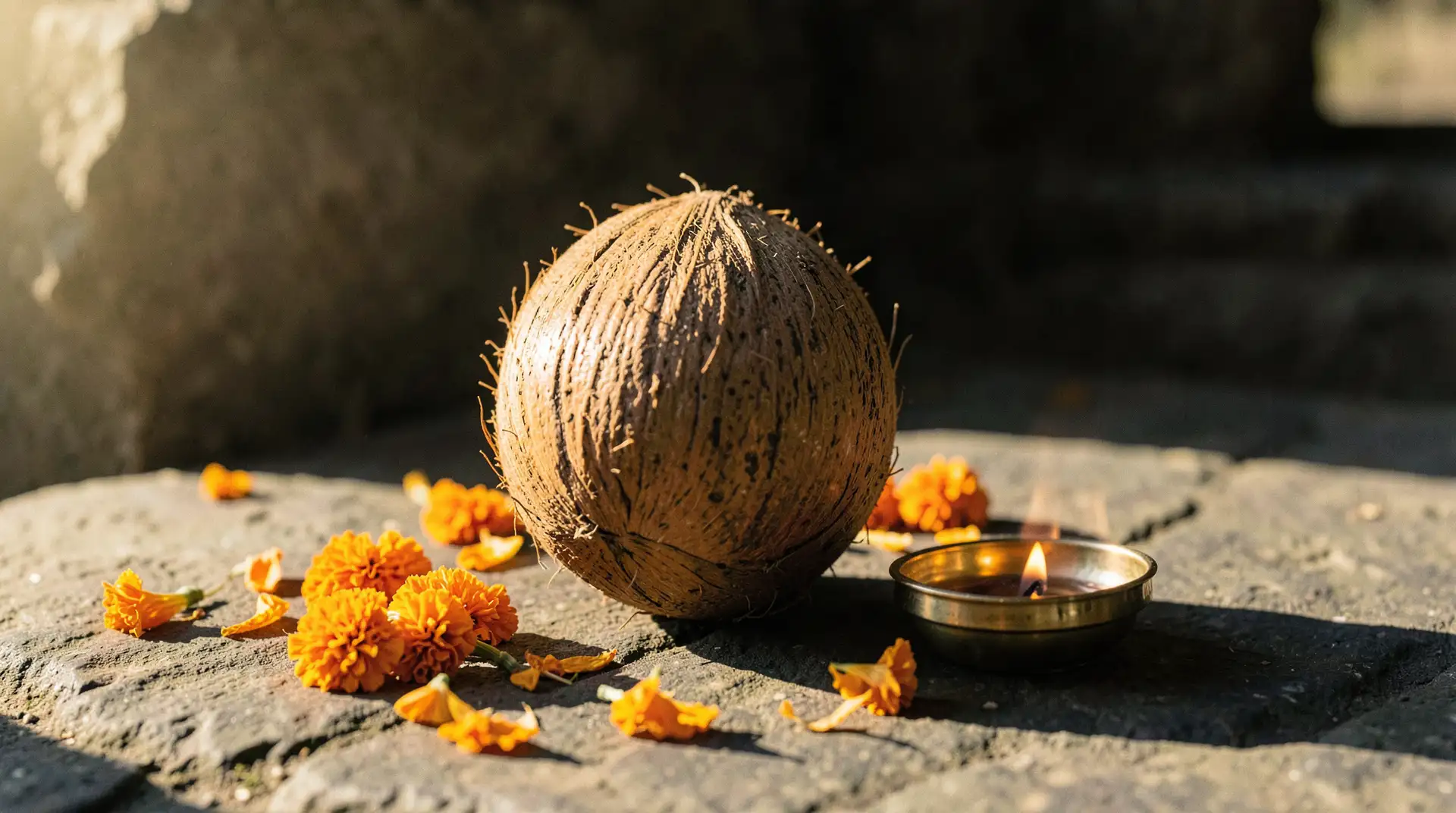
The hard outer shell is understood as the human ego, the fibrous husk as desire and attachment, and the white kernel inside as the pure self beneath. When a devotee breaks the coconut before a deity, the tradition holds that they are symbolically surrendering the ego and offering what is true and clean at the core. The act is called Nariyal Phodni in some regions, and the shattering is deliberate, it must break cleanly, not be pried open.
The coconut here is the seal between the sacred and the ordinary, the stopper that keeps the ritual space intact. In Tamil tradition, the coconut is called Thenkai and is associated with Lakshmi, the goddess of abundance, because every part of the tree, from root to frond, is useful and nothing is wasted.
In many Maharashtrian households, a coconut is broken at the threshold when a bride enters her new home for the first time, the breaking signals that a new life has begun and the old boundary has been crossed. In Tamil Nadu, coconuts are broken in a rolling motion under a vehicle's tyres during Pongal celebrations, a practice that has its own regional name and meaning.
In Andhra Pradesh, the offering at a temple often involves breaking several coconuts in quick succession, the sound itself understood as auspicious. What holds across these variations is the gesture: something whole is given up, and the giving is made irreversible.
The tradition of the Nariyal Purnima, observed by fishing communities along the western coast, involves offering a coconut to the sea at the end of the monsoon, asking permission to return to the water. In each of these moments, the coconut marks a threshold: something is ending, something is beginning, and the offering acknowledges both. The breaking is the acknowledgement made physical.
The coconut democratised devotion long before the word existed in Indian languages.The broken coconut is not a symbol of destruction. What the tradition actually encodes is the idea that something given completely, cracked open, irreversible, held back in no part, carries more meaning than something offered at a distance. The shell cannot be put back together. That is the point.
The Coconut as a Stand-In for the Self
In Vedic tradition, the coconut is one of the few offerings considered a complete substitute for a living sacrifice. The three eyes on its shell are said to represent the three eyes of Shiva, two that see the world and one that sees inward.The hard outer shell is understood as the human ego, the fibrous husk as desire and attachment, and the white kernel inside as the pure self beneath. When a devotee breaks the coconut before a deity, the tradition holds that they are symbolically surrendering the ego and offering what is true and clean at the core. The act is called Nariyal Phodni in some regions, and the shattering is deliberate, it must break cleanly, not be pried open.
Why the Coconut and Not Something Else
The coconut earned this role partly through its physical nature. It is one of the rare fruits that remains uncontaminated by human touch once sealed, no insect, no hand, nothing reaches the interior while the shell is intact. This made it ritually pure in a way that a cut fruit or a peeled offering could not be. The Kalash, a pot of water sealed with a coconut on top, appears at the opening of almost every major ritual in Hindu practice.The coconut here is the seal between the sacred and the ordinary, the stopper that keeps the ritual space intact. In Tamil tradition, the coconut is called Thenkai and is associated with Lakshmi, the goddess of abundance, because every part of the tree, from root to frond, is useful and nothing is wasted.
You may also like
- EPFO WhatsApp Service: Check your balance and view your passbook on WhatsApp; EPFO has launched a new service..
- Axis Bank Savings Account Rules: New rules for Axis Bank account holders effective December 1 – take note, or you might regret it..
- Only 25 days left to submit your life certificate; you can submit it from the comfort of your home—here's how..
- Why Is Goddess Lakshmi Worshipped on Diwali? Know the Story of Samudra Manthan, Significance and Puja Rituals
- Post Office Scheme: This Post Office scheme is a gift from Goddess Lakshmi; you will receive 2.12 lakh in just 5 years..
Regional Variations Across India
The way a coconut is broken and what is done with it afterward changes considerably from one part of India to another. In Kerala, the coconut is split with a single clean blow from a heavy knife, and the water is poured as an offering before the flesh is distributed.In many Maharashtrian households, a coconut is broken at the threshold when a bride enters her new home for the first time, the breaking signals that a new life has begun and the old boundary has been crossed. In Tamil Nadu, coconuts are broken in a rolling motion under a vehicle's tyres during Pongal celebrations, a practice that has its own regional name and meaning.
In Andhra Pradesh, the offering at a temple often involves breaking several coconuts in quick succession, the sound itself understood as auspicious. What holds across these variations is the gesture: something whole is given up, and the giving is made irreversible.
The Coconut in Rites of Passage
Beyond temples and inaugurations, the coconut appears at the hinge points of a human life. It is present at the Seemantham, the ceremony marking a first pregnancy. It is tied to the wrist of a groom during certain wedding rituals in South India. In some communities, a coconut is placed at the head of the deceased before cremation.The tradition of the Nariyal Purnima, observed by fishing communities along the western coast, involves offering a coconut to the sea at the end of the monsoon, asking permission to return to the water. In each of these moments, the coconut marks a threshold: something is ending, something is beginning, and the offering acknowledges both. The breaking is the acknowledgement made physical.
What the Tradition Carries Forward
The coconut endures as a ritual object partly because it asks nothing complicated of the person offering it. It costs little, it is available almost everywhere in India, and the act of breaking it requires no intermediary and no special knowledge. A farmer can do it at the corner of a new field. A child can do it at a school's foundation stone. This accessibility is not incidental, in Vedic tradition, an offering that could only be made by the wealthy or the priestly was considered less democratic than one available to all.The coconut democratised devotion long before the word existed in Indian languages.The broken coconut is not a symbol of destruction. What the tradition actually encodes is the idea that something given completely, cracked open, irreversible, held back in no part, carries more meaning than something offered at a distance. The shell cannot be put back together. That is the point.






Loving Newspoint? Download the app now
